
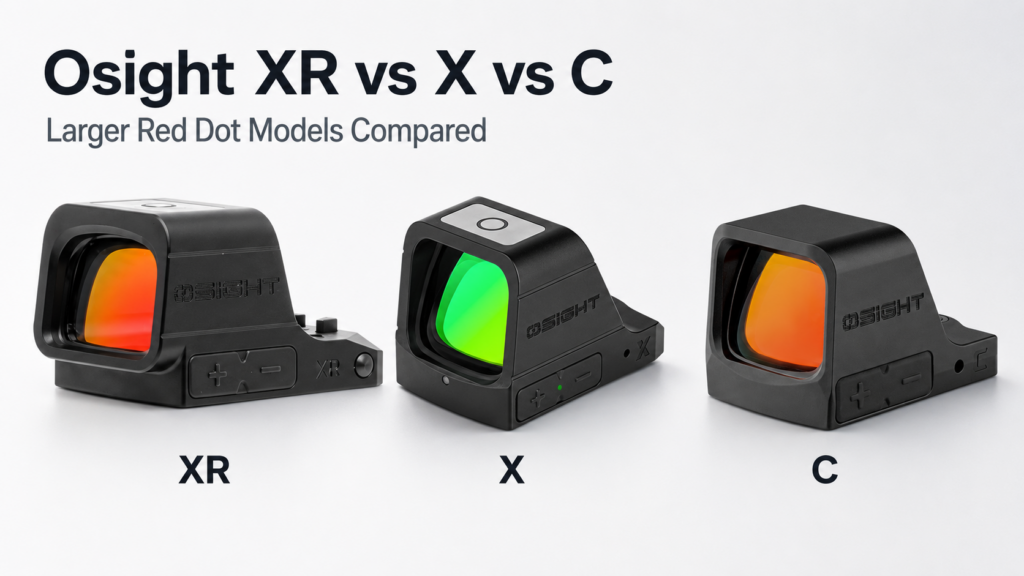
The Osight XR, X, and C all use the RMR mounting pattern, but they offer three different combinations of enclosure, window size, and battery system. The XR encloses the emitter and uses a rechargeable battery. The X keeps magnetic charging but uses a taller open window. The C pairs an open emitter with a replaceable CR1632.
That makes battery preference just as important as the open-versus-enclosed decision. Both the X and XR recharge, so charging alone is not a reason to choose the X over the XR. And the C is not simply an X with fewer reticle options: both offer a 3 MOA dot and 32 MOA circle, while their power systems and dimensions differ.
In This Guide
- Quick Comparison: Osight XR vs X vs C
- Osight XR Overview
- Osight X Overview
- Osight C Overview
- Osight XR vs Osight X: Enclosure or Taller Window?
- Osight XR vs Osight C: Two Changes at Once
- Osight X vs Osight C: More Than a Reticle Comparison
- Which Osight Model Should You Choose?
- What an Enclosed Emitter Changes
- Osight X Footprint: Do XR and C Use the Same Pattern?
- The Bottom Line
- Osight XR, X, and C FAQs
Quick Comparison: Osight XR vs X vs C
| Feature | Osight XR | Osight X | Osight C |
|---|---|---|---|
| Footprint | RMR | RMR / 407C / 507C pattern | RMR / 407C / 507C pattern |
| Emitter | Enclosed | Open | Open |
| Battery | Rechargeable; magnetic charging cover | Rechargeable; magnetic charging cover | Side-loading CR1632 |
| Reticle choices | 2 or 6 MOA dot; 32 MOA circle; either dot with circle | 3 MOA dot; 32 MOA circle; combined | 3 MOA dot; 32 MOA circle; combined |
| Window | 0.91 x 0.71 in | 0.94 x 0.85 in | 0.95 x 0.75 in |
| Body, L x W x H | 1.91 x 1.18 x 1.16 in | 1.77 x 1.18 x 1.30 in | 1.77 x 1.18 x 1.18 in |
| Optic weight | 1.69 oz | 1.62 oz | 1.48 oz |
| Backup rear sight | Collapsible Backup Rear Sight | No integrated CBRS | No integrated CBRS |
Published dimensions are rounded. Weights for the X and XR exclude their separate charging covers. A wider or taller window does not mean the mounting footprint changes.
Osight XR Overview
The Osight XR is the enclosed option in this group. Its emitter sits inside a 7075-T6 aluminum body, with a 0.91 x 0.71-inch window and five reticle modes. You can select a 2 MOA dot, 6 MOA dot, 32 MOA circle, or either dot inside the circle. The selectable dot sizes are a real difference from the fixed 3 MOA dot size used by the X and C.
The built-in battery charges through a magnetic cover with a display for the optic and cover’s battery levels. The sight remains mounted for charging. If you prefer replacing a disposable battery instead, the Osight XE vs XR comparison covers the closer enclosed alternative.
The XR also includes Osight’s Collapsible Backup Rear Sight. That is an integrated feature, not a guarantee that it lines up with every existing front sight. At 1.69 oz, the optic is slightly heavier than the X and C, and its enclosed body is longer. Those are modest but concrete differences to weigh against the protected emitter.
Osight X Overview
The Osight X red circle-dot model has the tallest published window here: 0.94 x 0.85 inches. Its open-reflex construction leaves the emitter behind the front lens exposed, while the rechargeable battery and magnetic cover provide the battery-status features that distinguish it from the C.
The X offers dot-only, circle-only, and circle-dot modes using a 3 MOA dot and 32 MOA circle. It also has automatic brightness sensing. Its body is 1.30 inches tall, compared with 1.18 inches for the C, so the larger window comes with a taller housing rather than being a free change in the same envelope.
Choose the X when you want this taller open view and like charging instead of replacing coin cells. Keep the charging cover with your equipment and account for that routine when comparing it with the C.
Watch the model name: the original Osight 3 MOA green-dot sight is a separate model. It should not be confused with an Osight X multi-reticle version just because both belong to the rechargeable, open-emitter family.
Osight C Overview
The C gives you an open emitter and multi-reticle system without the charging cover. A CR1632 loads from the side, allowing battery replacement with the optic still mounted. Its 0.95 x 0.75-inch window is nearly the same width as the X’s but shorter, and the optic weighs 1.48 oz.
Both the C red circle-dot and C green circle-dot offer a 3 MOA dot, a 32 MOA circle, and the combination. Color is a choice between separate versions; it is not a setting that changes the same sight from red to green.
The C is a useful starting point if you know you want a conventional replaceable battery. You retain the circle-dot choices rather than giving them up for the simpler power system. The trade-off against the XR is the exposed emitter, while the main trade-offs against the X are window height, automatic brightness, and charging features.
Osight XR vs Osight X: Enclosure or Taller Window?
The X and XR both use magnetic charging, so the more revealing comparison is the view and enclosure. The X has a taller open window; the XR has a protected internal emitter path and a shorter window. The XR also offers two dot sizes instead of the X’s single 3 MOA dot size.
The XR is not simply a larger X. Its body is longer but lower, and its window is smaller in both published dimensions. The X weighs 1.62 oz and the XR 1.69 oz before their charging covers. That small weight difference is less decisive than whether you want an enclosed design.
If an exposed emitter is acceptable and you value window height, compare the X first. If enclosure matters more, the XR provides it without abandoning the rechargeable system.
Osight XR vs Osight C: Two Changes at Once
Moving from the C to the XR changes both the emitter protection and the battery routine. The C takes a CR1632; the XR needs its magnetic charging cover. The XR adds selectable 2 and 6 MOA dot sizes and the collapsible backup rear sight. The C is lighter and has a slightly larger published window.
Neither set of features makes the other obsolete. If the enclosed design appeals but the charging cover does not, look at the XE AMRS before settling on a compromise. It provides an enclosed RMR option with a side-loading battery.
Osight X vs Osight C: More Than a Reticle Comparison
The X and C have closely matched reticle choices, but the X’s window is 0.10 inch taller. Both bodies are 1.77 inches long and 1.18 inches wide; the X is 0.12 inch taller and 0.14 oz heavier. The dimensional difference is worth considering if you have limited clearance around the optic.
The C suits a spare-battery routine. The X suits a rechargeable routine and adds automatic brightness sensing and the cover’s battery readout. If those features do not interest you, the C still provides the same basic 3 MOA dot / 32 MOA circle choices. Compare the exact versions and their current prices rather than assuming the X is better for every buyer.
Which Osight Model Should You Choose?
- XR: enclosed emitter, magnetic charging, and selectable 2 or 6 MOA dot sizes.
- X: the tallest window in this comparison, open emitter, and magnetic charging.
- C: open emitter, red or green circle-dot variants, and a replaceable CR1632.
What an Enclosed Emitter Changes
An enclosed design separates the internal emitter path from lint, rain, and debris. That helps address an obstruction inside the optic, but it does not make the exterior lenses immune to dirt or water. Both open and enclosed sights still need inspection and normal care.
The X and C leave that emitter path open. Their published windows are larger than the XR’s, but window size should be judged separately from enclosure: not every open optic is larger or lighter than every enclosed one.
Osight X Footprint: Do XR and C Use the Same Pattern?
The Osight X footprint is RMR. The XR and C use the same RMR mounting pattern. Osight also describes the X and C using the 407C / 507C reference. These descriptions identify the same mounting family, not three incompatible footprints.
That does not make them universal direct-fit optics. Your particular slide or plate still needs to support the sight, housing clearance, and appropriate hardware. A GLOCK MOS system, for example, is not the same thing as a bare RMR cut. Use the handgun and optic manufacturers’ compatibility information for the exact combination.
For a compact RMSc setup, see the SE vs S vs K comparison. Do not substitute one simply because its body looks similar in a photograph. For a closer look at the two enclosed sizes, compare Osight SE vs XR.
The Bottom Line
The most useful question is which combination you want: enclosed and rechargeable, open and rechargeable, or open with a replaceable battery. That points to the XR, X, or C respectively. Then compare the actual window, reticle, and body dimensions to choose the features you value most.
Osight XR, X, and C FAQs
The Osight X uses the RMR mounting pattern, also described by Osight with the 407C / 507C reference. Verify the exact slide or plate compatibility before ordering.
Yes. The XR is an enclosed-emitter optic with an RMR footprint. It is not an RMSc optic.
Both are open-emitter sights with a 3 MOA dot and 32 MOA circle. The X has a taller window and rechargeable battery with a magnetic charging cover. The C uses a side-loading CR1632.
No. The XR’s published window is 0.91 x 0.71 inches. The X’s is 0.94 x 0.85 inches. The XR’s main distinction is its enclosed emitter, not a larger window.
No. The original 3 MOA green-dot model and the Osight X are separate products. Read the complete model name and reticle specification rather than treating every rechargeable Osight as an X.
Manufacturer references: XR specifications, X specifications, and C specifications.