
The suffix on an EOTECH sight tells you something important: what you will see in its window. An EXPS3-0 and EXPS3-1 share a family name, but one has the familiar ring-and-dot pattern and the other has a dot without the ring. A model with more dots is not automatically a better version.
Start with the pattern you find comfortable, then choose a sight body with the features you need. This guide explains the differences between the standard ring, dot-only, two-dot, four-dot, DCR and green options. It is a comparison of products and sight pictures, not a ballistic or installation guide.
In this guide
- How to Read the Model Name
- The Standard -0: Ring and Center Dot
- The -1: A Dot Without the Outer Ring
- The -2: Ring and Two Dots
- The -4: More Marks, a Busier View
- The EOTECH DCR Reticle
- Which Models Have Each Pattern?
- Red vs Green EOTECH Reticles
- Specialty Patterns and Magnifier Packages
- Why Reticle Artwork Looks Different from the View Through a Sight
- Our Recommendation
How to Read the Model Name
Consider EXPS3-0. EXPS identifies a body style, 3 identifies the night-vision-compatible family, and the final -0 identifies the familiar ring-and-center-dot reticle. Those parts describe different decisions. A change in the final number does not necessarily mean a change in mount, electronics or size.
The convention is useful, but it is not a license to assume every suffix is sold in every sight body. Special models, packages and newer variants may have their own naming. Match the complete model designation to its reticle image instead of buying by a cropped photograph or a shortened listing title.
Our XPS vs EXPS comparison covers body and mount differences. The article you are reading covers the pattern itself, so you can keep those decisions separate.
The Standard -0: Ring and Center Dot
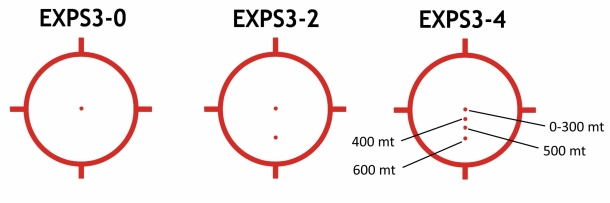
The standard -0 pattern combines a 68 MOA ring with a 1 MOA center dot. It is the appearance many buyers have in mind when they say they want an EOTECH. The central dot is small, while the larger ring is visually prominent.
Its appeal is balance rather than complexity. You get the recognizable outer shape without the additional lower dots of the -2 or -4. We would start here if you like the classic EOTECH view and have no specific reason to remove the ring or add more marks.
The ring does occupy more of the window than a dot-only pattern. For some people that is reassuring; for others it is unwanted visual structure. Neither preference is wrong. The relevant question is whether you enjoy looking through that pattern, not whether it is the most recognizable one in the range.
Examples include the EXPS2-0 and EXPS3-0. Their similar reticle does not make them identical sights: night-vision compatibility and other body specifications remain separate features.
The -1: A Dot Without the Outer Ring
The -1 removes the large ring and leaves a single 1 MOA dot. It is the natural option if you like the holographic sight platform but prefer a less decorated view. The important change is the absence of the ring, not a smaller optic body.
A simpler image can be appealing when you do not want additional marks competing for your attention. On the other hand, a buyer attracted specifically to EOTECH’s ring may find the dot-only option takes away the feature they wanted most.
We would not call dot-only objectively slower or more accurate for every user. Those are broad performance claims that a reticle illustration cannot establish. What it reliably changes is how much illuminated structure is in the view.
Compare the EXPS3-1 with the XPS2-1 if this is your preferred pattern. Their different body families still need to be considered independently.
The -2: Ring and Two Dots
The two-dot pattern keeps the familiar outer ring and adds a second dot below the center. It offers more reference information without becoming as dense as the four-dot option.
This is a good example of why the model suffix matters more than a side-view photograph. Two sights can look identical from the outside while presenting noticeably different images. If you prefer the look of the -0, do not assume a -2 is simply a better deal because a listing has a lower price.
The additional dot is a reference whose meaning depends on the manufacturer’s reticle information and the complete setup. It should not be treated as a universal distance label. For a buying decision, the useful distinction is that the pattern adds information, with a small increase in visual complexity.
The EXPS2-2 and EXPS3-2 are examples. You can compare them with the other reticles in their respective EXPS2 and EXPS3 collections.
The -4: More Marks, a Busier View
The four-dot reticle adds a vertical series of dots within the familiar ring. It is the more information-rich choice among these numbered patterns, and its appearance is visibly busier than the -0 or -1.
Choose it because you want that layout, not because four must be better than two. If the extra marks look distracting to you, there is no virtue in paying for them. Conversely, someone looking specifically for the multi-dot design will not get the same sight picture from a discounted single-dot model.
The EXPS3-4 is the relevant standalone sight. The pattern is also found in particular HHS packages, but the contents of the specific bundle matter more than a general promise of an EOTECH combo.
The EOTECH DCR Reticle
DCR stands for Danger Close Reticle. Its distinctive lower chevron and modified outer shape separate it from the standard closed ring-and-dot image. That is a real visual difference, not just a new name for the -0.
The appeal is the more distinctive lower reference and the way it changes the overall pattern. A buyer who likes a plain ring may not prefer it, and a buyer specifically seeking DCR should not substitute a standard -2 on the assumption that any additional mark is equivalent.
We would compare the artwork directly before selecting this option. The right pattern is the one you want to see consistently, not the one with the most dramatic name. Detailed use of its references belongs in the manufacturer’s instructions, not in a promise that one reticle makes every setup perform better.
Our listings include the EXPS3-DCR and XPS3-DCR. The DCR pattern does not erase the mounting and control differences between those families.
Which Models Have Each Pattern?
| Pattern | What changes visually | Examples |
|---|---|---|
| -0 | Ring and one center dot | EXPS2-0, EXPS3-0, XPS2-0 |
| -1 | Dot only, no outer ring | EXPS3-1, XPS2-1 |
| -2 | Ring and two dots | EXPS2-2, EXPS3-2, XPS2-2 |
| -4 | Ring and four dots | EXPS3-4 |
| DCR | Distinct lower chevron | EXPS3-DCR, XPS3-DCR |
| Green -0 | Green ring and center dot | EXPS2-0GRN, XPS2-0GRN |
This is a map of representative configurations, not a claim that every combination is currently in stock. Exterior color and reticle color are also different attributes: a tan housing does not mean a different illuminated pattern.
Red vs Green EOTECH Reticles
Green changes the color you see, not the basic purpose of the ring-and-dot design. Some buyers find green more comfortable or conspicuous, while others prefer red. It is a preference worth evaluating rather than a universal upgrade.
There is a specification tradeoff. EOTECH lists a lower runtime for the green XPS2 and EXPS2 configurations than for their standard red counterparts. Compare the exact model instead of assuming color is the only difference that matters to ownership.
The green EXPS2-0 is an example of a green reticle, while a standard EXPS3 in a tan finish still has a red reticle. A green sight is not automatically night-vision compatible either; that remains a property of the named model.
Specialty Patterns and Magnifier Packages
The XPS2-300 is a specialty configuration associated with .300 Blackout. It should not be treated as another cosmetic version of the generic two-dot sight. If you are buying it, buy it for the specific model and its documented pattern rather than matching only the number of visible dots.
A magnifier makes the sight picture easier to inspect, but it does not turn one reticle into another or add illumination features to the original sight. An HHS package should therefore be compared component by component: sight body, reticle, magnifier and mount.
For the differences between the magnifiers themselves, see our G33 vs G43 vs G45 guide. For complete combinations, browse EOTECH sight-and-magnifier packages.
Why Reticle Artwork Looks Different from the View Through a Sight
A clean digital diagram is useful for comparing shapes, but it is not a photograph of exactly what every eye will see. Holographic illumination has a different appearance from a flat illustration, and perceived sharpness varies with the observer and conditions.
Do not buy one color or pattern on a promise that it will eliminate every visual distortion. If a sight’s appearance concerns you, use the manufacturer’s support guidance and compare the actual optic where possible. A buying guide cannot diagnose an optical issue or tell you that a suspected defect is normal.
Our Recommendation
Choose -0 for the classic EOTECH look, -1 for less illuminated structure, and -2 or -4 only when you want their additional references. Choose DCR because you prefer its distinctive pattern. Then decide whether red or green looks better to you, and select the body with the mounting and electronic features you need.
For the body comparison, read EXPS2 vs EXPS3. If you already know the family, the model-specific collections let you compare the relevant reticles without mixing in unrelated optics.
Frequently Asked Questions
It generally identifies the familiar 68 MOA ring with a 1 MOA center dot. Match the complete model designation to its reticle illustration.
The dot-only -1 pattern removes the large outer ring. The standard -0 already has a single center dot with a ring.
DCR means Danger Close Reticle. It uses a distinctive lower chevron and differs visually from the standard ring-and-dot design.
These are separate model configurations, not a general menu of switchable patterns. Check the features of the exact sight before purchasing.
Not necessarily. Housing finish and reticle color are separate choices. Look for a listing that explicitly identifies a green reticle.
Sources
Manufacturer references: EOTECH reticle index, EXPS3 model options, XPS2 model options and EOTECH help center.