
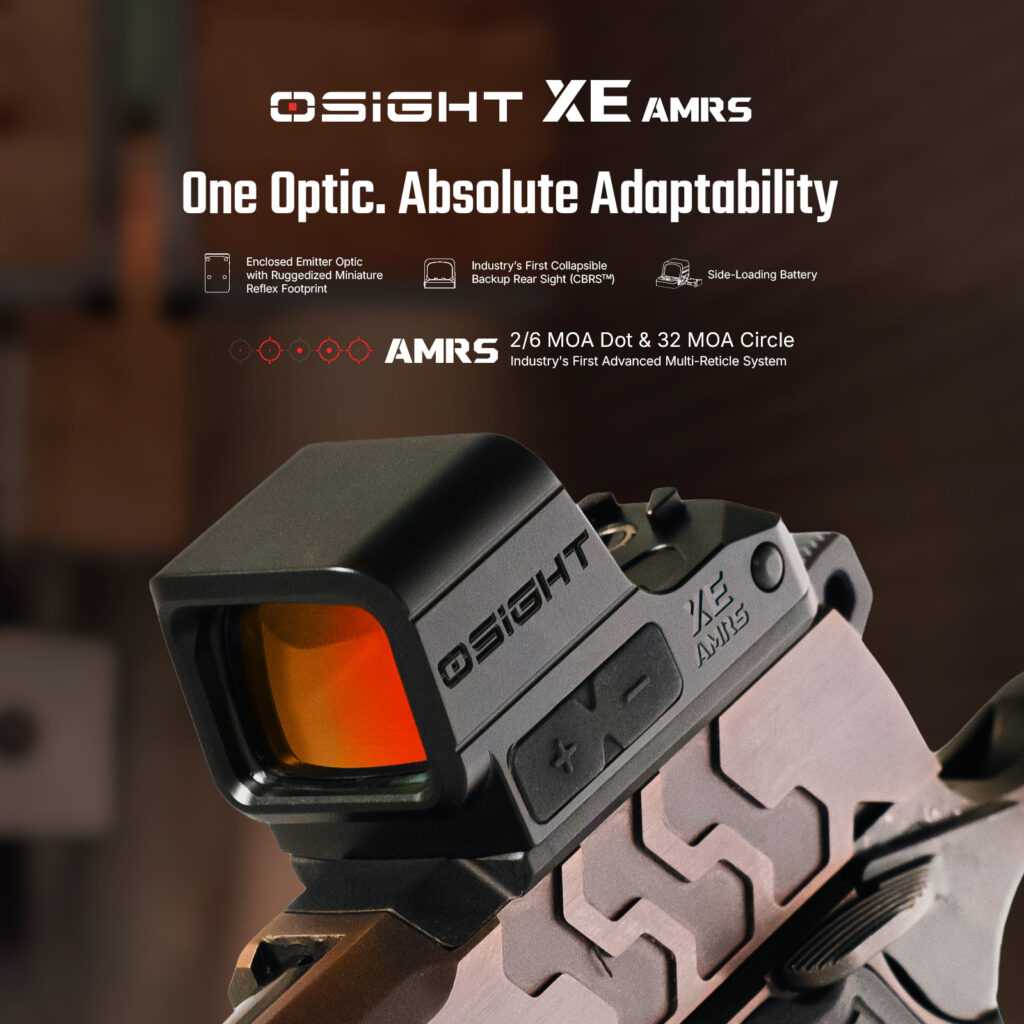
The Osight XE vs XR decision starts with how you want to power your optic. The XE AMRS uses a replaceable CR1632 battery. The XR has a rechargeable battery and a magnetic charging cover with a battery-level display. Both give you an enclosed emitter, RMR footprint, five red reticle modes, and a collapsible backup rear sight.
Their similar appearance is not misleading: the window sizes match and many of their headline features really are shared. But there are smaller differences in weight, width, and brightness settings that are worth checking before deciding which one fits your preferences.
In This Guide
- Quick Answer: Osight XE vs XR
- Osight XE vs XR Comparison Chart
- What the Osight XE and XR Have in Common
- Osight XE AMRS Overview
- Osight XR Overview
- Battery Replacement vs Magnetic Charging
- Reticle Comparison: The Same Five Choices
- Enclosure and Lens Care
- Window Size, Body Size, and Weight
- Osight XE Footprint: RMR, Like the XR
- Which One Is the Better Value?
- Final Verdict: XE or XR?
- Osight XE vs XR FAQs
Quick Answer: Osight XE vs XR
Choose the XE if you prefer replacing a coin cell and want an enclosed RMR optic without a charging accessory. Choose the XR if you prefer recharging and want a display showing the charge remaining in both the optic and its cover.
Neither choice requires giving up the five-mode reticle system or Collapsible Backup Rear Sight. The XE is not a basic version without those features, and the XR does not give you a larger window. The power system is the biggest difference, not the only difference.
Osight XE vs XR Comparison Chart
| Feature | Osight XE AMRS | Osight XR |
|---|---|---|
| Emitter and footprint | Enclosed; RMR | Enclosed; RMR |
| Housing | 7075-T6 aluminum | 7075-T6 aluminum |
| Battery system | Side-loading CR1632 | Built-in rechargeable; magnetic charging cover |
| Reticle modes | 2 MOA dot, 6 MOA dot, 32 MOA circle, and either dot with circle | 2 MOA dot, 6 MOA dot, 32 MOA circle, and either dot with circle |
| Window | 0.91 x 0.71 in | 0.91 x 0.71 in |
| Body, L x W x H | 1.91 x 1.20 x 1.16 in | 1.91 x 1.18 x 1.16 in |
| Optic weight | 1.80 oz | 1.69 oz; charging cover separate |
| Brightness settings | 8 daylight + 2 night-vision settings | 8 daylight + 3 night-vision settings |
| Backup rear sight | Collapsible Backup Rear Sight | Collapsible Backup Rear Sight |
| Optic water-resistance rating | IPX7 | IPX7 |
| Compare the products | Osight XE AMRS | Osight XR |
These are the manufacturer’s rounded specifications for the red AMRS models. The XR’s optic dimensions and weight do not include its removable charging cover.
What the Osight XE and XR Have in Common
Enclosed emitters: both place the emitter path inside a protected body. This separates it from the lint and debris that can enter an open sight. It does not eliminate the need to keep the outside lenses clean.
RMR mounting: both belong to the same mounting family. That narrows the comparison if you already have a compatible RMR slide or plate, although exact compatibility still depends on the specific setup.
Five reticle modes: both offer 2 and 6 MOA dots, a 32 MOA circle, and either dot combined with the circle. You are not choosing one dot size permanently when you choose between the XE and XR.
Collapsible Backup Rear Sight: both include Osight’s CBRS feature. Its presence should not be read as guaranteed alignment with every front sight; that remains dependent on the firearm and mounting arrangement.
Osight XE AMRS Overview
The Osight XE AMRS is the enclosed RMR option for someone who wants a conventional battery routine. A CR1632 loads through the side, allowing battery replacement without removing the sight. You do not need the XR’s charging cover or a charger to replenish the optic’s battery.
That power choice does not remove the features that make this pair interesting. The XE keeps the 0.91 x 0.71-inch window, five-mode reticle system, and collapsible backup rear sight. Its 7075-T6 aluminum body has an IPX7 rating. It is slightly wider and heavier than the XR, at 1.20 inches wide and 1.80 oz.
The practical appeal is familiarity. If you already keep spare batteries for your equipment and prefer a scheduled battery change, the XE fits that habit. Its side tray also avoids treating battery maintenance as a reason to disturb the optic’s mounting.
Who should choose the XE? The buyer who wants this enclosed RMR feature set but does not want to manage a charging cover. A replaceable battery is the reason to choose it, not an assumption that it is smaller or lighter.
Osight XR Overview
The Osight XR uses a built-in rechargeable battery and a magnetic cover that fits over the optic for charging. The cover’s display reports the optic and cover battery levels, so you can check both parts of the system rather than relying only on a low-battery warning.
Its 1.69 oz optic weight is a little lower than the XE’s, while the charging cover is separate. The window measures the same 0.91 x 0.71 inches. The XR also adds a third night-vision brightness setting; both models have eight daylight settings. That is a concrete specification difference, though not a benefit every buyer needs.
Charging can be convenient if it is already part of how you maintain your equipment. The trade-off is keeping the cover available and charged. Its battery display is useful, but the system is not maintenance-free simply because it avoids disposable cells.
Who should choose the XR? The buyer who prefers recharging and values the cover’s battery readout. Choose it for that ownership experience, not because it has a larger window or exclusive reticle modes.
Battery Replacement vs Magnetic Charging
The biggest long-term difference is what you need when the battery gets low. With the XE, it is a replacement CR1632. With the XR, it is the matching charged cover. Both let you service the power system while the optic remains mounted, but only one relies on a proprietary charging accessory.
The XE routine: keep an appropriate spare battery and follow the manufacturer’s replacement guidance. This is familiar if your other optics already use coin cells, and it avoids needing a charging cover when away from home.
The XR routine: check the cover’s display and recharge as part of your regular equipment checks. It can reduce your use of replacement coin cells, but the cover itself needs charging and needs to be kept with the optic’s accessories.
Do not compare advertised maximum runtimes as if they were measured at identical settings. Osight’s XE and XR figures use different brightness conditions, and dot-only runtime is not the same as running the full circle-dot reticle. Combined runtime including cover recharges is also different from one uninterrupted optic charge.
Reticle Comparison: The Same Five Choices
Both models offer these red reticle modes:
- 2 MOA dot.
- 6 MOA dot.
- 32 MOA circle.
- 2 MOA dot inside the 32 MOA circle.
- 6 MOA dot inside the 32 MOA circle.
The smaller dot leaves more of the viewed area unobstructed; the larger dot is more visually prominent. The surrounding circle adds another reference that some users like and others prefer to switch off. Since both sights offer all five options, reticle preference does not force the choice between these two models.
Enclosure and Lens Care
The enclosure protects the internal emitter path, but the outside glass is still exposed. Water, fingerprints, or dust on the exterior can affect the view on either model. That distinction matters more than treating an enclosed optic as something you can stop inspecting.
Both optic bodies carry an IPX7 rating. The XR’s separate charging cover has its own, lower IPX4 rating; do not assume the optic and charging accessory have identical protection.
Window Size, Body Size, and Weight
The windows match at 0.91 x 0.71 inches, so neither model offers a larger published viewing area. Their rounded lengths and heights also match at 1.91 and 1.16 inches. The XE is 0.02 inch wider and 0.11 oz heavier than the XR.
Those differences are small, but they make the comparison more accurate than calling the two identical except for batteries. The XR’s cover adds size only when attached for charging; it should not be counted as the optic’s normal mounted dimensions.
Osight XE Footprint: RMR, Like the XR
The Osight XE footprint is RMR, the same mounting family used by the XR, rather than RMSc or DPP. Verify compatibility for the exact slide or plate, including housing and holster clearance. Their similar bodies do not justify a blanket fit claim for every optics-ready handgun.
For range use: the shared window and reticle choices make the preferred battery routine the more useful distinction. The XR is convenient for someone who already charges equipment between visits; the XE fits someone who prefers carrying a spare cell.
For a home-defense setup: the shared feature list does not establish a reliability winner. Fit, manufacturer guidance, and consistent inspection matter more than the battery label. Neither model should be treated as maintenance-free.
For everyday carry: compare actual clearance and choose a battery routine you will maintain. The XR is slightly lighter as an optic; the XE avoids a charging accessory. Both enclose the emitter, while their external lenses still need attention.
For duty-style use: an agency’s approved-equipment list and testing requirements come before a general shopping comparison. Enclosure and a backup-sight feature alone do not establish approval or suitability for a particular role.
Which One Is the Better Value?
Compare the current price of the exact XE AMRS and XR, then decide whether you will use the charging cover and battery display. There is no reason to pay extra for a feature you do not want, but equally little reason to avoid it if it is the main benefit you are shopping for.
The shared enclosure, window size, reticle choices, and backup rear sight mean the XE does not give up those features. The XR’s value is its rechargeable system and charge visibility, along with its slightly lower optic weight and extra low-brightness setting.
Final Verdict: XE or XR?
Choose the Osight XE AMRS for an enclosed RMR optic with a replaceable CR1632. Choose the Osight XR for the same core reticle and window concept with magnetic charging and a battery readout. Neither is automatically the better choice; the distinction is which power system and features you want to live with.
If you are also considering an open-emitter model, the XR vs X vs C comparison explains what changes in window size, weight, and battery setup.
Osight XE vs XR FAQs
The XE uses a side-loading CR1632. The XR uses a built-in rechargeable battery and magnetic charging cover with a battery display. Weight, width, and the number of night-vision brightness settings also differ.
Yes. The XE AMRS is an enclosed RMR-footprint red dot with five reticle modes and a Collapsible Backup Rear Sight.
Yes. The XR encloses the emitter and uses the RMR footprint. It is the rechargeable model in this comparison.
Both use the RMR pattern. That does not guarantee direct fit on every optics-ready handgun; verify the exact slide or plate compatibility.
Both have enclosed emitters and the same published window size. The XR optic is slightly lighter; the XE avoids a charging cover. Choose according to confirmed fit and the battery-maintenance routine you prefer.
Neither offers a larger window or more reticle modes than the other. The XR suits a recharging routine, while the XE suits a replaceable-battery routine.
Yes. Both offer a 2 MOA dot, 6 MOA dot, 32 MOA circle, and either dot combined with the circle, for five modes.
Choose the XE if a side-loading CR1632 is your preference. Choose the XR if magnetic charging and the cover’s battery display are features you want. Neither requires giving up the enclosure, window size, or five-mode reticle system.
View the Osight XE AMRS and Osight XR product pages at Deerford Defense for the exact models and their current purchase options.
Manufacturer references: Osight XE AMRS specifications and Osight XR specifications.