
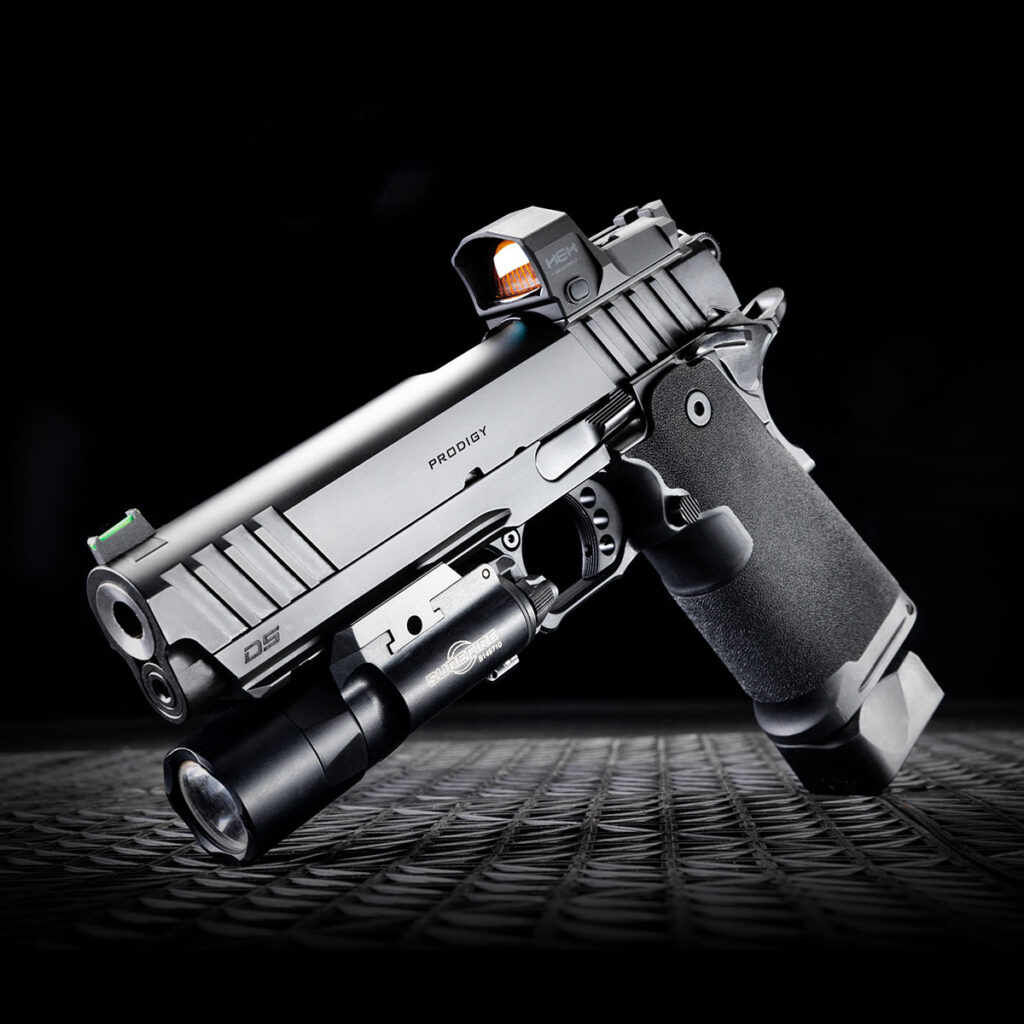
The Springfield Prodigy is one of the most interesting pistols in Springfield Armory’s catalog because it sits in two worlds at once.
On one hand, it is clearly connected to the 1911 platform. It has the single-action feel, frame-mounted safety, grip angle, and general shooting character that make people love 1911 pistols in the first place.
On the other hand, the Prodigy is not a traditional single-stack .45 ACP 1911. It is Springfield’s modern double-stack 1911 DS platform, chambered in 9mm, built around higher capacity, AOS optic readiness, a polymer grip module, and modern performance features.
That is where the comparison gets interesting.
Should you buy a Springfield Prodigy, or should you buy a more traditional Springfield 1911 like a Garrison, Ronin, Operator, TRP, Emissary, Mil-Spec, Loaded, or EMP?
The answer depends on what you want from the gun.
Shop Springfield Prodigy Pistols
Quick Answer: Springfield Prodigy vs Springfield 1911
The Springfield Prodigy is the better choice if you want a modern double-stack 9mm 1911-style pistol with higher capacity, optic-ready AOS support, a Picatinny rail, competition-leaning features, and modern defensive or range capability.
A traditional Springfield 1911 is the better choice if you want the classic single-stack 1911 experience, especially in .45 ACP, with a slimmer grip, forged construction, classic styling, and model families like the Garrison, Ronin, Operator, TRP, Emissary, Mil-Spec, Loaded, or EMP.
In plain English:
Buy the Prodigy if you want a modern high-capacity 1911-style 9mm.
Buy a traditional Springfield 1911 if you want the classic 1911 feel, especially in .45 ACP or a slimmer single-stack format.
Neither choice is wrong. They simply serve different buyers.
What Is the Springfield Prodigy?
The Springfield Prodigy is part of Springfield’s 1911 DS family. DS stands for double stack, and that is the big difference between the Prodigy and a normal single-stack 1911.
Springfield took the proven 1911 platform and reworked it around a double-stack 9mm magazine system. The full-size Prodigy models can offer 17+1 and 20+1 capacity depending on magazine configuration, while Prodigy Compact models are built around a 15-round double-stack magazine.
That is a major change.
A traditional 1911 is usually slim, single-stack, and often chambered in .45 ACP. The Prodigy keeps the 1911-style single-action shooting feel, but it adds more capacity, optic support, and a more modern feature set.
The Prodigy lineup includes several major model groups:
Springfield Prodigy AOS
Springfield Prodigy Compact
Springfield Prodigy Comp
Springfield Prodigy COA
Springfield Prodigy Gear Pac models
Low-capacity Prodigy models
4.25-inch and 5-inch Prodigy variants
The Prodigy is best understood as Springfield’s answer to the modern double-stack 1911 / 2011-style market. It gives shooters a way to get a high-capacity, optic-ready, 9mm 1911-style pistol without shopping only in the higher-end custom or semi-custom world.
Shop Springfield Prodigy Pistols
What Is a Traditional Springfield 1911?
A traditional Springfield 1911 is the classic side of the lineup.
Springfield’s broader 1911 family includes everything from simple, heritage-focused pistols to premium defensive models. The lineup includes Mil-Spec, Garrison, Ronin, Operator, Emissary, Loaded, EMP, TRP, and other configurations. Springfield describes its 1911 series as using forged major components and covering everything from ultra-compact Ronin EMP pistols to full-size Operator pistols.
That variety matters because “Springfield 1911” does not refer to one pistol.
A Springfield Mil-Spec is very different from a Springfield TRP.
A Garrison is different from an Operator.
A Ronin EMP is different from a full-size .45 ACP Loaded model.
A 9mm EMP is different from a .45 ACP Government-size 1911.
The common thread is the classic 1911 architecture: single-action trigger, frame-mounted thumb safety, grip safety, slim grip profile, and a shooting feel that many people still prefer over modern striker-fired pistols.
Traditional Springfield 1911 models also tend to offer more caliber variety than the Prodigy. Depending on model, Springfield 1911 pistols can appear in .45 ACP, 9mm, 10mm, and other configurations across the broader family. The Prodigy family is centered around 9mm.
The Biggest Difference: Capacity
Capacity is the first major difference between the Prodigy and a typical Springfield 1911.
The Prodigy is a double-stack 9mm pistol. Full-size Prodigy models are built around 17-round and 20-round magazine configurations, while compact Prodigy models use 15-round double-stack magazines.
A traditional single-stack 1911 usually holds far fewer rounds. That is not a flaw. It is part of the design.
A .45 ACP 1911 commonly has a lower round count because it uses a single-stack magazine and a larger cartridge. A 9mm single-stack 1911 may give you a little more capacity than .45 ACP, but it still will not match the Prodigy’s double-stack setup.
That difference changes the role of the pistol.
The Prodigy is for shooters who want 1911-style handling without giving up modern capacity.
A traditional Springfield 1911 is for shooters who are comfortable with lower capacity because they value the slimmer grip, classic feel, and traditional format.
Capacity alone does not decide which pistol is better, but it is probably the most obvious reason someone would choose the Prodigy.
Grip Feel: Slim Single Stack vs Wider Double Stack
The second major difference is grip feel.
A traditional 1911 has a slim grip. That is one of the reasons people love the platform. Even in .45 ACP, the single-stack frame can feel very natural in the hand. For shooters with smaller hands, or for anyone who prefers a thinner pistol, this matters a lot.
The Prodigy has a wider grip because it uses a double-stack magazine. Springfield designed the Prodigy’s polymer grip module to remain comfortable, but there is no getting around the fact that a double-stack 1911 DS pistol will feel larger in the hand than a single-stack 1911.
That is not automatically bad.
A wider grip can give some shooters more control. It can help fill the hand, improve support-hand contact, and make the gun feel more stable during faster shooting. But if you specifically love the classic slim 1911 feel, the Prodigy may not scratch the same itch.
The best way to think about it:
A traditional Springfield 1911 feels classic, slim, and familiar.
The Springfield Prodigy feels modern, fuller, and more performance-oriented.
Caliber: 9mm Prodigy vs .45 ACP, 9mm, and 10mm 1911 Options
The Prodigy is a 9mm platform. That is central to its identity.
That makes sense. The Prodigy is built for double-stack capacity, recoil control, optic-ready shooting, and fast follow-up shots. 9mm fits that role extremely well.
Traditional Springfield 1911 pistols give you more caliber variety. A buyer shopping the broader Springfield 1911 collection may be looking for a .45 ACP Mil-Spec, a 9mm Ronin, a 10mm Ronin, a .45 ACP Operator, a 9mm Garrison, a compact EMP in 9mm, or another model-specific configuration.
This is a major reason the broader 1911 collection still matters.
A buyer who wants the classic .45 ACP 1911 experience is probably not looking for a Prodigy. That buyer is likely better served by a traditional Springfield 1911.
A buyer who wants a softer-shooting, higher-capacity, optic-ready 9mm 1911-style pistol is exactly the kind of person who should look at the Prodigy.
Optics: Prodigy AOS vs Traditional Iron-Sight 1911s
Optic readiness is another major advantage for the Prodigy.
Many Prodigy models use Springfield’s AOS, or Agency Optic System. The AOS setup is designed for mounting compatible pistol red dots using optic-specific plates. Springfield’s Prodigy page highlights the platform’s optics-ready design along with the ambidextrous safety and Picatinny rail.
This matters because pistol red dots are no longer niche. Many serious handgun buyers now want a red-dot-ready pistol from the start.
Traditional Springfield 1911 models are mixed. Some are classic iron-sight pistols. Some newer or more premium models include AOS optic-ready configurations. But as a family, the Prodigy is more clearly built around modern red-dot use.
The easiest way to split it:
Choose the Prodigy if optic-ready capability is a major priority.
Choose a traditional 1911 if you prefer irons, classic styling, or a model where optic readiness is not the main concern.
There are exceptions, especially with Springfield AOS 1911 models, but the Prodigy is the cleaner starting point for a modern optic-ready double-stack setup.
Rail and Accessory Support
The Prodigy also comes with a Picatinny rail on many models, making it easier to mount weapon lights and other compatible accessories. That pairs naturally with its modern defensive and performance role.
Traditional Springfield 1911 pistols vary.
A Mil-Spec or Garrison may have a more classic non-railed setup. An Operator is much more likely to be the right traditional Springfield 1911 for someone who wants a light-bearing defensive pistol. Springfield’s Operator family is described around duty-grade features, including tactical sights, G10 grips, ambidextrous safety, and other defensive features.
This is why comparing “Prodigy vs 1911” can get tricky.
A Prodigy vs Mil-Spec comparison is obvious: modern double-stack performance pistol vs traditional classic 1911.
A Prodigy vs Operator comparison is closer: both can lean defensive and modern, but one is double-stack 9mm and the other is a more traditional 1911 format.
A Prodigy vs TRP AOS comparison is also closer, because both can be premium, optic-ready, and defensive-focused.
The Prodigy is not the only modern Springfield 1911-style option, but it is the most clearly double-stack modern option.
Trigger Feel: Why Both Still Appeal to 1911 Fans
The Prodigy and traditional Springfield 1911 pistols both keep one of the platform’s biggest advantages: the single-action trigger feel.
That is one of the main reasons someone would choose either option over a striker-fired pistol.
A good 1911 trigger has a different character than a Glock, Echelon, Hellcat, M&P, PDP, or P320. It tends to be short, clean, and easy to shoot well once the user is familiar with the platform.
The Prodigy keeps that broad shooting appeal while adding capacity and modern features. Traditional Springfield 1911 pistols keep the trigger feel in a more classic package.
The difference is not that one has a 1911 trigger and the other does not.
The difference is the rest of the pistol built around that trigger.
Prodigy: single-action feel with double-stack capacity and modern features.
Traditional Springfield 1911: single-action feel with classic slim-frame design and model-family variety.
Springfield Prodigy AOS: The Core Modern Option
The Prodigy AOS is the main model group most buyers should understand first.
This is the optic-ready Prodigy that keeps the basic double-stack 1911 DS formula front and center. It is available in full-size 5-inch and 4.25-inch variants depending on the listing, with 9mm chambering, double-stack capacity, ambidextrous safety, Picatinny rail, and AOS optic support.
The Prodigy AOS is the best starting point if you want the platform without necessarily jumping into the Comp, Compact, COA, or Gear Pac variants.
It is the clean version of the Prodigy idea: modern 9mm capacity, 1911-style controls, optic readiness, and performance-driven handling.
Shop Springfield Prodigy Pistols
Springfield Prodigy Comp: For Flatter Shooting
The Prodigy Comp adds an integral compensator to the platform. Springfield describes the Prodigy Comp as using an AOS-compatible slide and barrel assembly that is integrally compensated to help reduce muzzle rise.
This is the version to compare if fast follow-up shots matter.
A compensator does not make the pistol shoot itself, but it can help the gun track flatter, especially during faster strings of fire. That makes the Prodigy Comp a strong option for range use, training, competition-style shooting, or anyone who simply wants a softer-tracking double-stack 1911.
The Prodigy Comp is not necessarily better for everyone. Some buyers prefer the simplicity of a non-compensated pistol. Others want the extra recoil-management advantage.
The decision is role-based.
Choose the Prodigy Comp if you want the Prodigy platform with additional recoil control.
Springfield Prodigy Compact: Carry-Driven Double Stack 1911
The Prodigy Compact brings the 1911 DS platform into a smaller, carry-driven format.
Springfield describes the Prodigy Compact as using a 15-round double-stack magazine, compact polymer grip module, lightweight aluminum frame, shortened beavertail, and recontoured hammer to reduce the overall footprint.
That is a very different role from a full-size 5-inch Prodigy.
The Compact is the model for someone who wants the Prodigy concept but does not want a full-size pistol. It keeps the 9mm double-stack 1911 DS idea but makes the gun more portable.
This is also the model that most directly competes with carry-oriented traditional 1911s like the EMP or Ronin EMP.
A traditional EMP gives you a smaller single-stack 9mm 1911-style pistol. Springfield describes the EMP as built around the 9mm cartridge, with smaller dimensions for concealed carry.
The Prodigy Compact gives you a more modern double-stack take on that general carry-size conversation.
Springfield Prodigy COA: Factory Optic Included
Some Prodigy models come with the Aimpoint COA closed-emitter optic from the factory.
This matters because many buyers want to run a red dot but do not want to piece together the pistol, optic plate, optic, screws, torque specs, and zeroing process separately. A factory optic-equipped model simplifies the setup.
The COA models make the most sense for shooters who already know they want an optic-equipped Prodigy and prefer a factory package.
For buyers who want to choose their own optic, the standard AOS models may make more sense.
Traditional Springfield 1911: The Classic Side
The traditional Springfield 1911 collection is where you go for the classic platform experience.
This includes pistols like:
Mil-Spec
Garrison
Ronin
Operator
TRP
Emissary
Loaded
EMP
10-8 Performance
California-compliant 1911 variants
AOS-equipped traditional 1911 models
These pistols can differ dramatically, but they share the broader traditional 1911 DNA. Many use forged major components, classic single-stack magazines, hammer-fired single-action operation, manual safeties, and familiar 1911 ergonomics. Springfield’s 1911 Series page specifically emphasizes forged major components and the broad range of applications covered by its lineup.
This is the side of the catalog to shop if you want tradition, .45 ACP, slimmer grip feel, or one of Springfield’s more classic families.
Shop Springfield 1911 Pistols:
Springfield Garrison: A Great Traditional 1911 Starting Point
The Springfield Garrison is a strong example of the traditional 1911 side.
It is not as basic as a Mil-Spec, and it is not as tactical as an Operator or TRP. It sits in a sweet spot for buyers who want a refined classic 1911 with forged construction, modern upgrades, and traditional styling.
Springfield describes the Garrison as a 1911 built with modern materials and design while maintaining more than a century of heritage.
This is the kind of pistol to compare against the Prodigy if you are asking yourself, “Do I want a classic 1911, or do I want a modern double-stack version?”
Choose the Garrison side of the argument if you want a slimmer, more traditional single-stack pistol.
Choose the Prodigy if capacity, 9mm speed, and optics matter more.
Springfield Operator: The Defensive Traditional 1911
The Operator is Springfield’s duty-grade traditional 1911 family.
Compared with a Garrison or Mil-Spec, the Operator leans much harder into defensive use. Springfield highlights features like tactical sights, G10 grips, ambidextrous safety, forward slide serrations, two magazines with bumper pads, and a more serious defensive feature set.
This is one of the better comparisons against the Prodigy for someone who wants a defensive pistol.
The Operator gives you a traditional 1911 format with tactical features.
The Prodigy gives you a double-stack 9mm format with capacity and optic-ready performance.
Both make sense. The choice comes down to whether you want the traditional single-stack 1911 feel or the modern 1911 DS concept.
Springfield Ronin and EMP: The Carry Side of Traditional 1911s
The Ronin and EMP models matter because not every traditional Springfield 1911 is a full-size .45 ACP range gun.
The Ronin family gives buyers a refined two-tone 1911 with modern features. The EMP is even more carry-specific, because it is built around the 9mm cartridge in a smaller platform. Springfield describes the EMP as designed from the ground up for 9mm, giving it a smaller and more compact frame for concealed carry.
This matters when comparing the Prodigy Compact.
A Prodigy Compact is the modern double-stack carry-driven choice.
An EMP is the slim, compact, traditional 9mm 1911-style choice.
The Prodigy Compact gives you more capacity and modern features.
The EMP gives you a smaller, more traditional single-stack feel.
Springfield TRP: Premium Traditional 1911 Territory
The TRP is one of Springfield’s more premium traditional 1911 lines.
This is the family to compare if you want a hard-use, premium-feeling 1911 but do not necessarily want the Prodigy’s double-stack format. TRP models may include AOS optic-ready options, Operator variants, Carry Contour models, 9mm and .45 ACP chamberings, and more premium fit/finish features depending on the exact pistol.
The TRP is not the budget choice. It is for shooters who want a serious traditional 1911.
The Prodigy and TRP can overlap in price and purpose, but they still feel very different.
Choose the TRP if you want premium traditional 1911 character.
Choose the Prodigy if you want double-stack 9mm capacity and modern 1911 DS performance.
Prodigy vs Traditional 1911 for Range Use
For range use, both are excellent, but they are enjoyable in different ways.
The Prodigy is easier to shoot fast for many people because of the 9mm chambering, heavier/stable platform, double-stack grip, and higher capacity. You reload less often, recoil is manageable, and the AOS system makes it easy to build a red-dot range pistol.
A traditional Springfield 1911 gives you a different kind of enjoyment. A .45 ACP Garrison, Mil-Spec, Operator, or TRP has that classic recoil impulse and single-stack feel. A 9mm Ronin or Garrison is softer and still feels very much like a traditional 1911.
The Prodigy is the better high-volume range tool for many shooters.
A traditional 1911 is the better classic shooting experience.
That is the real difference.
Prodigy vs Traditional 1911 for Carry
For carry, the comparison gets more personal.
A full-size Prodigy is not the easiest gun to conceal. It is a double-stack 1911 DS pistol with a larger grip and more weight than many carry-focused pistols.
A Prodigy Compact is much more carry-relevant, but it still has a wider grip than a single-stack 1911.
A traditional Springfield EMP, Ronin EMP, or compact 1911 may be easier to conceal because of the slimmer grip profile. The EMP especially makes sense for buyers who want a compact 9mm 1911-style pistol without moving into a wider double-stack frame.
Choose the Prodigy Compact if you want more capacity and can carry the wider grip.
Choose a traditional compact 1911 or EMP if slimness and concealment matter more.
Prodigy vs Traditional 1911 for Home Defense
For home defense, the Prodigy has a strong argument.
Higher capacity, 9mm controllability, optic-ready AOS support, and a Picatinny rail all matter in a defensive pistol. The Prodigy gives you a modern setup while keeping the 1911-style trigger and controls.
That said, a traditional Operator, TRP, or railed 1911 can also make sense for home defense. A .45 ACP Operator with a rail and tactical sights is a very different kind of defensive pistol, but it is still a valid one.
The deciding factor is what you value.
Prodigy: capacity, 9mm, optics, modern performance.
Operator/TRP: traditional 1911 feel, .45 ACP or 9mm options, duty-grade single-stack setup.
For most buyers who specifically want a modern home-defense 1911-style pistol, the Prodigy is probably the easier recommendation.
Prodigy vs Traditional 1911 for Competition-Style Shooting
For competition-style shooting, the Prodigy is the more natural choice.
The double-stack 9mm format, optic-ready AOS system, high capacity, and Comp variants all point toward faster shooting. Springfield also notes that extended 20- and 26-round magazines are available for the Prodigy family.
A traditional 1911 can absolutely be used in competition, depending on the discipline and division. But when modern capacity and optics matter, the Prodigy has the advantage.
The Prodigy Comp is especially relevant here. Its integrally compensated design helps reduce muzzle rise and makes the pistol more appealing for faster strings of fire.
Choose the Prodigy if speed, capacity, and optic use matter.
Choose a traditional 1911 if the division or your personal preference favors single-stack shooting.
Prodigy vs 1911: Which Is More “Authentic”?
This is where 1911 people love to argue.
A traditional single-stack .45 ACP 1911 is more historically authentic. That is the platform most people picture when they hear “1911.” Slim grip, single-stack magazine, steel frame, .45 ACP chambering, and classic controls.
The Prodigy is not trying to be that.
It is a modern evolution of the platform. It keeps the parts people love — trigger feel, control layout, grip angle, single-action shooting — but changes the capacity, grip, optic support, and overall role.
So yes, a Garrison, Mil-Spec, Ronin, Operator, or TRP will feel more like a traditional 1911.
The Prodigy will feel more like a modern double-stack performance pistol with 1911 DNA.
That distinction matters. The Prodigy is not the best answer for a purist. It is the better answer for someone who wants to modernize the 1911 concept.
Which One Should You Buy?
Buy the Springfield Prodigy if you want:
A modern double-stack 1911-style pistol
9mm chambering
Higher capacity
AOS optic support
A Picatinny accessory rail
Compact, full-size, Comp, and COA model options
A range, defensive, or competition-style pistol with 1911 controls
A more modern alternative to a traditional single-stack 1911
Shop Springfield Prodigy Pistols
Buy a traditional Springfield 1911 if you want:
Classic single-stack 1911 feel
A slimmer grip
.45 ACP options
9mm or 10mm options depending on model
Traditional styling
Mil-Spec, Garrison, Ronin, Operator, TRP, Emissary, Loaded, or EMP models
A more historically familiar 1911 shooting experience
A carry model like the EMP or a duty-style model like the Operator or TRP
Final Verdict: Springfield Prodigy or Traditional 1911?
The Springfield Prodigy and a traditional Springfield 1911 are not really fighting for the exact same buyer.
The Prodigy is for the shooter who loves the 1911 idea but wants modern capacity, 9mm speed, optics, rails, and performance features.
A traditional Springfield 1911 is for the shooter who wants the classic platform: slimmer grip, .45 ACP heritage, forged steel feel, and model families that preserve the 1911’s original character while adding modern upgrades.
The Prodigy is the modern answer.
The Springfield 1911 collection is the classic answer.
For many buyers, the right solution may eventually be both: a Prodigy for high-capacity 9mm range and defensive use, and a traditional Springfield 1911 for the timeless experience that made the platform famous in the first place.