
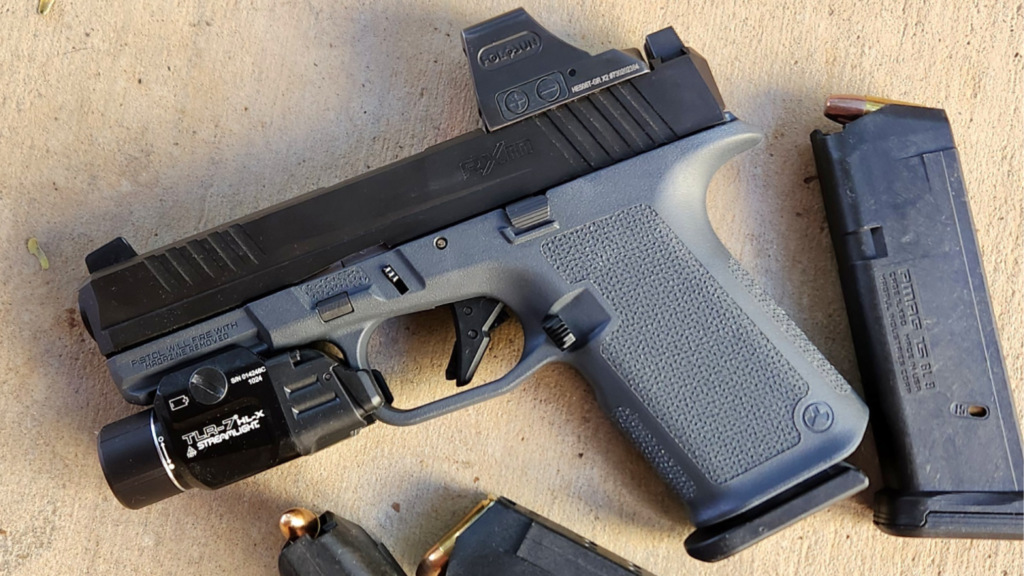
The Ruger RXM is one of the more interesting pistols Ruger has released in years because it is not just another basic polymer-frame 9mm. It is a Ruger and Magpul collaboration built around modularity, broad accessory support, and a familiar striker-fired handgun layout.
On paper, the RXM looks like it was designed for the shooter who likes the Glock 19 size class, wants optics-ready capability from the factory, appreciates Magpul ergonomics, and does not want to be locked into a completely proprietary pistol ecosystem.
That makes it a very different kind of Ruger handgun. The RXM is not a small pocket pistol like the LCP MAX. It is not a rimfire range pistol like the Mark IV. It is not a classic metal-frame pistol like the SR1911. It is Ruger’s attempt at a serious modern 9mm carry and duty-size platform with modular features baked in from the start.
You can browse current models in our full Ruger RXM Pistols collection at Deerford Defense.
Quick Ruger RXM Specs
Exact specs vary by model, but the RXM family generally centers around these features:
| Feature | Ruger RXM General Specs |
|---|---|
| Caliber | 9mm Luger |
| Action | Striker-fired semi-automatic |
| Capacity | 15+1 or 17+1 depending on model |
| Barrel Length | 4″ or 4.5″ depending on configuration |
| Threaded Barrel Models | Available on select 4.5″ models |
| Optic Cut | RMR, DeltaPoint Pro, RMSc, or Aimpoint A-CUT depending on model |
| Grip Frame | Magpul Enhanced Handgun Grip |
| Serialized Component | Removable stainless steel Fire Control Insert |
| Magazines | Magpul PMAG GL9 magazines included on many models |
| Sights | Co-witness-height sights on many models |
| Manual Safety | No external manual safety on standard models |
| Accessory Rail | Yes, for lights and lasers |
| General Role | Carry, home defense, range use, training, and modular 9mm setups |
What Is the Ruger RXM?
The Ruger RXM is a striker-fired 9mm pistol built with a removable serialized Fire Control Insert, or FCI. That internal chassis is the legally serialized firearm, while the grip frame is a replaceable Magpul Enhanced Handgun Grip module.
That is the most important thing to understand about the RXM. The grip frame is not just “a polymer frame with Magpul texture.” The design is built around a modular fire-control system, which gives the platform more flexibility than a traditional one-piece polymer pistol.
In plain English, Ruger built the internal firearm, Magpul built the grip system, and the result is a pistol that feels familiar but has more room to evolve.
The RXM is clearly aimed at the Glock 19-sized world of carry pistols. Standard 15-round models are compact enough for concealed carry with the right holster, but still large enough to shoot comfortably. The 17-round models give shooters a fuller grip and more capacity, pushing the pistol closer to a full-size role.
The Big Deal: Ruger’s Fire Control Insert
The removable Fire Control Insert is what makes the RXM stand out.
On a typical polymer-frame pistol, the frame itself is the serialized firearm. That means changing the frame is not as simple as swapping a normal accessory. With the RXM, the serialized stainless FCI sits inside the Magpul grip frame. That opens the door for different grip sizes, colors, textures, and configurations while keeping the same core pistol.
That matters because handgun fit is personal. Grip angle, texture, finger reach, palm swell, undercut, magazine well shape, and overall size can all change how a pistol feels in the hand. A modular grip system gives shooters a better chance of tuning the pistol to fit them instead of forcing themselves to adapt to one fixed frame.
This is not a new concept in the handgun world, but it is a big move for Ruger, especially combined with Magpul’s involvement.
Magpul Enhanced Handgun Grip: The Part You Actually Feel
The RXM’s Magpul grip module is one of the pistol’s biggest selling points. The grip has a more modern feel than many basic factory polymer frames, with practical texture, a high-grip-friendly beavertail, undercut trigger guard, indexing pads, and a low-profile flared magwell.
The texture is important. A carry pistol needs enough grip to stay planted during recoil, but it cannot be so aggressive that it becomes miserable against clothing or skin. The RXM’s grip is designed to live in that middle ground: useful, controllable, but not obnoxious.
The shape also helps. The undercut trigger guard lets the firing hand sit higher, which can improve recoil control. The beavertail helps prevent slide bite and gives the shooter a consistent high grip. The flared magwell is subtle enough for carry but still useful during reloads.
This is where the RXM feels more like a Magpul product than a typical factory handgun. Ruger handled the firearm. Magpul made the interface between the shooter and the gun.
Optics-Ready From the Start
The RXM is built for modern red dot use. Standard models are commonly cut for RMR, DeltaPoint Pro, and RMSc optic footprints, giving shooters a lot of flexibility without needing to send the slide out for milling.
That matters because pistol optics are no longer a niche upgrade. A lot of carry, duty, and range pistols are being set up with red dots from day one. The RXM recognizes that and gives shooters a practical optics-ready slide right out of the box.
There is one important warning: not every RXM uses the same optic system.
Most standard RXM models use the RMR, DPP, and RMSc-compatible cut. Some Lipsey’s exclusive models use the Aimpoint A-CUT system instead and may come with or be designed around the Aimpoint COA optic. That is not a bad thing, but it does mean buyers need to check the exact model before ordering.
If you already own an optic, make sure the RXM model you choose matches the footprint you need.
Barrel Lengths, Capacity, and Model Differences
The RXM lineup is not just one pistol in one configuration. The major differences are barrel length, magazine capacity, grip color, threaded barrel availability, and optic cut.
The 4″ models are the most balanced carry-style versions. They are compact enough for everyday carry while still offering a full enough grip and sight radius for regular range use.
The 4.5″ threaded-barrel models are the better choice if you plan to run a suppressor or compatible muzzle device where legal. These models are slightly longer, but the threaded barrel makes them more flexible for shooters who want a suppressor-ready 9mm.
The 15+1 models fit the Glock 19-style role better. They are the obvious choice if you want a compact defensive pistol that still feels substantial in the hand.
The 17+1 models give you more grip length and more capacity. These are better suited for range use, home defense, duty-style setups, and shooters who simply prefer a fuller grip.
Color options and distributor exclusives add another layer. Depending on inventory, you may see black, Flat Dark Earth, OD Green, Stealth Gray, two-tone models, custom slide cuts, themed finishes, or other limited variants in the Ruger RXM collection.
Gen3 Compatibility: Why It Matters
One of the smartest parts of the RXM is its compatibility story. Ruger and Magpul designed many major components around Gen3-style compatibility, which gives the pistol access to a much larger aftermarket than a fully proprietary design would have.
For the average shooter, that can matter in a few ways.
Holsters are easier to find when a pistol fits into an existing size and accessory ecosystem.
Magazine options are easier when the pistol works with PMAG GL9 magazines and compatible Glock-pattern magazines.
Replacement parts and upgrades are less intimidating when the platform is not completely locked down.
That does not mean every Gen3 part on the planet will automatically drop in without checking fitment. It does mean the RXM starts with a much better accessory foundation than many new pistol designs.
For a new pistol platform, that is a huge advantage.
How the RXM Compares to a Glock 19
The obvious comparison is the Glock 19. The RXM lives in the same general 9mm compact pistol category and is clearly meant to appeal to shooters who like that size class.
The Glock 19 has the advantage of history. It has decades of proven use, massive holster support, huge aftermarket availability, and a reputation that is hard to ignore.
The RXM’s advantage is that it gives you a more modern factory package with Magpul ergonomics, modular grip potential, an optics-ready slide, and a removable fire-control chassis. Instead of buying a pistol and immediately wanting to replace half the frame-related feel, the RXM starts with a more thoughtfully designed grip system.
The practical way to think about it is this:
Choose a Glock 19 if you want the most proven and universally supported option.
Choose the RXM if you want a Glock-compatible-ish ecosystem with better factory ergonomics, Ruger/Magpul collaboration, and modular grip-frame potential.
The RXM does not need to “kill” the Glock 19 to be successful. It just needs to give shooters a strong alternative in the same size class, and that is exactly what it does.
How the RXM Compares to the Ruger Security-9
The Ruger Security-9 is a more budget-minded pistol. It is simple, affordable, and practical. For someone who wants a basic Ruger 9mm for defense or range use, the Security-9 still makes sense.
The RXM is the more modern and modular pistol. It has the Magpul grip frame, removable Fire Control Insert, stronger optics-ready focus, better accessory compatibility, and a more serious aftermarket path.
In other words, the Security-9 is the practical budget pistol. The RXM is the more future-facing platform.
If you are shopping strictly by price, the Security-9 may be enough. If you care about optics, modularity, grip feel, magazine ecosystem, and long-term customization, the RXM is the more interesting choice.
How the RXM Compares to the Ruger MAX-9
The MAX-9 is Ruger’s micro-compact 9mm carry pistol. It is smaller, easier to conceal, and better suited for deep concealment than the RXM.
The RXM is larger, easier to shoot well for many people, and better suited to a light-and-optic-equipped defensive setup. It gives up some concealability but gains shootability, capacity, grip control, and accessory support.
Choose the MAX-9 if you want a smaller carry pistol.
Choose the RXM if you want a more shootable compact 9mm that still carries well with the right holster.
Carry Use: Is the RXM Too Big?
For many shooters, no. The RXM sits in the practical compact category. It is not a tiny pistol, but it is not a full-size duty gun either, at least in its 15-round 4″ configuration.
That makes it a realistic concealed carry pistol for people who already carry Glock 19-sized guns, SIG P320 Compact-style guns, CZ P-10 C-style guns, or similar compact 9mm pistols.
The biggest carry considerations are holster selection, optic choice, light choice, and the exact model. A 15-round 4″ model will carry differently than a 17-round threaded-barrel model. The more you add, the less compact it becomes.
For everyday carry, the standard 15-round model is the cleanest choice. For home defense, range use, or suppressor use, the threaded and 17-round models become more appealing.
Range Use: Where the RXM Makes Sense
The RXM should be a very approachable range pistol for most shooters. It is chambered in 9mm, has a useful grip size, offers good factory sight options, and has enough weight and control surface to be easier to shoot than a tiny micro-compact.
The grip design is the star here. A pistol that fits the hand better is easier to control during recoil. The RXM’s undercut, texture, beavertail, and magwell shape all help the pistol feel more planted than a bare-bones polymer frame.
This is also a good platform for red dot practice. The co-witness-height sights on many models are useful, and the optics-ready slide means you can build the pistol into a modern carry or range setup without starting from scratch.
Home Defense Setup
For home defense, the RXM makes a lot of sense in the right configuration. A compact or full-size 9mm pistol with an optic, weapon light, and 15- or 17-round magazines is a very practical defensive setup.
The accessory rail matters here. A defensive pistol should be easy to pair with a quality weapon light if it is being considered for home defense. The RXM’s rail gives it that flexibility.
For this role, a 17-round model or threaded-barrel model may make more sense than the smallest carry configuration. The longer grip gives you more capacity and control, while a light and optic can make the pistol easier to use under stress with proper training.
As always, the pistol itself is only part of the setup. Safe storage, ammunition choice, training, and local laws matter too.
Suppressor Use and Threaded-Barrel Models
Threaded-barrel RXM models are the ones to look at if you want to run a suppressor or compatible muzzle device where legal. These models commonly use a 4.5″ barrel and 1/2″-28 thread pattern.
A suppressed 9mm pistol can be a fun range setup, but it is worth remembering that suppressor use changes the way a pistol handles. You may need the right suppressor, piston, recoil booster, sights, optic setup, and ammunition to get the best experience.
The RXM’s co-witness-height sights and optic-ready design make the threaded models more useful than a pistol that was never really meant to host a can.
For buyers interested in this route, check the current Ruger RXM Pistols collection for threaded-barrel options.
What I Like About the RXM
The RXM makes sense because Ruger did not try to win people over with one gimmick. The pistol has several practical strengths that work together.
The Magpul grip frame is the biggest win. It gives the pistol a better factory feel than many plain polymer pistols.
The removable FCI gives the platform room to grow.
The optics-ready slide fits what shooters are actually buying today.
The Gen3 compatibility direction gives the pistol a stronger aftermarket path.
The PMAG GL9 magazine support is practical and affordable.
The 15+1 and 17+1 options let buyers choose between carry balance and fuller-size capacity.
The threaded-barrel models give suppressor-minded shooters a factory option.
That is a strong feature set for a modern 9mm.
What I Do Not Like as Much
The RXM is still a newer platform, which means it does not have the same long-term track record as pistols like the Glock 19, M&P, or P320. That does not make it bad, but it does mean buyers who value decades of institutional use may still lean toward older designs.
The optic-cut differences can also create confusion. A buyer needs to pay attention to whether they are getting the standard RMR/DPP/RMSc cut or an Aimpoint A-CUT model. That is not difficult, but it matters.
The RXM also may not be small enough for people who want a true micro-compact carry pistol. If your priority is the smallest possible 9mm, this is probably not the model you are shopping for.
Finally, the modular grip system is exciting, but its long-term value depends on continued grip-frame support. The concept is strong. The ecosystem still needs time to grow.
Who Should Buy the Ruger RXM?
The RXM is a good fit for shooters who want a modern compact 9mm with better factory ergonomics than a basic polymer pistol.
It makes sense if you want:
A Glock 19-sized carry or range pistol
A Ruger 9mm with Magpul grip design
An optics-ready slide
A modular Fire Control Insert system
Good magazine and holster compatibility potential
15+1 or 17+1 capacity
A threaded-barrel option
A practical home-defense pistol
A pistol that is easy to customize without feeling overly complicated
It may not be the best fit if you want the smallest possible carry gun, a hammer-fired pistol, a metal-frame pistol, or a platform with decades of proven agency use behind it.
Final Verdict: Is the Ruger RXM Worth It?
The Ruger RXM is worth a serious look if you are shopping for a modern 9mm pistol in the compact-to-full-size range. Its biggest strength is that it combines Ruger manufacturing with Magpul ergonomics and a modular chassis-style design.
That gives it a clear identity. It is not just a cheaper Glock alternative. It is a Ruger/Magpul pistol that borrows the best idea from modern modular handguns and combines it with a grip system that actually feels purpose-built.
For concealed carry, the 15-round 4″ models are the cleanest fit. For range use or home defense, the 17-round and threaded-barrel models are more appealing. For red dot shooters, the standard optics-ready cut gives plenty of flexibility, while the Aimpoint A-CUT exclusives are worth considering if you specifically want that optic system.
The RXM is not trying to be a pocket pistol. It is not trying to be a race gun. It is a practical, modular, optics-ready 9mm that should appeal to shooters who want something familiar, but not boring.
If that sounds like what you are after, browse our current Ruger RXM Pistols for sale at Deerford Defense.
FAQ
The Ruger RXM is chambered in 9mm Luger.
Yes. The RXM is a striker-fired semi-automatic pistol.
Many models ship with Magpul PMAG GL9 magazines. Depending on the model, capacity may be 15+1 or 17+1.
Yes. Many RXM models are cut for RMR, DeltaPoint Pro, and RMSc optics. Some Lipsey’s exclusive models use the Aimpoint A-CUT optic system instead.
Standard RXM models do not have an external manual safety. They use internal safeties and an integrated trigger safety.
The Fire Control Insert, or FCI, is the serialized stainless steel internal chassis of the pistol. It sits inside the Magpul grip module and allows the grip frame to be changed.
Ruger and Magpul designed many major RXM components around Gen3-style compatibility. Fitment can vary by part, so always confirm compatibility before buying accessories or upgrades.
Yes. Select RXM models use a 4.5″ threaded barrel, commonly with a 1/2″-28 thread pattern.
You can shop current models in the Ruger RXM Pistols collection at Deerford Defense. Firearms purchased online must ship to a licensed FFL dealer, where the transfer is completed according to federal, state, and local law.