The Holosun EPS Core vs Osight SE decision comes down to how much optic you want around the window. Both offer an enclosed emitter, a replaceable battery, and a compact mounting footprint. The EPS Core gives you a larger viewing window and more reticle-color choices. The standard RMSc Osight SE is narrower and lighter, with a straightforward choice between a multi-reticle model and a larger single dot.
Our pick: choose the EPS Core if window size or a gold reticle tops your list. Choose the Osight SE if you want a lighter enclosed optic with a smaller body. Neither requires a charging cover. This comparison covers the EPS Core family and the standard RMSc Osight SE models, not the SE MOS or SE DPP.
In This Guide
- Holosun EPS Core: A Larger Window in an Enclosed Design
- Osight SE: A Narrower, Lighter Enclosed Alternative
- EPS Core vs Osight SE: Side-by-Side Comparison
- Price Comparison: A $30 to $80 Gap in These Red Models
- Which Differences Are Worth Paying For?
- Which One Should You Choose?
- Frequently Asked Questions
Holosun EPS Core: A Larger Window in an Enclosed Design
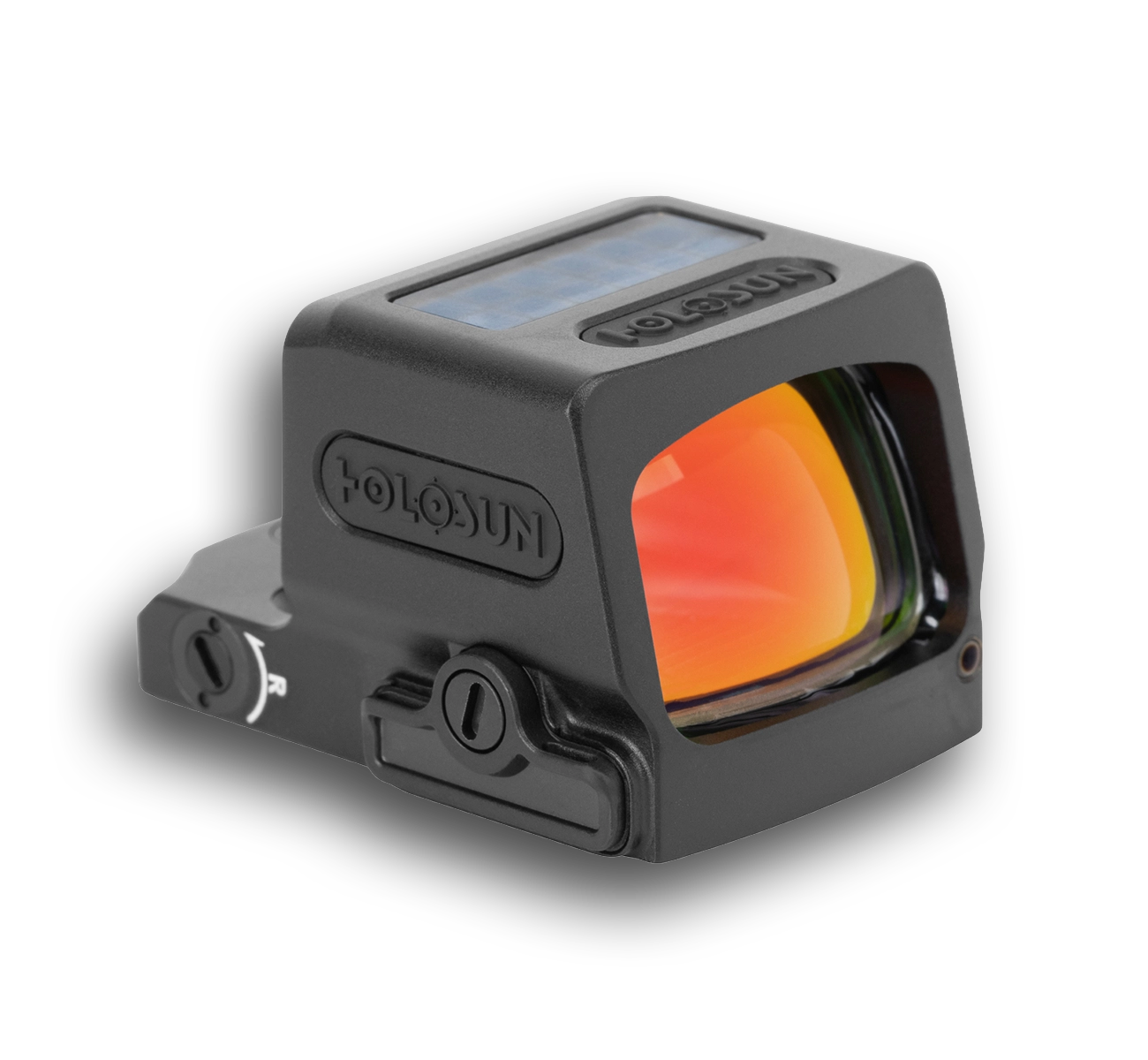
The EPS Core’s main attraction is its combination of a compact footprint and a relatively generous window. Holosun lists a 0.90-by-0.63-inch viewing window in a 1.61-by-1.18-by-0.97-inch body. That makes it wider than the standard SE, although the two are very close in overall length and height. The additional width is worth considering if you dislike the more confined view of smaller enclosed optics.
Fixed Dot or MRS, With Three Color Choices
You can choose a fixed 3 MOA EPS Core or an MRS version with selectable dot, circle, and circle-dot presentations. These are different models, not extra modes hidden in every EPS Core. Red, green, and gold options give the family a wider color selection than the SE.
The fixed-dot model makes sense if you already know you prefer a clean, uncluttered reticle. The EPS Core MRS is the more flexible choice if you want to switch between a dot and a circle-based presentation. A gold reticle is another reason to stay with the Holosun family, but color remains a personal preference rather than a universal upgrade.
A Replaceable Battery, With Solar Failsafe on MRS Models
A side-loading CR1620 powers the EPS Core, so battery replacement does not require removing the optic from its mount. Shake Awake manages standby operation, and manual brightness controls let you select the illumination level. Those are useful conveniences whether you select the fixed-dot or MRS version.
MRS models add Solar Failsafe; the fixed 3 MOA models do not. Solar Failsafe provides supplemental power under suitable lighting conditions. It does not turn the CR1620 into a rechargeable battery. If you are comparing the EPS Core with a solar-charging SCS, that distinction matters.
Housing, Weight, and Weather Protection
The EPS Core uses a 6061 aluminum housing and carries an IPX8 water-resistance rating. Listed weight is 1.4 ounces. Its enclosed construction puts the emitter behind protective glass, keeping the emitter itself separated from outside dust and moisture. You still need to keep the exterior lenses clean; enclosed does not mean maintenance-free.
For someone choosing the EPS Core primarily for its window, the tradeoff is straightforward: you get more viewing area than the SE, but also a wider, heavier optic. Whether that is a worthwhile exchange depends more on your size preference than on a single specification winning the comparison.
Osight SE: A Narrower, Lighter Enclosed Alternative
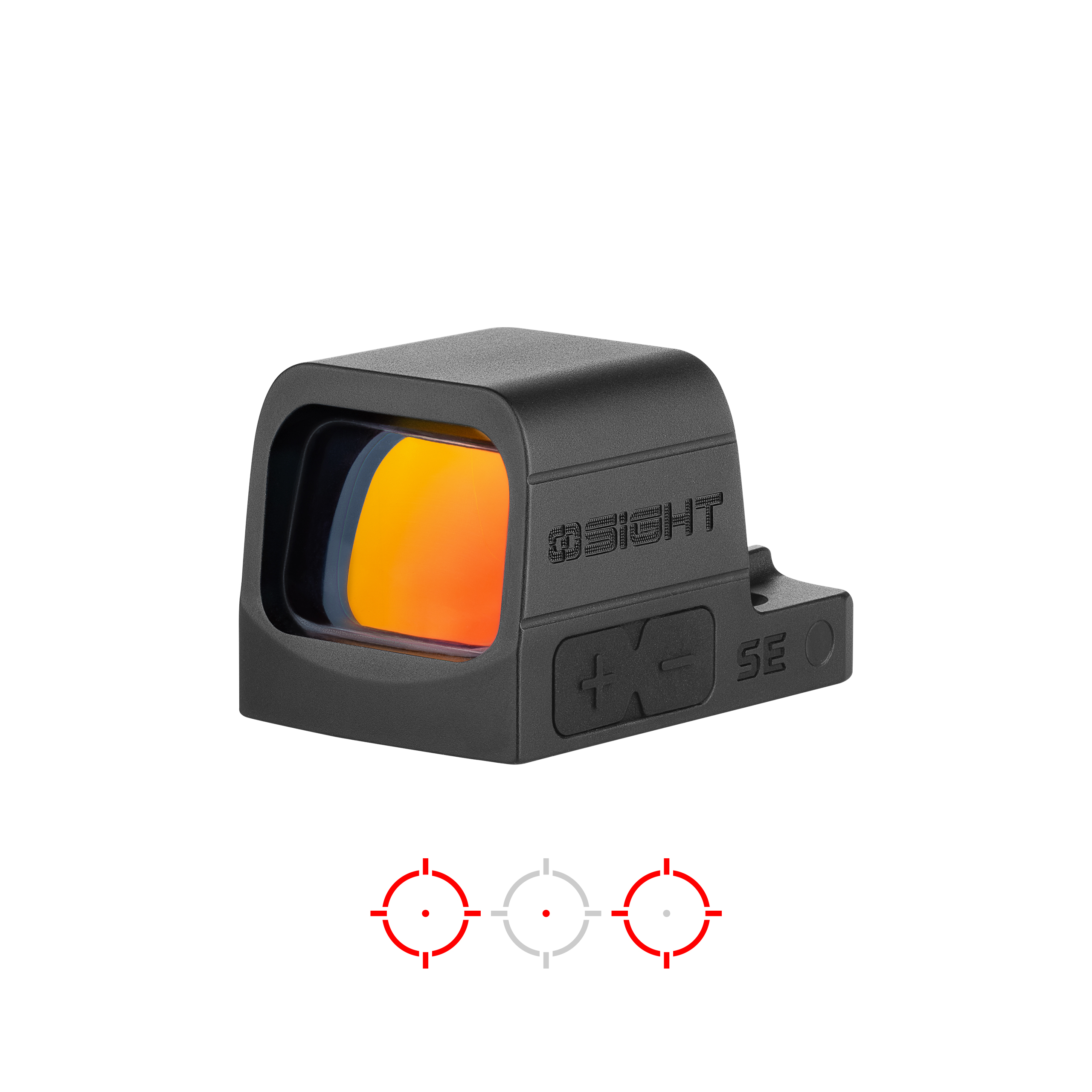
The standard Osight SE takes a different approach to compactness. Its 0.83-by-0.55-inch window sits in a body measuring 1.59 by 0.98 by 0.97 inches. At 0.97 ounce, it is lighter than the EPS Core, and its narrower body is the more noticeable physical difference between the two.
That makes the SE appealing if you want an enclosed optic without as much width across the top of the slide. The smaller window is the compromise. A lighter housing does not make the SE categorically better, just as a larger window does not automatically make the EPS Core the right choice for every buyer.
Multi-Reticle or 6 MOA, in Red or Green
The SE family offers a 2 MOA dot with a 32 MOA circle on multi-reticle models, plus separate fixed 6 MOA versions. The multi-reticle model lets you choose the dot, circle, or both. A fixed 6 MOA SE suits someone who wants a larger dot without a surrounding circle.
Deerford Defense carries red multi-reticle, green multi-reticle, and fixed-dot options. Compare the exact variant rather than assuming every SE has the same reticle. Unlike the EPS Core range, the standard SE lineup discussed here does not include a gold option.
Coin-Cell Power Without a Charging Accessory
The standard SE uses a side-loading CR1620, not Osight’s magnetic charging cover. That is an important difference between the SE and some other Osight models. Its manual brightness controls provide eight daylight and two night-vision-compatible levels, while motion activation and an inactivity timer help manage battery use.
A low-power warning gives you a visible reminder to replace the battery. If your priority is an optic with a conventional, owner-replaceable power source, both the SE and EPS Core meet that requirement. Solar backup is a reason to consider the EPS Core MRS, not a feature you lose by choosing the SE over a fixed-dot EPS Core.
7075-T6 Aluminum and an Enclosed Emitter
The SE pairs a 7075-T6 aluminum housing with an IPX7 rating. Its aspherical lens and enclosed emitter are central features of the design. The alloy difference alone is not a reason to declare one optic tougher: complete housing design matters too. For this purchase, the more useful distinction is how much window size and overall width you want.
EPS Core vs Osight SE: Side-by-Side Comparison
| Feature | Holosun EPS Core | Osight SE RMSc |
|---|---|---|
| Emitter | Enclosed | Enclosed |
| Listed footprint | RMSc | RMSc |
| Window | 0.90 x 0.63 inches | 0.83 x 0.55 inches |
| Body dimensions | 1.61 x 1.18 x 0.97 inches | 1.59 x 0.98 x 0.97 inches |
| Listed weight | 1.4 ounces | 0.97 ounce |
| Reticle choices | Fixed 3 MOA or selectable MRS | 2 MOA / 32 MOA multi-reticle or fixed 6 MOA |
| Color choices | Red, green, gold | Red, green |
| Battery | Side-loading CR1620 | Side-loading CR1620 |
| Solar power | Solar Failsafe on MRS models only | No |
| Housing / water rating | 6061 aluminum / IPX8 | 7075-T6 aluminum / IPX7 |
Price Comparison: A $30 to $80 Gap in These Red Models
Price is a real part of this decision. As of September 17, 2026, Deerford Defense displays the red 3 MOA EPS Core at $229.99 and the red EPS Core MRS at $279.99. The red multi-reticle Osight SE is displayed at $199.99, while the red 6 MOA SE is $179.99.
| Comparison | EPS Core displayed price | SE displayed price | Difference |
|---|---|---|---|
| Red multi-reticle models | $279.99 | $199.99 | EPS Core is $80 more |
| Red fixed-dot models | $229.99, 3 MOA | $179.99, 6 MOA | EPS Core is $50 more; dot sizes differ |
| Core fixed dot vs SE multi-reticle | $229.99 | $199.99 | EPS Core is $30 more; reticle options differ |
These are advertised item prices, not email-quote prices or delivered totals. Both families offer an Email for Quote option on their product pages. Request the relevant quotes before treating the displayed gap as your final savings; shipping and any applicable checkout charges are separate.
At the displayed prices, the SE is the lower-cost route into an enclosed multi-reticle optic. The EPS Core MRS premium buys a larger window and Solar Failsafe, not simply the ability to select a circle-dot reticle. If those extra features do not matter to you, the SE’s lower advertised price is a persuasive reason to choose it.
Which Differences Are Worth Paying For?
Window Size Versus Overall Width
The EPS Core has the larger window in both dimensions. The SE has the narrower body. Think about which characteristic you actually want before letting a feature count settle the purchase. If small optics tend to feel visually cramped to you, the EPS Core’s extra window space is a meaningful benefit. If you want to keep bulk down, the SE offers enclosed construction in a lighter package.
The Right Reticle Is More Important Than Extra Modes
A buyer who wants a single 6 MOA dot has a direct match in the SE lineup. Someone who wants a fixed 3 MOA dot has a direct match in the EPS Core. If you want circle-and-dot options, compare the multi-reticle versions of both, rather than comparing the cheapest fixed-dot model from one family with a more feature-rich model from the other.
Do Not Compare Battery-Life Headlines Without the Settings
Brightness and reticle selection affect runtime. Manufacturers’ maximum-hour figures are not necessarily measured at equivalent brightness levels, so a larger advertised number does not establish a real-world battery-life winner. Both designs let you replace the battery from the side, which is the more useful shared ownership benefit.
Check Fit, Then Compare the Exact Variants
Both are listed with an RMSc footprint, but that is not a promise that either optic will mount directly to every pistol described as optics-ready. The slide’s cut and the manufacturer’s compatibility guidance still control fit. Also, an SE MOS is not an RMSc SE with a different reticle; it is a separate mounting version.
Once you have confirmed fit, compare the current price of the color and reticle you actually want. Paying extra for MRS or gold makes sense when you want those features. It adds little value if you intend to use a red single dot and leave it there.
Which One Should You Choose?
- Choose the EPS Core for its larger window, gold option, or Solar Failsafe on an MRS model.
- Choose the Osight SE for a narrower, lighter body or a fixed 6 MOA option.
- Choose by variant, not just brand: both families offer different reticles, and those differences matter more than a generic claim that one is the best budget optic.
Compare the current Holosun EPS Core models and Osight SE models to find the color and reticle that fit your preference.
Frequently Asked Questions
The EPS Core has a larger window and a wider body than the standard RMSc SE. Their listed length and height are similar, but the EPS Core weighs 1.4 ounces versus the SE’s 0.97 ounce.
Yes. The EPS Core and standard RMSc SE both use a side-loading CR1620. The SE MOS uses a different battery, so do not assume every SE version is identical.
No. Solar Failsafe is a feature of EPS Core MRS models, not the fixed 3 MOA versions. It supplies supplemental power; it does not recharge the CR1620.
No. The SE uses a replaceable coin-cell battery. It is different from Osight models built around rechargeable batteries and magnetic charging covers.
Yes. Both protect the emitter inside an enclosed housing. Their exterior lenses still need to be kept clear of dirt and moisture.
The EPS Core family includes gold options. The standard RMSc SE models covered here offer red or green.
Specification sources: Holosun EPS Core MRS, Holosun EPS Core 3 MOA, and Osight SE series. Specifications checked September 17, 2026.