
The Holosun 507COMP vs Osight XE choice is a comparison between two very different priorities. The standard 507COMP offers the larger window and a wide selection of ring-based reticles in an open-emitter design. The Osight XE AMRS encloses its emitter and lets you choose between two dot sizes without changing optics.
Our recommendation: choose the 507COMP if a large, open viewing window is your first priority. Choose the XE AMRS if you want an enclosed RMR-footprint optic with selectable 2 MOA and 6 MOA dots. Both use side-loading CR1632 batteries, so neither requires a charging cover. This article compares the standard 507COMP, not the separate 507 Pro Max.
In This Guide
- Holosun 507COMP: A Large Window With More Ring Options
- Osight XE AMRS: Enclosed RMR With Two Dot Sizes
- 507COMP vs XE AMRS: Side-by-Side
- Price Comparison: A $120 Gap Between the Red Models
- The Differences That Matter When Choosing
- Our Recommendation
- Frequently Asked Questions
Holosun 507COMP: A Large Window With More Ring Options
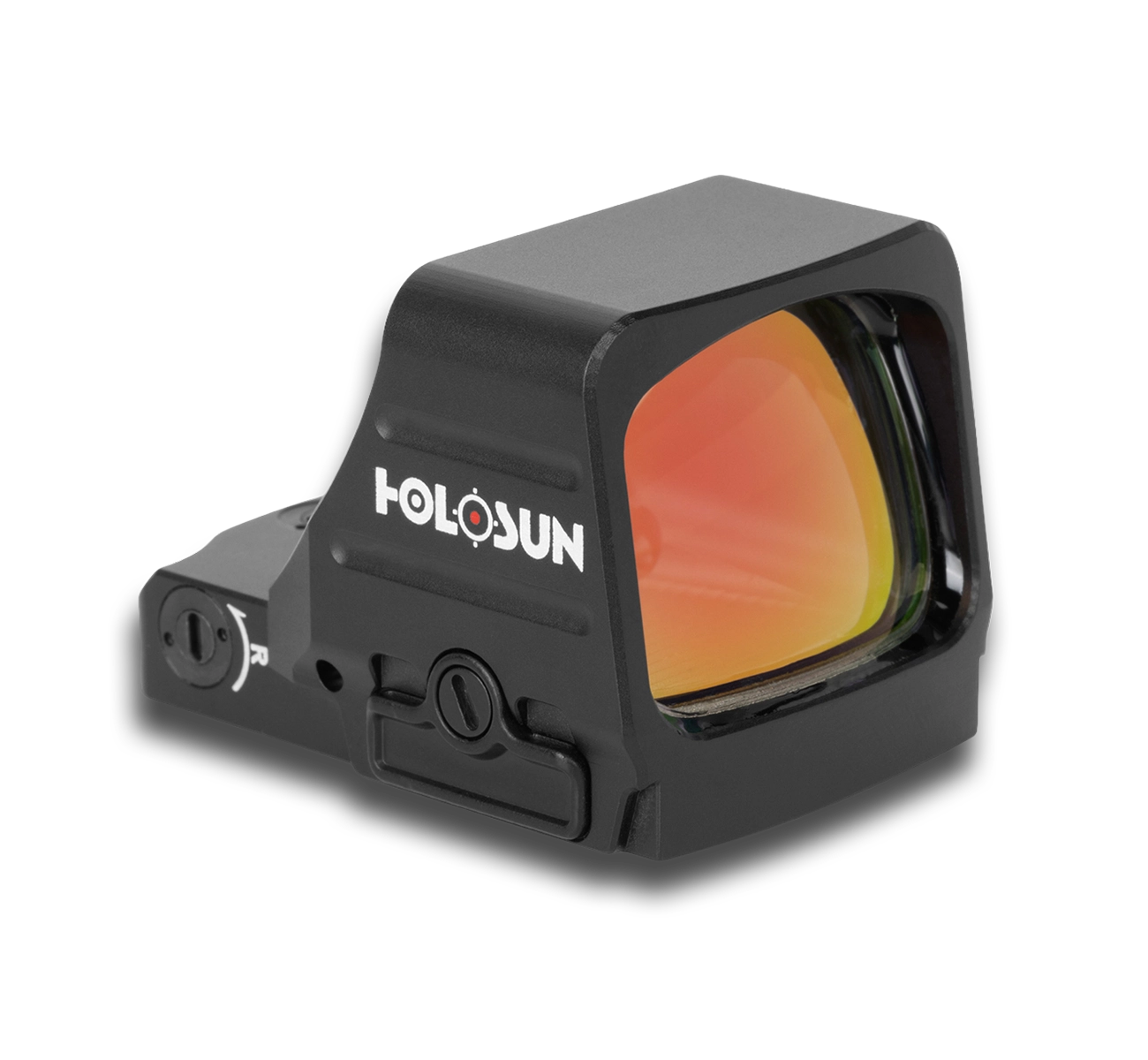
The Holosun 507COMP is built around a 1.1-by-0.87-inch window. It is noticeably larger in both dimensions than the XE’s window, and that extra viewing area is the clearest reason to consider the Holosun. You are buying a large-window optic rather than trying to minimize the size of the sight housing.
The open-emitter layout leaves space behind the front lens instead of enclosing the emitter between front and rear glass. That construction gives the 507COMP its distinctive shape. It also means the emitter area is exposed to outside contamination, a tradeoff worth understanding before choosing it over an enclosed alternative.
A 2 MOA Dot With 8, 20, and 32 MOA Circles
The 507COMP’s reticle system combines a 2 MOA dot with selectable 8, 20, and 32 MOA circles in several configurations. Holosun currently calls it the Performance Reticle System, or PRS. The range of circle sizes is what separates it from a simpler dot-and-32-MOA-circle design.
If you like experimenting with different amounts of visual information in the window, the 507COMP gives you more ring sizes to compare. If you prefer a plain dot, you can use that instead. Importantly, changing circle configurations does not turn the center dot into a 6 MOA dot; that is a different capability offered by the XE.
The family includes red, green, and gold models. Pick the color you actually prefer. None is guaranteed to appear sharper to every eye, and a color change should not be sold as a universal solution for astigmatism.
Familiar Battery Access and Manual Controls
A CR1632 sits in a side-loading battery tray. You can replace it without removing the optic from its mount, and Shake Awake manages illumination during periods of inactivity. Manual brightness selection and lockout are useful if you want to keep a chosen setting from changing accidentally.
The standard 507COMP is not a solar-charging optic. If you want an internal rechargeable battery or a charging cover, you are looking for a different design. Its appeal is a common coin-cell power source paired with accessible controls and a large window.
7075-T6 Aluminum and an RMR Footprint
Holosun lists a 7075-T6 aluminum body, a 1.7-ounce weight, and an IP67 rating. The RMR footprint is familiar, but it is not a guarantee of direct fit on every optics-ready slide. A slide designed around another pattern may require an appropriate adapter or may not support the combination.
The 507COMP makes the most sense when you want its window and reticle choices enough to accept the open emitter. Choosing it purely because it has a high water-resistance rating misses that distinction: water resistance of the electronics and physical enclosure of the emitter are different features.
Osight XE AMRS: Enclosed RMR With Two Dot Sizes
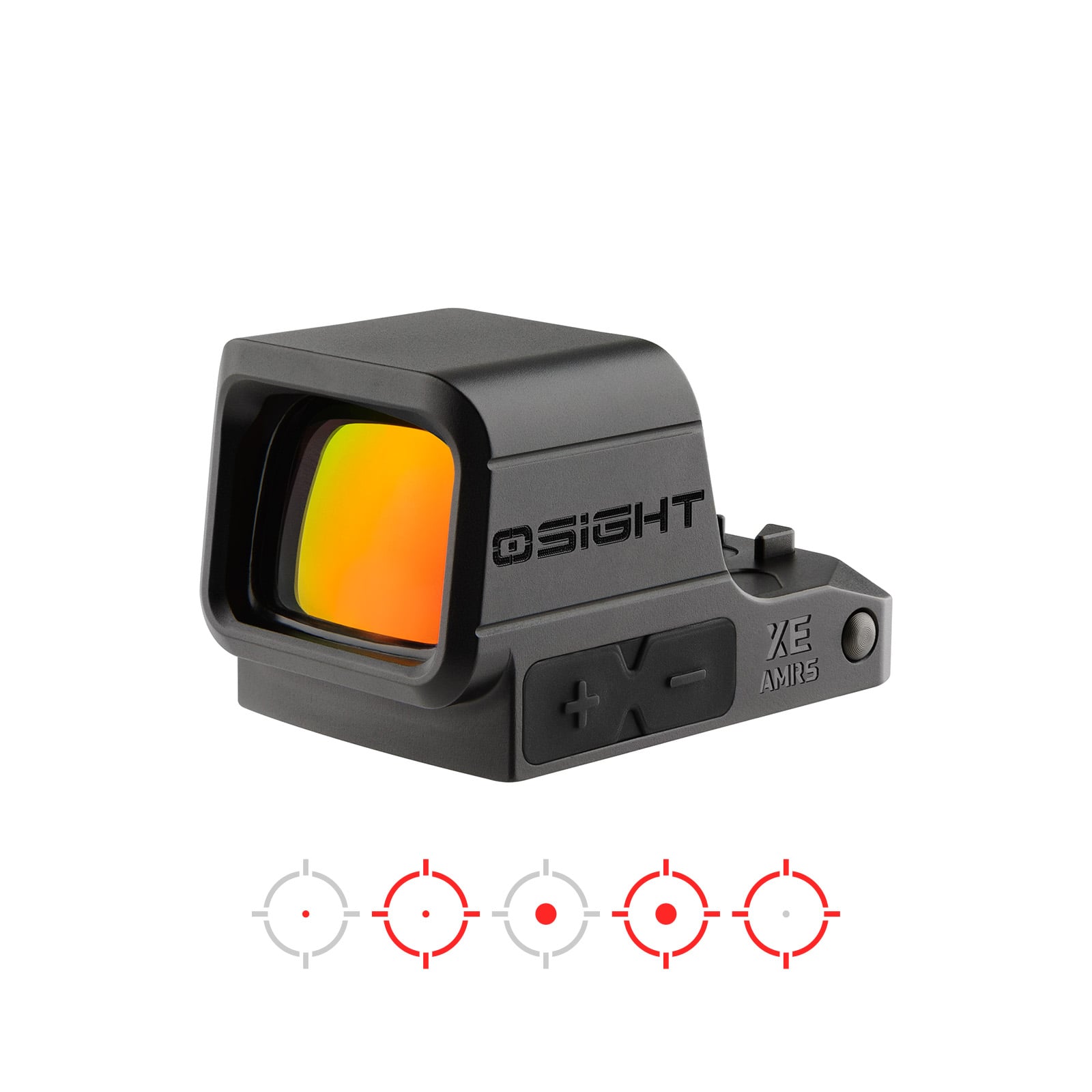
The Osight XE AMRS offers an enclosed emitter on an RMR footprint. Its 0.91-by-0.71-inch window is smaller than the 507COMP’s, but its emitter is protected inside the housing. That is the central exchange: less viewing area in return for an enclosed design.
The XE is not simply a rechargeable Osight with a different name. It uses a replaceable CR1632, and its AMRS reticle system is a major part of what distinguishes it from other models in the range. For buyers who want enclosed construction without managing a charging cover, it is a particularly relevant alternative.
Five Modes, Including 2 MOA and 6 MOA Dots
XE AMRS offers five presentations: a 2 MOA dot, a 6 MOA dot, a 32 MOA circle, a 2 MOA dot with the circle, or a 6 MOA dot with the circle. Unlike the 507COMP, it changes the center dot size as well as whether a circle is displayed.
That flexibility is useful if you are undecided between a small dot and a larger one. You can make that choice within the same optic rather than buying separate fixed-dot versions. The limitation is color: the XE AMRS covered here is a red-reticle model, not a substitute for a green or gold 507COMP.
A Side Battery, Not a Magnetic Charging Cover
The XE’s side-loading CR1632 gives it the same basic battery-replacement convenience as the Holosun. It also provides motion activation, an inactivity timeout, manual brightness, and a low-power indicator. Osight lists eight daylight and two night-vision-compatible brightness levels.
Osight advertises up to 105,000 hours in its Mode 3 dot-only condition. Holosun lists up to 50,000 hours at setting 6 for the 507COMP. Those are not equivalent test settings, so they should not be read as proof that the XE lasts twice as long in the same use. Reticle choice and brightness change the practical result.
Enclosure and a Collapsible Rear Sight
The XE uses a 7075-T6 aluminum housing, carries an IPX7 rating, and weighs 1.80 ounces. It also includes Osight’s collapsible backup rear sight. That is an additional feature of the XE, but it is not a promise of a compatible sight picture with every front sight or slide.
Enclosed construction keeps outside lint, dust, and water away from the emitter itself. The outer windows remain exposed, so cleaning still matters. Choose the enclosure for the protection it actually provides, not because any optic can stay usable with a dirty front lens.
507COMP vs XE AMRS: Side-by-Side
| Feature | Holosun 507COMP | Osight XE AMRS |
|---|---|---|
| Emitter | Open | Enclosed |
| Footprint | RMR | RMR |
| Window | 1.1 x 0.87 inches | 0.91 x 0.71 inches |
| Reticle choices | 2 MOA dot with selectable 8, 20, and 32 MOA circles and combinations | 2 or 6 MOA dot, 32 MOA circle, and dot-circle combinations |
| Colors | Red, green, gold models | Red |
| Battery | Side-loading CR1632 | Side-loading CR1632 |
| Charging cover | Not used | Not used |
| Brightness | Manual, with lockout | Manual, with memory |
| Housing | 7075-T6 aluminum | 7075-T6 aluminum |
| Listed weight | 1.7 ounces | 1.80 ounces |
| Water rating | IP67 | IPX7 |
| Integrated rear sight | No | Collapsible backup rear sight |
Price Comparison: A $120 Gap Between the Red Models
As of September 17, 2026, Deerford Defense displays the red Holosun 507COMP at $369.99 and the Osight XE AMRS at $249.99. The $120 advertised-price gap makes the XE a meaningfully less expensive option, not just a differently shaped alternative at the same price.
The green 507COMP is displayed at $399.99, while the gold 507COMP is $369.99. Those models cost $150 and $120 more than the red XE respectively, but they also offer colors the XE does not provide.
These are public item prices, not email-quote prices. Use the Email for Quote option on each product page to compare the current offers. Shipping and any applicable checkout charges are separate, so the displayed difference is not a promise of the final delivered-price difference.
At the advertised prices, the Holosun premium is chiefly about the larger window, reticle-circle choices, and available colors. The XE already gives you enclosure and two dot sizes for less. If those are your priorities, there is little reason to pay more simply to move to the Holosun name. If the 507COMP’s window is the feature you want, the smaller XE does not replace that benefit.
The Differences That Matter When Choosing
Large Window or Enclosed Emitter?
If you want the largest window of these two, the 507COMP is the clear choice. Its viewing area is larger without needing to rely on marketing language about field of view. The XE instead gives you a sealed emitter chamber. Neither feature replaces the other, which is why naming one the best optic for everyone would be misleading.
For a buyer drawn to the 507COMP specifically because of its competition-oriented window, the XE should be considered an alternative design, not a smaller copy. For a buyer who will only consider enclosed optics, the XE meets a requirement the standard 507COMP does not.
Dot-Size Choice or Circle-Size Choice?
The reticle comparison is unusually useful here. Holosun gives you several circle sizes around a 2 MOA dot. Osight gives you two center-dot sizes with a 32 MOA circle. Choose the Holosun if different ring diameters are the feature you want. Choose the XE if being able to switch between 2 and 6 MOA is more appealing.
More combinations are not automatically better. If you expect to use a plain 2 MOA dot all the time, both can provide it. In that case, enclosure, window dimensions, and color are likely to matter more than the number of available reticle modes.
Compare Current Prices After Confirming Fit
Both use the RMR footprint, but the complete fit still depends on the slide and any required mounting hardware. Confirm that first, then compare the actual variant you want. A red XE should not be compared with a green or gold 507COMP as though color were an incidental difference if that color is the reason you are shopping.
The better value is the optic that supplies your must-have feature without paying for capabilities you will not use. A larger window has value if you want it. An enclosure has value if you require it. A lower price alone does not make those two experiences interchangeable.
Our Recommendation
- Choose the 507COMP for the larger window, additional circle sizes, or a green or gold reticle.
- Choose the XE AMRS for an enclosed emitter and selectable 2 MOA and 6 MOA dots in one red-reticle optic.
- Either works for conventional battery ownership: both use a side-loading CR1632 rather than a rechargeable system.
Browse the Holosun 507COMP collection or see the Osight XE AMRS for current product details and pricing. If you want an enclosed Osight but are also considering a rechargeable model, our XE vs XR comparison explains that separate choice.
Frequently Asked Questions
No. The standard 507COMP has a 1.1-by-0.87-inch window, while the XE AMRS measures 0.91 by 0.71 inches. The Holosun window is larger in both dimensions.
Yes. Both are RMR-footprint optics. That does not guarantee direct fit on every optics-ready slide; compatibility still depends on the slide and the appropriate mounting arrangement.
No. Its system uses a 2 MOA dot with different circle options. The XE AMRS can select either a 2 MOA or 6 MOA center dot.
No. The XE AMRS uses a side-loading CR1632. It should not be confused with rechargeable Osight models such as the XR.
The standard 507COMP family includes green and gold versions in addition to red. The XE AMRS model compared here uses a red reticle.
No. This article covers the standard 507COMP. The 507 Pro Max is a separate model, so its specifications should not be substituted for those of the 507COMP.
Specification sources: Holosun 507COMP, Holosun 507COMP manual, and Osight XE AMRS specification sheet. Specifications checked September 17, 2026.