
A Trijicon SRO vs RMR comparison is not simply a contest between a newer optic and an older one. The SRO emphasizes a large, rounded viewing window and convenient top battery access. The RMR Type 2 has a smaller overall profile and a distinctive housing designed to protect its lens. Both use a single illuminated dot, but their shapes make the ownership decision quite different.
This guide compares the 2.5 MOA SRO with the adjustable-LED RMR Type 2 RM06, which has a 3.25 MOA red dot. The distinction matters: an automatic-only Type 2 does not have the same controls, and an RMR HD is a different product with a top-loading battery and additional reticle features.
The quickest way to narrow the choice is to ask which compromise matters more. Would you rather have the SRO’s spacious view and battery convenience, or the Type 2’s more compact outline? The price gap in our matched examples is modest, so shape and maintenance are stronger starting points.
In This Guide
- Trijicon SRO: Room Around a Single Dot
- RMR Type 2: A Compact, Distinctive Housing
- Trijicon SRO vs RMR Type 2 at a Glance
- A Bigger Window Is a Preference, Not a Universal Upgrade
- Maintenance and Price: What the Difference Buys
- Which One Should You Choose?
- Frequently Asked Questions
Trijicon SRO: Room Around a Single Dot
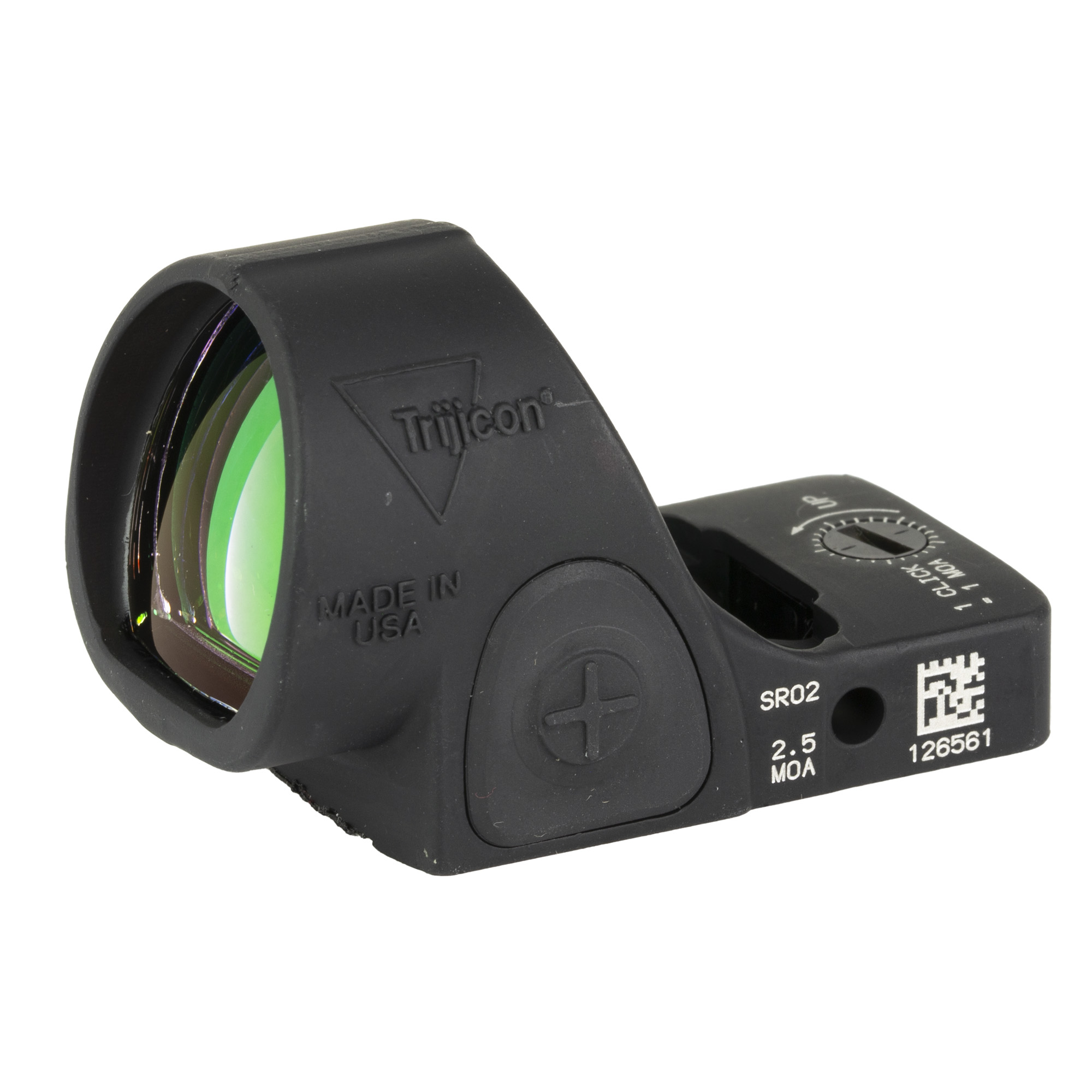
The SRO has a 0.98-by-0.89-inch viewing window with a rounded upper outline. The design gives the glass a prominent place in the optic’s profile. For a buyer who dislikes the feeling of looking through a small opening, that is a reason to consider the SRO independently of its other specifications.
Trijicon offers three fixed red-dot sizes: 1 MOA, 2.5 MOA, and 5 MOA. Each is its own model. There is no menu setting that changes a 2.5 MOA SRO into a 5 MOA version, and there is no selectable surrounding circle in these models. The appeal is a large window with a simple illuminated reference.
The SRO combines automatic brightness with eight adjustable settings, including two night-vision-compatible levels. Its Lock-In and Lock-Out functions address different preferences. Lock-In preserves a manually selected level; Lock-Out keeps automatic operation active while preventing accidental button changes. You can choose the control approach without changing optics.
A top-loading CR2032 compartment makes periodic battery replacement more convenient than accessing a battery underneath the sight. Trijicon specifies more than three years of continuous use at setting 4 of 8 and 70 degrees Fahrenheit. Actual replacement intervals still depend on brightness, temperature, and the battery itself.
The SRO uses an open emitter. Its electronics are protected from water, but the external light path remains exposed. Its window and controls are reasons to consider it; a sealed emitter is a different feature that this model does not offer.
Browse our Trijicon SRO collection when dot size is the remaining decision. The three choices share the SRO’s recognizable form rather than representing different window sizes.
RMR Type 2: A Compact, Distinctive Housing
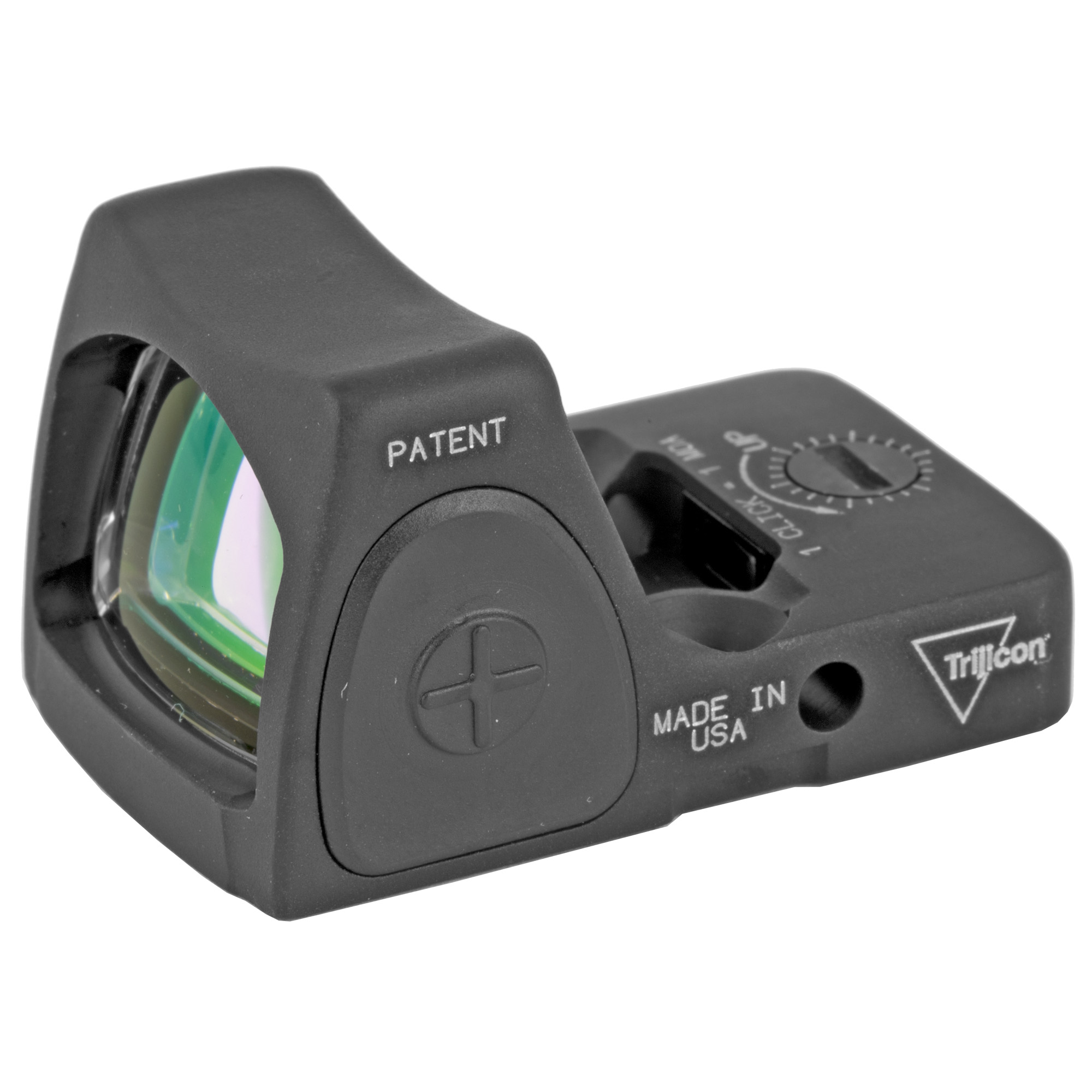
The RMR Type 2 has a visibly different shape. Its upper housing rises at either side of the lens, and the overall body is shorter than the SRO’s forward-projecting design. Trijicon describes that housing shape as a way to direct impact forces away from the lens. The protective housing is a key design difference, although neither optic is immune to damage.
The RM06-C-700672 used here has a 3.25 MOA red dot. It is an adjustable-LED model, with buttons for manual control as well as automatic brightness. Buyers who search for an RMR Type 2 should check that designation carefully: automatic-LED models and other reticle sizes are separate choices.
The adjustable Type 2 range also includes a 1 MOA model and a 6.5 MOA model. Those sizes do not align exactly with the SRO range. If you are comparing by dot size, a 3.25 MOA RMR and a 2.5 MOA SRO are nearby options, not identical reticles with different housings.
The main convenience tradeoff is the battery location. The CR2032 is beneath the Type 2, so reaching it requires removing the sight. Trijicon lists more than four years of continuous use for the red adjustable model at setting 4 of 8 and 70 degrees Fahrenheit. That long stated interval may make the maintenance arrangement acceptable to you, but it does not make bottom access equivalent to top access.
Trijicon lists a weight of 1.2 ounces for the Type 2 and about 1.6 ounces for the SRO. More important than that modest difference is the shape occupying the space above the mount. Check the RMR Type 2 collection for exact reticle and control configurations.
Trijicon SRO vs RMR Type 2 at a Glance
| Feature | SRO2-C-2500002 | RM06-C-700672 Type 2 |
|---|---|---|
| Compared dot | 2.5 MOA red | 3.25 MOA red |
| Design emphasis | Large, rounded viewing window | Compact profile and protective housing shape |
| Brightness | Automatic and manual | Automatic and manual |
| Battery | CR2032, top access | CR2032, bottom access |
| Published continuous runtime | Over 3 years at setting 4 of 8, 70 F | Over 4 years at setting 4 of 8, 70 F |
| Emitter | Open | Open |
| Footprint | RMR; body clearance still matters | RMR |
| Public item price, September 18, 2026 | $542.58 | $514.17 |
A Bigger Window Is a Preference, Not a Universal Upgrade
The SRO’s window is its clearest selling point. It is a strong reason to choose the optic if you value an open-looking view around the dot. The Type 2’s smaller outline is a similarly legitimate reason to choose the RMR. An optic can be less visually spacious while fitting your overall size preferences better.
Do not treat the same mounting pattern as proof of the same fit. The SRO projects forward of its mounting area. Trijicon warns against arrangements in which the optic overhangs the chamber or breech face, where clearance can become a problem. A plate that accepts an RMR is not, by itself, confirmation that the complete SRO body works in the same space.
Holster compatibility is also optic-specific. A listing that says it accommodates an RMR may not leave room for an SRO. Confirm the exact model with the holster manufacturer rather than assuming that a common screw pattern settles the issue.
Maintenance and Price: What the Difference Buys
The SRO’s battery arrangement is a practical benefit even if you do not expect to replace batteries often. Accessing the cell from above avoids taking the optic off its mounting surface just to reach it. The Type 2 balances that inconvenience with a longer published runtime under the conditions listed in the table.
Those runtime figures are not a substitute for a maintenance routine. A number measured at a moderate setting does not promise the same interval at the highest brightness or in extreme weather. It is more useful to decide whether the access method fits your expectations than to assume that either headline number eliminates upkeep.
Our September 18, 2026 public item prices were $542.58 for the 2.5 MOA SRO and $514.17 for the red RM06 Type 2, before shipping. The difference was $28.41. At that gap, the SRO is not a dramatically more expensive purchase, but the lower-priced Type 2 is not a lesser version of the same optic either. Current prices can change, and other dot sizes may differ.
If you were considering an RMR HD instead, start a separate comparison. Its top-loading battery, larger window, forward-facing light sensor, and circle/dot choices change the decision. Calling every RMR simply an RMR can hide the very feature differences that matter most.
Which One Should You Choose?
- Choose the SRO for the rounded, spacious window, a choice of three fixed dot sizes, and top battery access.
- Choose the adjustable RMR Type 2 for its compact body, distinctive protective housing, and straightforward single-dot configuration.
- Confirm fit before buying either, especially when reusing a plate or holster selected for a different optic.
Both choices make sense when the features match your priorities. Compare the exact SRO 2.5 MOA and RM06 Type 2 3.25 MOA, then consider the other dot sizes only if that preference changes your decision. There is no need to pay for a shape you do not prefer just because it is more prominent in a specification comparison.
Frequently Asked Questions
Yes, but the SRO’s larger, forward-projecting body requires its own clearance check. A shared mounting pattern does not guarantee compatibility with every plate, slide arrangement, or holster.
Yes. The SRO has a top-access CR2032 compartment. The RMR Type 2 battery is underneath the optic and requires removal to reach it.
Both types exist. The RM06 compared here is an adjustable-LED model with manual and automatic brightness. Check the exact model rather than assuming every Type 2 has side-button controls.
No. The SRO2 has a 2.5 MOA dot, while the RM06 has a 3.25 MOA dot. Both are single-dot reticles, but their specified sizes differ.
No. Both the SRO and the RMR Type 2 use open emitters. Weather-resistant electronics do not mean that the light path is enclosed.
No. The HD is a different design with top battery access, additional reticle options, a larger window, and different light-sensing features. This comparison specifically covers the adjustable RMR Type 2.
Manufacturer references: Trijicon SRO2 and RMR Type 2 RM06.