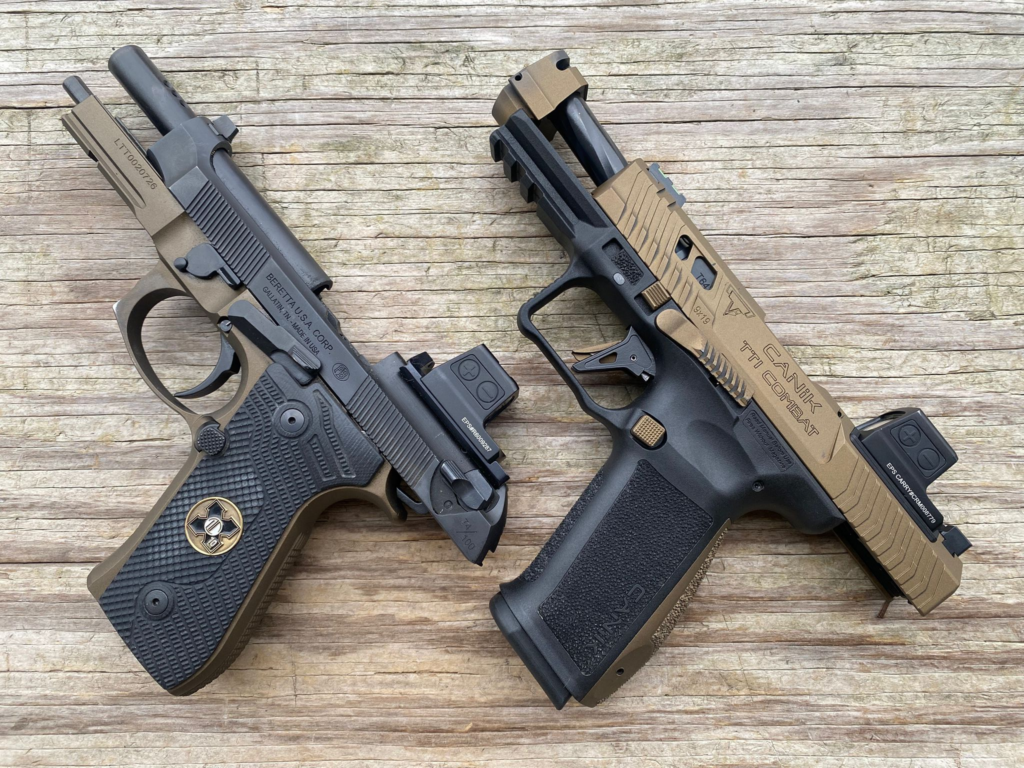
The Holosun EPS and EPS Carry are both enclosed emitter pistol optics, but they are built for different handgun setups. The EPS is the larger option with more window area, while the EPS Carry is the slimmer option built for concealed carry pistols.
If you are deciding between the Holosun EPS vs EPS Carry, the main question is simple: do you want a larger enclosed optic for a compact or full-size pistol, or a smaller enclosed optic for a slimline carry pistol?
TLDR: Holosun EPS vs EPS Carry
The main difference between the Holosun EPS and EPS Carry is size. The EPS has a larger window and wider housing, making it a better fit for compact and full-size handgun setups. The EPS Carry has a smaller window and slimmer housing, making it a better fit for concealed carry and micro-compact pistol setups.
- Choose the Holosun EPS if you want a larger enclosed pistol optic with more window area.
- Choose the Holosun EPS Carry if you want a smaller enclosed carry optic with less slide overhang.
Browse available models here: Holosun EPS Sights and Holosun EPS Carry Sights.
Quick Navigation
- EPS vs EPS Carry Models
- EPS vs EPS Carry Footprint
- Size and Window Difference
- Reticle Options
- Battery Life and Controls
- EPS vs EPS Carry Specs
- Similarities
- Differences
- Which One Should You Choose?
Holosun EPS vs EPS Carry Models
The EPS family includes full-size EPS models, EPS Core models, and EPS Carry models. The standard EPS gives shooters a larger enclosed optic body. The EPS Carry is the smaller carry-focused version. EPS Core models are a newer option that can combine a full-size EPS viewing lens with a more compact RMSc-style fitment, depending on the exact model.
Holosun EPS Options
- Holosun EPS Core 3 MOA Green Dot Sight, Enclosed RMSc Footprint
- Holosun EPS Core 3 MOA Gold Dot Sight, Enclosed RMSc Footprint
For more full-size EPS options, browse the full Holosun EPS Sights collection.
Holosun EPS Carry Options
- Holosun EPS Carry Green Dot Sight, 2 MOA Dot
- Holosun EPS Carry Green MRS Sight, 2 MOA Dot & 32 MOA Circle
- Holosun EPS Carry Gold Dot Sight, 2 MOA Dot
For more carry-size options, browse the full Holosun EPS Carry Sights collection.
Quick Answer: EPS vs EPS Carry
| Question | Holosun EPS | Holosun EPS Carry |
|---|---|---|
| Best fit | Compact and full-size pistol setups | Slimline and concealed carry pistol setups |
| Window size | Larger 0.90″ × 0.63″ window | Smaller 0.77″ × 0.58″ window |
| Body size | Wider full-size housing | Narrower carry-focused housing |
| Footprint | K footprint on standard EPS models | K footprint |
| Included adapter plate | RMR-to-K plate on standard EPS models | RMSc-to-K plate |
| Main reason to choose it | You want more window area | You want less width and less bulk |
Holosun EPS Overview
The Holosun EPS is the larger enclosed pistol optic. It gives you more window area than the EPS Carry, which can make the dot easier to track during recoil and give the sight a more full-size feel on the pistol.
Standard EPS models use a K footprint and include an RMR-to-K adapter plate. That makes the EPS a strong choice for larger handgun setups where the shooter wants an enclosed emitter optic with more viewing area.
EPS Core offers a different fit from the standard EPS: an RMSc mounting pattern with a full-size EPS viewing lens. Match that footprint and the supplied hardware to your pistol before ordering.
Holosun EPS Carry Overview
The Holosun EPS Carry is the smaller version built around concealed carry. It has a narrower body and smaller window than the EPS, which helps it fit better on slimline and micro-compact pistol slides.
The EPS Carry uses a K footprint and includes an RMSc-to-K adapter plate. That makes it a popular option for shooters who want an enclosed emitter optic without adding unnecessary width to a carry pistol.
EPS vs EPS Carry Footprint
The footprint can be confusing because standard EPS models and EPS Carry models are both based around the K footprint, but they are usually packaged with different adapter plates.
Standard EPS models include an RMR-to-K adapter plate. EPS Carry models include an RMSc-to-K adapter plate. EPS Core models can differ by exact model, with some direct-mounting to RMSc.
The safest rule is simple: match the optic to your slide cut, adapter plate, and included hardware. Do not assume that “EPS” and “EPS Carry” fit the same pistol the same way just because both are enclosed Holosun optics.
| Fitment detail | Holosun EPS | Holosun EPS Carry |
|---|---|---|
| Standard footprint | K footprint | K footprint |
| Typical included plate | RMR-to-K adapter plate | RMSc-to-K adapter plate |
| Slide type | Compact and full-size pistol setups | Slimline and micro-compact carry setups |
| Main fitment advantage | Larger optic with more window area | Narrower optic with less slide overhang |
Size and Window Difference
The EPS has the larger window. That makes it a strong choice if you want more glass and a more open sight picture.
The EPS Carry has the smaller body. That matters on concealed carry pistols because less width and less overhang can make the optic feel more natural on a slim slide.
| Spec | Holosun EPS | Holosun EPS Carry |
|---|---|---|
| Window size | 0.90″ × 0.63″ | 0.77″ × 0.58″ |
| Body dimensions | 1.63″ × 1.19″ × 0.99″ | 1.63″ × 1.07″ × 0.95″ |
| Weight | 1.4 oz | 1.23 oz |
| Best use | Compact/full-size pistols | Slimline carry pistols |
| Main size advantage | More window area | Less bulk on the slide |
Deck Height and Iron Sights
Both optics are designed with a low deck height compared to many older enclosed pistol optics. That helps keep the sight picture lower on the slide.
Co-witness still depends on the full setup. Slide cut depth, adapter plate thickness, and iron sight height all affect whether your irons are visible through the window. If co-witness matters to you, confirm the full pistol, plate, optic, and sight setup before ordering.
Reticle Options
Both EPS and EPS Carry models are available in different reticle configurations depending on the exact model. Dot-only versions keep the sight picture simple, while MRS versions give you more flexibility.
- 2 MOA dot: smaller aiming point for precision
- 3 MOA dot: balanced dot size on some EPS Core models
- 6 MOA dot: larger aiming point for faster pickup
- MRS: selectable dot, circle, or circle-dot reticle
For shooters who want the simplest carry setup, a dot-only model makes sense. For shooters who want the most flexibility, an MRS model is the better fit.
Battery Life and Controls
Both optics use a CR1620 battery with a side-loading battery tray. That means the battery can be replaced without removing the optic from the slide.
Both are rated up to 50,000 hours of battery life, depending on model, brightness setting, reticle choice, and use. Both also include Shake Awake, which helps conserve battery by powering the optic down when idle and waking it when motion is detected.
| Battery/control feature | EPS and EPS Carry |
|---|---|
| Battery | CR1620 |
| Battery location | Side tray |
| Battery life | Up to 50,000 hours |
| Brightness settings | 8 daylight / 4 night vision |
| Shake Awake | Yes |
| Removable battery | Yes |
Holosun EPS vs EPS Carry Specs
| Spec | Holosun EPS | Holosun EPS Carry |
|---|---|---|
| Optic type | Enclosed emitter pistol optic | Enclosed emitter pistol optic |
| Footprint | K footprint on standard EPS models | K footprint |
| Included adapter plate | RMR-to-K adapter plate on standard EPS models | RMSc-to-K adapter plate |
| Window size | 0.90″ × 0.63″ | 0.77″ × 0.58″ |
| Body dimensions | 1.63″ × 1.19″ × 0.99″ | 1.63″ × 1.07″ × 0.95″ |
| Weight | 1.4 oz | 1.23 oz |
| Battery | CR1620 | CR1620 |
| Battery location | Side tray | Side tray |
| Battery life | Up to 50,000 hours | Up to 50,000 hours |
| Brightness settings | 8 daylight / 4 night vision | 8 daylight / 4 night vision |
| Adjustment | 1.5 MOA per click | 1.5 MOA per click |
| Windage/elevation travel | ±30 MOA | ±30 MOA |
| Water resistance | IPX8 | IPX8 |
| Vibration rating | 5000G | 5000G |
Holosun EPS and EPS Carry Similarities
The EPS and EPS Carry share many of the same core benefits. Both are enclosed emitter pistol optics, both use side-loading CR1620 batteries, and both are built for shooters who want better emitter protection than a traditional open-emitter pistol dot.
- Both are enclosed emitter pistol optics
- Both use CR1620 batteries
- Both use side-loading battery trays
- Both are rated up to 50,000 hours of battery life
- Both include Shake Awake
- Both offer 8 daylight and 4 night vision brightness settings
- Both have 1.5 MOA click adjustments
- Both have ±30 MOA windage/elevation travel
- Both are IPX8 rated
- Both have 5000G vibration resistance
Holosun EPS and EPS Carry Differences
The biggest differences are size, window area, width, included adapter plate, and intended pistol fit.
| Difference | Holosun EPS | Holosun EPS Carry |
|---|---|---|
| Window | Larger | Smaller |
| Width | Wider | Narrower |
| Weight | 1.4 oz | 1.23 oz |
| Adapter plate | RMR-to-K plate on standard EPS models | RMSc-to-K plate |
| Best role | Compact/full-size pistol setups | Slimline concealed carry setups |
Red, Green, and Gold Reticle Options
The EPS family includes red, green, and gold reticle variants depending on the model. Red is the traditional choice and works well for most shooters. A green dot variant can appear brighter or easier to pick up for some eyes. Gold gives shooters another contrast option if red or green does not stand out the way they want.
If you have astigmatism, reticle color is personal. Some shooters see less starburst or distortion with green or gold, while others prefer red. Dot size, brightness setting, reticle shape, and your individual eyesight can all change how the reticle appears.
Why Choose an Enclosed Emitter Optic?
Both the EPS and EPS Carry use enclosed emitter designs. That means the emitter is protected inside the optic housing instead of being exposed like a traditional open-emitter pistol dot.
For carry and duty use, that can be a major advantage. Lint, dust, rain, and debris are less likely to block the emitter and interfere with the reticle. That is why enclosed pistol optics have become so popular for everyday carry.
To compare more options, browse Holosun Enclosed Emitter Red Dots.
Is the Holosun EPS or EPS Carry Better?
Neither optic is automatically better. The better choice depends on your pistol size, slide width, optic cut, and how much window area you want.
The Holosun EPS is better if you want the larger window and more full-size feel. It makes sense on compact and full-size handgun setups where a wider optic is not a problem.
The Holosun EPS Carry is better if you want a smaller optic for concealed carry. It makes sense on slimmer pistol setups where width, overhang, and bulk matter more.
Final Verdict: Holosun EPS vs EPS Carry
Choose the Holosun EPS if you want a larger enclosed optic with more window area for a compact or full-size pistol.
Choose the Holosun EPS Carry if you want a smaller enclosed optic for a slimline carry pistol with less bulk and less slide overhang.
Both are strong enclosed emitter optics. The right answer comes down to slide size, optic cut, adapter plate, and whether you want the bigger EPS or the smaller EPS Carry.
For more handgun optic options, browse our full Holosun Pistol Red Dots collection.
FAQ: Holosun EPS vs EPS Carry
What is the main difference between the Holosun EPS and EPS Carry?
The main difference is size. The EPS has a larger window and wider housing, while the EPS Carry has a smaller window and narrower housing for concealed carry pistols.
Do the EPS and EPS Carry use the same footprint?
Standard EPS and EPS Carry models are both based around the K footprint, but the included adapter plates are different. Standard EPS models include an RMR-to-K adapter plate, while EPS Carry models include an RMSc-to-K adapter plate.
What is the Holosun EPS footprint?
Standard EPS models use the Holosun K footprint and include an RMR-to-K adapter. EPS Core uses a different RMSc mounting pattern, so confirm which version fits your pistol.
What is the Holosun EPS Carry footprint?
The EPS Carry uses a K footprint and includes an RMSc-to-K adapter plate.
Which one is better for concealed carry?
The EPS Carry is usually the better concealed carry option because it is narrower, lighter, and designed for slimmer pistol slides.
Which one has the larger window?
The Holosun EPS has the larger window at 0.90″ × 0.63″. The EPS Carry has a smaller 0.77″ × 0.58″ window.
Are both optics enclosed emitter designs?
Yes. Both the EPS and EPS Carry use enclosed emitter designs to help protect the emitter from lint, rain, dirt, and debris.
Which one should I buy?
Buy the EPS if you want a larger enclosed pistol optic with more window area. Buy the EPS Carry if you want a smaller enclosed pistol optic for a slimline carry setup.