
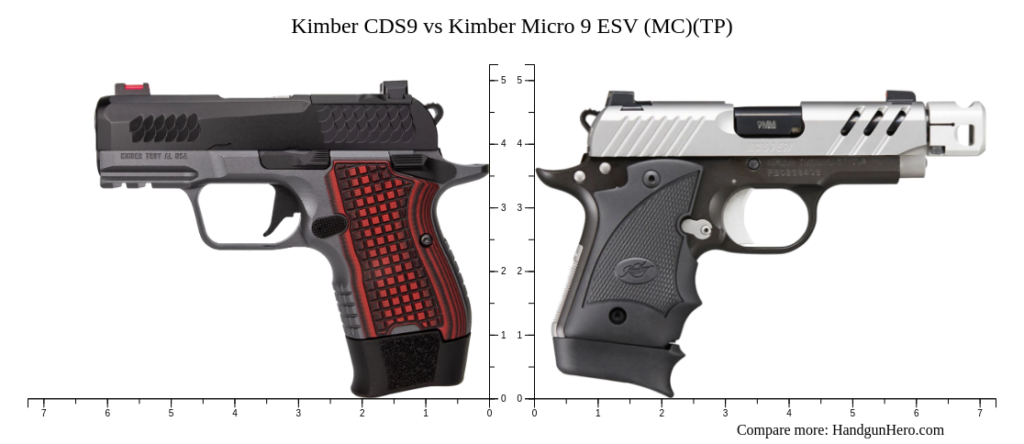
Kimber has more than one answer for buyers looking for a compact 9mm carry pistol. Two of the biggest names in that conversation are the Kimber CDS9 and the Kimber Micro 9.
At first glance, they may look like they belong in the same general category. Both are compact Kimber 9mm pistols. Both are built around concealed carry. Both carry some 1911 influence in the way Kimber approaches controls, trigger feel, and overall styling.
But they are not the same pistol.
The Kimber Micro 9 is the smaller, more traditional 1911-inspired carry gun. It is built for buyers who want a compact metal-frame 9mm with familiar controls, a single-action trigger, and a slim carry profile. Kimber describes the Micro 9 as a micro 1911-style platform with a single-action trigger and 1911-style thumb safety, slide release, and magazine release.
The Kimber CDS9 is the newer, more modern double-stack option. CDS9 stands for Covert Double Stack 9mm, and Kimber positions it as a modern everyday concealed carry pistol with more capacity and updated defensive features.
That difference matters.
The Micro 9 is about slimness, simplicity, style, and traditional Kimber carry feel. The CDS9 is about capacity, modern features, optics support, and a more current compact defensive pistol layout.
You can browse the two collections here:
Shop Kimber CDS9 Pistols
Shop Kimber Micro 9 Pistols
If you are still comparing both against Kimber’s broader 1911 lineup, you can also browse here:
Quick Answer: Kimber CDS9 vs Micro 9
The Kimber Micro 9 is the better fit if you want the smaller, slimmer, more traditional Kimber carry pistol. It is compact, easy to conceal, and built around a 1911-inspired control layout. It makes the most sense for buyers who value size and simplicity over maximum capacity.
The Kimber CDS9 is the better fit if you want a newer compact 9mm with double-stack capacity, optic-ready options, rail-equipped variants, and a more modern defensive pistol feature set. It makes the most sense for buyers who like Kimber styling but want more capacity and utility than the Micro 9.
That is the entire comparison in one sentence:
Micro 9 for slim traditional carry. CDS9 for modern double-stack carry.
But there is a lot more to it than that.
What Is the Kimber Micro 9?
The Kimber Micro 9 is a compact 9mm pistol built around the idea of giving shooters a small carry handgun with familiar Kimber and 1911-inspired handling.
It is not a full-size 1911. It is not trying to be. The Micro 9 is much smaller, lighter, and more concealment-focused. But it borrows enough from the 1911 world that it feels different from most polymer-framed micro-compact pistols.
Kimber describes the Micro 9 as having several 1911-style advantages, including a single-action trigger with a short, smooth pull, plus a thumb safety, slide release, and magazine release that follow the 1911 pattern.
That is the Micro 9’s identity.
It is for the buyer who wants a compact 9mm handgun, but still wants the kind of control layout and metal-frame feel that Kimber shoppers tend to appreciate.
The Micro 9 lineup also has a lot of personality. Kimber offers many versions, including Stainless, Raptor, Rapide, Rose Gold, Bel Air, Sapphire, Amethyst, RTC bundles, and other special editions. Kimber’s Micro 9 category includes groups like Micro 9 Stainless, Micro 9 Raptor, Micro 9 Rapide, Micro 9 RTC, Micro 9 Liberty, and special-edition variants.
That variety is a big part of why the Micro 9 has stayed popular. It is not just one small pistol. It is a family of compact Kimber carry guns with different finishes, grips, sight setups, and visual styles.
Browse the full collection here:
Kimber Micro 9 Pistols
What Is the Kimber CDS9?
The Kimber CDS9 is Kimber’s newer compact double-stack 9mm pistol.
The name stands for Covert Double Stack 9mm, and that tells you the role Kimber had in mind. This pistol is built for concealed carry, but unlike the Micro 9, it is not centered around the smallest possible single-stack format.
Instead, the CDS9 is built around more capacity and more modern features.
Kimber’s CDS9 category describes it as a modern everyday concealed carry pistol for the 1911 handgun owner. Kimber also says the CDS9 takes elements from the Micro 1911 and KDS9c double-stack 9mm platforms and rebuilds them into a more modern design with increased capacity and improved ergonomics.
That makes the CDS9 a bridge between Kimber’s smaller Micro pistols and its larger double-stack 9mm handguns.
It is still compact. It is still carry-focused. But it gives buyers more modern utility than the Micro 9, especially when you start looking at optic-ready, rail-equipped, and threaded-barrel variants.
The CDS9 Classic model gives a good sense of the size. Kimber lists the CDS9 Classic at 6.2 inches long, 1.1 inches wide, and 21.44 ounces with an empty magazine. That is still compact, but it is not the same kind of tiny pocket-style footprint people associate with the Micro 9.
Browse the full collection here:
Kimber CDS9 Pistols
The Biggest Difference: Size vs Capacity
The biggest difference between the Kimber CDS9 and Micro 9 is the tradeoff between size and capacity.
The Micro 9 is smaller and slimmer. That is its strength. It is built for buyers who want a compact pistol that is easy to conceal, easy to carry, and familiar to anyone who likes 1911-style controls.
The CDS9 is still compact, but it is built around a double-stack magazine design. That means it gives you more capacity, but it also changes the feel, grip size, and overall carry profile.
Kimber lists CDS9 variants with different magazine heights depending on the magazine used, including 10-round, 13-round, and 15-round magazine configurations on the CDS9 OR/RL model. Kimber also describes a stainless CDS9 OR/RL model as having 15+1 capacity, optic capability, and light capability.
That is the clear dividing line.
The Micro 9 is easier to hide.
The CDS9 gives you more rounds and more modern utility.
Neither answer is automatically better. It depends on what you care about more.
Why Choose the Kimber Micro 9?
The Micro 9 makes the most sense for buyers who want a smaller Kimber carry pistol and do not need the extra size or capacity of a double-stack design.
There are a few reasons this pistol remains appealing.
First, the Micro 9 has a familiar control layout. For Kimber 1911 owners, the thumb safety, slide release, and magazine release feel more natural than the controls on many striker-fired compact pistols.
Second, the single-action trigger gives the pistol a distinct feel. Kimber specifically highlights the Micro 9’s short, smooth single-action trigger pull as one of the design advantages of the platform.
Third, the Micro 9 is available in a lot of different styles. Some buyers want a clean stainless model. Others want something more visually distinct like a Rapide, Raptor, Rose Gold, Bel Air, Sapphire, or Amethyst version. Kimber’s Micro 9 special-edition category includes several of those more appearance-driven models.
Fourth, the Micro 9 is easy to understand. It is a small 9mm Kimber carry pistol with 1911-inspired controls. For a lot of buyers, that is the entire appeal.
It is not the highest-capacity option. It is not the most modern optic-ready option. It is not trying to replace the CDS9. It is a slim, stylish, compact Kimber pistol for people who care about concealability and handling.
Why Choose the Kimber CDS9?
The CDS9 makes the most sense for buyers who like Kimber’s design direction but want something newer, higher-capacity, and more feature-rich than the Micro 9.
The double-stack magazine is the first reason. More capacity matters to many buyers, especially for defensive carry, training, and anyone who simply does not want to be limited to a smaller single-stack setup.
The second reason is modern configuration support. CDS9 variants include optic-ready models, rail-equipped models, and threaded-barrel options depending on the exact listing. Kimber’s CDS9 OR/RL/TFS page lists a threaded barrel with 1/2×28 thread pitch, and the OR/RL naming points toward optic-ready and rail-equipped configurations.
The third reason is ergonomics. Kimber says the CDS9 was rebuilt from the frame up with a modern design, more capacity, and better ergonomics. That matters because the CDS9 is not just a stretched Micro 9. It is its own pistol family.
The fourth reason is where it sits in Kimber’s lineup. The CDS9 gives you something more capable than a Micro 9 without jumping all the way into larger double-stack Kimber pistols like the KDS9c or 2K11.
That middle-ground role is important.
If the Micro 9 feels too small or too limited, but the 2K11 family feels too large, the CDS9 is the Kimber pistol that fills the gap.
Carry Comfort: Which One Is Easier to Conceal?
For pure concealment, the Micro 9 has the advantage.
A smaller pistol is usually easier to conceal, easier to carry for long periods, and easier to fit into different clothing setups. The Micro 9 was built around that role from the beginning.
The CDS9 is still a compact concealed-carry pistol, but the double-stack design changes the math. More capacity means more grip. More grip can mean more printing, more weight, and more overall bulk.
That does not make the CDS9 hard to carry. It just means it is not the same type of carry pistol as the Micro 9.
The Micro 9 is the better choice if your biggest priority is keeping the gun small and simple.
The CDS9 is the better choice if you are willing to carry a little more pistol in exchange for more rounds and more modern features.
This is one of those areas where the “best” option depends on the person. A buyer who carries every day in light clothing may lean Micro 9. A buyer who wants more capacity and uses a good belt/holster setup may lean CDS9.
Capacity: The CDS9 Has the Advantage
Capacity is where the CDS9 clearly pulls ahead.
The Micro 9 is small and slim, but that comes with a capacity tradeoff. Kimber’s broader Micro platform page says each Micro includes an extended 7-round magazine. That is very different from what you get with the CDS9 family.
The CDS9 is built around a double-stack design. Kimber lists CDS9 configurations with 10-, 13-, and 15-round magazine heights depending on the model and magazine used. Some retailer listings for CDS9 Classic packages also show one 13-round magazine and two 15-round magazines included, which reflects the larger capacity role of the platform.
That does not mean the CDS9 is automatically the right answer for everyone. Some buyers are comfortable with the Micro 9’s smaller package and lower capacity. Others want as much capacity as they can reasonably carry.
If capacity is high on your list, the CDS9 is the more obvious choice.
Trigger and Controls: Both Keep the Kimber Feel
One reason this comparison is interesting is that both pistols are trying to preserve some Kimber identity.
The Micro 9 does that through its 1911-inspired controls and single-action trigger. Kimber specifically highlights the Micro 9’s thumb safety, slide release, and magazine release as being pure 1911 in design influence.
The CDS9 does it in a more modern way. Kimber describes the CDS9 Stainless OR/RL as having 1911 trigger characteristics along with 15+1 capacity, optics capability, and light capability.
So this is not a comparison between a classic-feeling Kimber and a totally unrelated modern pistol. Both are Kimber carry guns. Both are meant to appeal to people who like Kimber’s approach.
The difference is how far each one goes toward modern utility.
The Micro 9 feels closer to the traditional compact 1911-inspired side.
The CDS9 feels closer to the modern double-stack defensive pistol side.
Optics and Accessory Support
If you want optic support, the CDS9 is the cleaner place to start.
The CDS9 lineup includes optic-ready variants, and the OR designation is part of Kimber’s model naming. Kimber’s CDS9 Classic OR page lists the pistol as part of the optic-ready side of the CDS9 lineup. The CDS9 OR/RL and OR/RL/TFS models also bring rail and threaded-barrel options into the family.
That matters because a lot of modern carry buyers now want the ability to run a red dot and a compact weapon light. The CDS9 is built much more directly around that expectation.
The Micro 9 is more traditional. Some models may have upgraded sights or carry-focused features, but the Micro 9 lineup is not as clearly centered around optics and accessory rails as the CDS9 family.
If you want a small Kimber with traditional sights and classic carry styling, the Micro 9 is fine.
If you want optics, rails, and a more modern defensive setup, the CDS9 is the stronger choice.
Shooting Feel: Small and Snappy vs Bigger and More Controlled
The Micro 9 is smaller, and smaller 9mm pistols usually require more attention from the shooter. That does not mean they are unpleasant or hard to shoot, but compact size always comes with tradeoffs.
A smaller pistol gives you less grip area, less mass, and a shorter sight radius. That can make it easier to carry but harder to shoot as well as a larger pistol.
The CDS9 is larger and higher-capacity. That extra size can help with control, especially for buyers who want more hand contact on the grip. It should feel more substantial than the Micro 9, especially when using larger magazines.
This is the carry pistol tradeoff in its purest form.
Small guns carry better.
Larger compact guns usually shoot better.
The Micro 9 wins on concealability.
The CDS9 likely wins for control, capacity, and feature support.
Micro 9 Model Variety
One of the Micro 9’s biggest advantages is how many versions Kimber has made.
If you care about appearance, finish, and style, the Micro 9 lineup gives you a lot to look at. Kimber lists Micro 9 families like Stainless, Raptor, Special Editions, Rapide, RTC, and Liberty.
That gives shoppers several different directions.
A Stainless model keeps things clean and classic.
A Raptor model leans into Kimber’s more distinctive textured styling.
A Rapide model has a more aggressive performance-inspired look.
Special editions like Rose Gold, Sapphire, Bel Air, and Amethyst are for buyers who want something more visually unique.
RTC bundles may appeal to buyers who want a package-style listing with carry-oriented accessories, depending on the exact product.
The Micro 9 lineup has a lot of personality. That matters because many Kimber buyers are not just shopping specs. They also care about finish, styling, and how the pistol feels as an object.
Browse them here:
Kimber Micro 9 Pistols
CDS9 Model Variety
The CDS9 lineup is not as visually wide as the Micro 9 lineup, but it is more configuration-driven.
Instead of choosing between a large number of special finishes, buyers are usually comparing feature sets.
The main things to look for are:
Optic-ready models
Rail-equipped models
Threaded-barrel models
Classic versions
Stainless variants
Magazine capacity differences
Sight and grip differences
The CDS9 OR/RL model is a good example. The name points toward optic-ready and rail-equipped features, and Kimber lists different heights depending on whether the pistol is using 10-, 13-, or 15-round magazines.
The CDS9 OR/RL/TFS adds the threaded-barrel angle, with Kimber listing a 1/2×28 threaded barrel on that variant.
That makes the CDS9 more of a features-first collection. Buyers are less likely to be choosing based only on finish and more likely to be choosing based on optic support, rail support, threaded barrel, and capacity.
Browse them here:
Kimber CDS9 Pistols
Kimber CDS9 vs Micro 9 for Everyday Carry
For everyday carry, both pistols can make sense, but they appeal to different habits.
The Micro 9 is for the buyer who wants the gun to disappear. It is smaller, slimmer, and simpler. It is the kind of pistol that makes sense when concealability is the first priority.
The CDS9 is for the buyer who is willing to carry a little more gun to get more capability. More capacity, optics support, rail support, and a larger grip can all be real advantages if you are comfortable with the added size.
Think about how you actually carry.
If you carry in lighter clothing, prefer a smaller footprint, or want a slimmer pistol, the Micro 9 has the edge.
If you carry with a strong belt and holster setup and want more rounds on board, the CDS9 starts to make more sense.
Neither pistol can make the decision for you. The right answer depends on what you are willing to carry every day, not just what looks better on paper.
Kimber CDS9 vs Micro 9 for Range Use
For range use, the CDS9 has the advantage for most shooters.
The larger grip, higher capacity, and more modern setup make it better suited for longer practice sessions. You can shoot more between reloads, and the larger frame gives most people more to hold onto.
The Micro 9 can still be a good range pistol, but it is primarily a carry gun. Smaller pistols are usually less forgiving, especially for newer shooters. They require more attention to grip, trigger control, and recoil management.
That does not make the Micro 9 bad. It just means expectations matter.
If you want a compact pistol that you will mostly carry and occasionally practice with, the Micro 9 fits.
If you want a compact Kimber that you will carry and train with more heavily, the CDS9 is probably the better fit.
Kimber CDS9 vs Micro 9 for New Shooters
For new shooters, this comparison is not as simple as “smaller is better.”
A smaller pistol may be easier to carry, but it is not always easier to shoot. The Micro 9’s small size can be attractive, but the shorter grip and lighter overall package may make it more demanding.
The CDS9 is larger, which may help new shooters get a better grip. More capacity also means fewer reloads during practice, which can make range sessions smoother.
That said, the CDS9 also has more features to understand depending on the model. Optics, rails, threaded barrels, and magazine options can add complexity.
For a newer shooter who wants a simple Kimber carry pistol, the Micro 9 may feel less intimidating.
For a newer shooter who is serious about training and wants more capacity, the CDS9 may be the stronger long-term choice.
Kimber CDS9 vs Micro 9 for 1911 Owners
If you already own or like 1911 pistols, both options make sense for different reasons.
The Micro 9 will probably feel more familiar from a traditional control standpoint. Kimber emphasizes the 1911-style thumb safety, slide release, magazine release, and single-action trigger as core parts of the Micro 9 design.
The CDS9 will feel like Kimber’s newer answer to the question: “What if I want a compact 9mm with Kimber character, but more capacity and modern carry features?”
That is why the CDS9 is so interesting. It is not trying to be a tiny classic 1911. It is trying to modernize the compact Kimber carry pistol.
For the traditionalist, Micro 9.
For the modernized carry buyer, CDS9.
Kimber CDS9 vs Micro 9 for Capacity-Focused Buyers
If capacity is one of your top priorities, choose the CDS9.
This is the easiest category in the comparison.
The Micro 9 is compact and slim, but that comes with a lower-capacity format.
The CDS9 is built around double-stack capacity. Kimber lists CDS9 configurations with magazine heights tied to 10-, 13-, and 15-round magazines, depending on the variant.
This does not mean everyone needs the CDS9. It simply means that buyers who already know they want more rounds on board should not spend too much time trying to make the Micro 9 into something it is not.
The Micro 9 is the smaller pistol.
The CDS9 is the capacity pistol.
Kimber CDS9 vs Micro 9 for Style
Style is subjective, but Kimber buyers often care about it.
The Micro 9 has the advantage if you want the widest range of looks. Kimber has offered many Micro 9 variants with different finishes, grips, and special-edition treatments. The Special Editions category includes models such as Bel Air, Sapphire, Rose Gold, Amethyst, and Aurora.
The CDS9 has a more modern, functional style. It looks and feels more like a serious compact defensive pistol with Kimber influence.
That may appeal more to buyers who care less about dressy finishes and more about optic cuts, rails, capacity, and practical carry features.
So if you want personality, the Micro 9 gives you more visual variety.
If you want utility, the CDS9 is the stronger direction.
The Role of the Kimber KDS9c
It is worth mentioning the KDS9c because some buyers comparing the CDS9 and Micro 9 may also run into that model.
The KDS9c is another Kimber double-stack 9mm carry pistol, but it sits above the CDS9 in the lineup. It is more premium, more substantial, and more closely tied to Kimber’s higher-end double-stack 1911-style direction.
The CDS9 is more compact and covert by concept.
The Micro 9 is smaller and more traditional.
The KDS9c is another step up in size and refinement.
If the CDS9 seems close but you want a more premium compact Kimber double-stack, the KDS9c may also be worth comparing. But for this article, the simpler split remains CDS9 vs Micro 9: modern capacity vs slim traditional carry.
Which One Should You Buy?
Buy the Kimber Micro 9 if you want the smaller, slimmer, more traditional Kimber carry pistol.
It is the better fit if you care about:
Concealability
Slim profile
1911-inspired controls
Single-action trigger feel
Style and finish variety
A compact 9mm Kimber with a simpler role
Buy the Kimber CDS9 if you want a more modern compact 9mm with higher capacity and more features.
It is the better fit if you care about:
Double-stack capacity
Optic-ready options
Rail-equipped models
Threaded-barrel variants
A larger grip
A more modern defensive carry setup
If you still are not sure, start with the role.
For the smallest Kimber 9mm carry option in this comparison, go Micro 9.
For the more capable compact Kimber 9mm, go CDS9.
Final Recommendation
The Kimber Micro 9 and Kimber CDS9 are both compact Kimber 9mm pistols, but they are built around different priorities.
The Micro 9 is the classic compact carry choice. It is slim, familiar, stylish, and easy to understand. It is the better option if you want a smaller Kimber with 1911-inspired handling.
The CDS9 is the modern compact carry choice. It offers more capacity, more feature support, and a more current defensive pistol layout. It is the better option if you want a Kimber carry gun that feels more in line with today’s optic-ready, double-stack market.
For most buyers, the decision comes down to this:
If you want the gun to carry smaller, choose the Micro 9.
If you want the gun to do more, choose the CDS9.
Browse both collections here:
Kimber Micro 9 Pistols
Kimber CDS9 Pistols
FAQ
What is the difference between the Kimber CDS9 and Micro 9?
The Kimber Micro 9 is a smaller, slimmer 9mm carry pistol with 1911-inspired controls. The CDS9 is a newer compact double-stack 9mm with more capacity and more modern feature options, including optic-ready and rail-equipped variants.
What does Kimber CDS9 stand for?
CDS9 stands for Covert Double Stack 9mm. Kimber uses that name for its compact double-stack 9mm carry pistol family.
Is the Kimber Micro 9 a 1911?
The Micro 9 is not a full-size 1911, but Kimber describes it as a micro 1911-style platform in many respects. It uses 1911-inspired controls, including a thumb safety, slide release, and magazine release.
Is the Kimber CDS9 better than the Micro 9?
Not automatically. The CDS9 is better if you want more capacity, optic support, rail options, and a more modern compact carry setup. The Micro 9 is better if you want a smaller, slimmer, more traditional Kimber carry pistol.
Which is better for concealed carry, the CDS9 or Micro 9?
The Micro 9 is easier to conceal because it is smaller and slimmer. The CDS9 gives you more capacity and more modern features, but with a larger carry profile.
Does the Kimber CDS9 have more capacity than the Micro 9?
Yes. The CDS9 is a double-stack 9mm design, while the Micro 9 is a smaller single-stack style carry pistol. Kimber lists CDS9 configurations with 10-, 13-, and 15-round magazine heights depending on magazine setup.
Is the Kimber CDS9 optic-ready?
Some CDS9 models are optic-ready. Look for OR in the model name, and always check the individual product listing for the exact optic setup.
Is the Kimber Micro 9 optic-ready?
The Micro 9 lineup is more traditional and not as centered around optic-ready configurations as the CDS9 family. Check each individual listing for sight and optic details.
Should I buy the Kimber CDS9 or Micro 9 for range use?
For range use, the CDS9 will usually be easier to shoot for longer sessions because it has more grip, more capacity, and more modern features. The Micro 9 is still useful for practice, but it is more specialized around compact carry.