
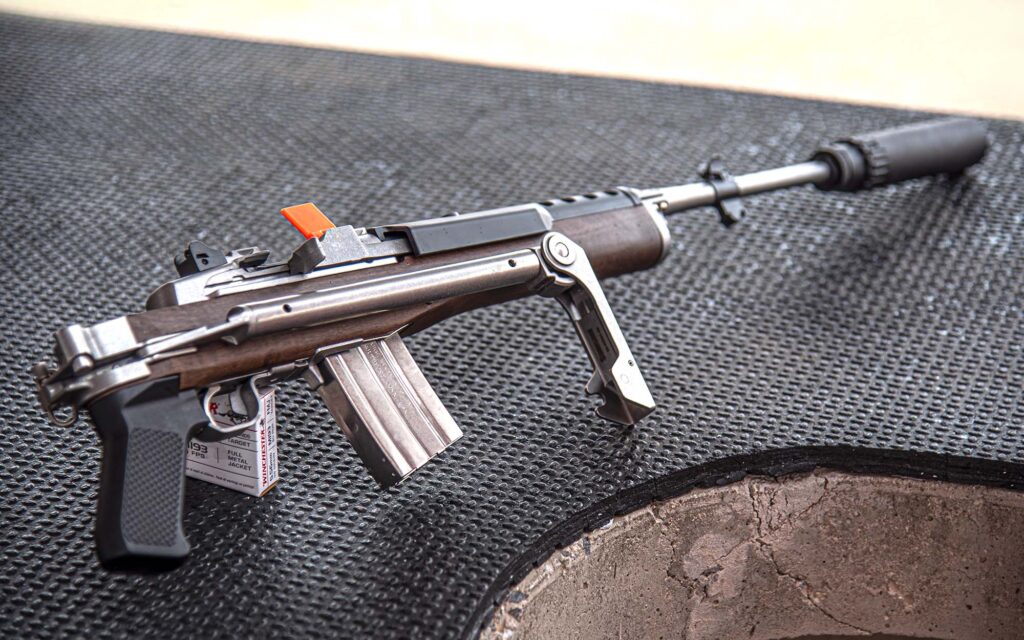
The Ruger Mini-14 is one of the most recognizable semi-automatic rifles Ruger has ever made. It has been a ranch rifle, a patrol rifle, a TV gun, a hunting rifle, a ban-era survivor, an AR alternative, and a rifle that has somehow stayed relevant through decades of changing firearms trends.
That is why the Mini-14 is interesting. It is not just another semi-auto 5.56 rifle. It has its own personality.
Where the AR-15 is modular, angular, and endlessly customizable, the Mini-14 feels more traditional. It has wood-stock roots, Garand-style operating DNA, a rock-and-lock magazine system, and a profile that looks more like a ranch gun than a modern sporting rifle. For some shooters, that is exactly the appeal.
In this guide, we are going to look at the history of the Ruger Mini-14, how the rifle evolved, and how to compare the major Mini-14 variants available today, including Ranch, Tactical, stainless, hardwood, synthetic, 5.56 NATO, .223 Remington, and .300 Blackout models.
You can also browse our full Ruger Mini-14 Rifles collection at Deerford Defense to compare current inventory.
Quick Ruger Mini-14 Variant Comparison
| Mini-14 Variant | Best For | General Personality |
|---|---|---|
| Mini-14 Ranch Rifle | General use, hunting, property rifles, classic Mini-14 ownership | Traditional, practical, optic-friendly |
| Mini-14 Tactical | Shorter handling, threaded barrel, defensive/range setup | More modern and utility-focused |
| Mini-14 Stainless | Weather resistance, field use, long-term durability | Rugged and outdoors-minded |
| Mini-14 Hardwood | Classic look, ranch rifle feel, traditional shooters | Old-school Mini-14 personality |
| Mini-14 Synthetic Stock | Lower maintenance, wet weather, field carry | Practical and durable |
| Mini-14 .300 Blackout | Suppressor-minded use, heavier bullets, short-range utility | More specialized than 5.56 |
| Mini-14 5-Round Models | Hunting, compliant setups, lower-capacity preference | Practical and simple |
| Mini-14 20-Round Models | Range use, defensive setup, higher-capacity configuration where legal | More classic semi-auto utility |
The Short Version: What Is the Ruger Mini-14?
The Mini-14 is a semi-automatic centerfire rifle with a traditional rifle profile and a Garand-style operating system. Current Ranch Rifle models are most commonly chambered in 5.56 NATO, while Tactical and older/distributor inventory can include .300 Blackout or older .223 Remington configurations.
The name “Mini-14” comes from its relationship to the M14 rifle. It is not literally just a shrunken M14, but the inspiration is obvious. Ruger wanted a smaller, lighter, commercially practical semi-auto rifle built around the .223 Remington / 5.56-size cartridge class.
That is the whole pitch: M14 attitude, smaller cartridge, Ruger manufacturing, and a more traditional sporting rifle feel.
The Mini-14’s Origins: Bill Ruger, Jim Sullivan, and the M14 Influence
The Mini-14 story starts in the late 1960s. Bill Ruger wanted a semi-automatic rifle that could bring some of the M14’s look and handling into a smaller commercial package. To help make that happen, Ruger worked with L. James “Jim” Sullivan, one of the important names in modern rifle design.
Sullivan was already famous in firearms design circles because of his work scaling Eugene Stoner’s AR-10 concept down into what became the AR-15. In other words, the Mini-14 was not drawn up by someone guessing at how to shrink a rifle concept. It involved a designer who already understood the engineering problems that come with making a rifle smaller, lighter, and commercially realistic.
Development work began in the late 1960s, and the Mini-14 arrived in the early 1970s. It was chambered around .223 Remington at a time when that cartridge was becoming increasingly important in American rifle culture.
The rifle’s basic idea was clever. Instead of competing directly with the AR-15 on the AR’s own terms, Ruger built something that felt more familiar to traditional rifle owners. It had a conventional stock, a simple safety location, exposed operating rod movement, iron sights, detachable magazines, and an action system inspired by the Garand/M14 family.
That made the Mini-14 feel less like a military-style black rifle and more like a practical ranch, farm, and utility gun.
Why the Mini-14 Was Different From the AR-15
The Mini-14 and AR-15 are often compared because both are semi-automatic rifles commonly chambered in the 5.56/.223 family. But they are very different rifles.
The AR-15 uses an inline layout, direct-impingement or piston variations depending on model, AR-pattern magazines, a buffer tube system, and a highly modular receiver/handguard/stock ecosystem.
The Mini-14 uses a more traditional stock shape, a Garand-style action, a fixed-piston gas system, Mini-14-pattern magazines, and a receiver/operating system that feels more like a classic service rifle than a modern modular platform.
The AR-15 eventually became the dominant American semi-auto rifle platform because of modularity, parts availability, accuracy potential, military familiarity, and massive aftermarket support.
The Mini-14 survived because it offered something different. It was handy, rugged, easy to understand, and traditional enough to appeal to shooters who never really wanted an AR.
The Original Mini-14: A Ranch Gun Before the Ranch Rifle Name Took Over
Early Mini-14 rifles were simple, wood-stocked, semi-automatic rifles. They had a traditional look and were aimed at practical users: ranchers, farmers, hunters, recreational shooters, and law enforcement buyers who wanted a compact centerfire semi-auto rifle.
Before “Ranch Rifle” became the dominant Mini-14 identity, the standard rifle already carried that spirit. It was not a benchrest gun. It was not a precision rifle. It was a practical carbine-style rifle meant to be used.
Older models have their own collector interest today, but the important part of the story is this: the Mini-14 became popular because it fit a real-world role before the modern AR-15 market exploded.
It was a rifle you could keep around the property, take to the range, use for varmints where legal, or carry as a general-purpose semi-auto.
The AC-556: The Mini-14’s Select-Fire Branch
Any real history of the Mini-14 has to mention the AC-556, but with an important distinction: the AC-556 is not the same thing as the civilian Mini-14.
The AC-556 was Ruger’s select-fire version intended for military, law enforcement, and security markets. It was introduced after the semi-auto Mini-14 and offered semi-automatic, burst, and full-auto capability depending on selector position.
That version became its own piece of firearms history. It also helped cement the Mini-14’s image as more than just a sporting rifle. The platform had a foot in both worlds: traditional commercial rifle and law-enforcement/military-adjacent utility rifle.
For normal buyers today, the important takeaway is not that the Mini-14 is an AC-556. It is not. The takeaway is that the Mini-14 action had enough practical appeal that Ruger tried to build a select-fire service version around it.
The A-Team Effect: The Mini-14 as a Pop Culture Gun
The Mini-14 also became famous because of television.
A stainless Mini-14 with a folding stock became one of the most recognizable rifles on The A-Team. For a lot of shooters who grew up in the 1980s or watched reruns later, that rifle was their first real memory of the Mini-14.
That matters more than people admit. Firearms become iconic not only because of specs, but because of stories. The Mini-14 has a story. It was a rifle you saw on TV, saw in patrol cars, saw on farms, saw in gun shops, and saw in the hands of people who wanted something different from the AR.
Even today, part of the Mini-14’s appeal is emotional. Some people want one because it is practical. Some want one because it is not an AR. Some want one because it reminds them of an older era of Ruger rifles, stainless folders, wood stocks, and “I love it when a plan comes together.”
The Ranch Rifle: The Optics Problem Gets Fixed
One of the biggest turning points in Mini-14 history was the Ranch Rifle.
Early Mini-14 rifles were useful, but mounting optics was not as clean as shooters wanted. As scopes became more common on utility rifles, Ruger needed to make the Mini-14 more optic-friendly.
The Ranch Rifle solved that problem with integral scope bases machined into the receiver and factory scope ring support. That changed the rifle’s role. It was no longer just a handy iron-sight semi-auto. It became a more serious field rifle that could be scoped for hunting, varmint control, and general property use.
Over time, the Ranch Rifle concept became central to the entire Mini-14 family. Modern Ranch models generally include integral scope mounts, included scope rings, and a drilled-and-tapped receiver for the included Picatinny rail.
That is why the Ranch Rifle is still the most important Mini-14 variant for most buyers.
The 2000s Retooling and Accuracy Reputation
The Mini-14 has always had fans, but it also developed a reputation over the years. Older rifles were often praised for reliability and handling, while accuracy was sometimes criticized compared to AR-platform rifles.
Ruger eventually retooled and updated the Mini-14 line. Modern rifles are generally seen as better, more consistent, and more refined than many older examples. The current rifles use cold hammer-forged barrels, modern sight setups, integral optic mounting, and the updated Ranch-based pattern.
That does not mean the Mini-14 is now trying to be a precision AR or a heavy-barreled varmint rifle. It still is not that. But the modern Mini-14 is a better rifle than many people remember from old internet arguments.
It is best judged for what it is: a rugged, handy, semi-auto utility rifle with classic styling and practical field use.
Mini-14 Ranch Rifle
The Ranch Rifle is the heart of the current Mini-14 lineup. This is the version that keeps the traditional Mini-14 identity alive: 5.56 NATO or older .223 Remington configurations, conventional stock options, 18.50-inch barrel on many models, useful sights, and optic-mounting support.
The Ranch Rifle is the model to choose if you want the classic Mini-14 experience.
From our current inventory, the Ruger Mini-14 Ranch 5.56 NATO Blued Hardwood Rifle, 20-Round is probably the most classic modern setup: wood stock, blued finish, 5.56 NATO chambering, and 20-round capacity where legal.
If you like the same general rifle but want a lower-capacity hunting or compliance-friendly setup, compare the Ruger Mini-14 Ranch 5.56 NATO Blued Hardwood Rifle, 5-Round.
For a more weather-resistant field rifle, the Ruger Mini-14 Ranch 5.56 NATO Stainless/Black Synthetic Rifle, 5-Round makes a lot of sense. Stainless construction and a synthetic stock are a better match for rain, humidity, truck use, and rougher field conditions.
There is also a .223 Remington listing in our inventory: the Ruger Mini-14 Ranch .223 Rem Stainless Rifle, 5-Round. This is the one to look at if you specifically want a .223-marked Mini-14 rather than a current 5.56 NATO listing. As always, follow the markings and manufacturer guidance for the exact rifle and ammunition you plan to use.
Who Should Buy a Mini-14 Ranch Rifle?
The Ranch Rifle is best for the shooter who wants a classic Mini-14.
It makes sense for:
Property use
Range shooting
Varmint or predator use where legal
A traditional alternative to an AR-15
A wood-and-steel semi-auto rifle
A scoped 5.56 NATO field rifle
A lower-capacity hunting or compliant setup
If you only buy one Mini-14, the Ranch Rifle is the obvious place to start.
Mini-14 Tactical
The Tactical models are the more modern side of the Mini-14 family. These rifles usually move away from the traditional 18.50-inch Ranch Rifle feel and lean into shorter barrels, threaded muzzles, factory flash suppressors, and more defensive or utility-minded configurations.
This is the model line to compare if you want a Mini-14 that feels less like a classic ranch rifle and more like a compact semi-auto carbine.
In our current inventory, the Ruger Mini-14 Tactical 5.56 NATO Stainless Rifle, 20-Round is a strong modern Mini-14 setup. It keeps the Mini operating system and Ruger character, but adds the Tactical model features and 20-round capacity where legal.
For something with a little more visual attitude, the Ruger Mini-14 Tactical 5.56 NATO Rifle, 16.1-Inch Speckled Black/Brown Wood, 20-Round is one of the more distinctive versions in the current collection.
The Tactical line also includes .300 Blackout options. The Ruger Mini-14 Tactical .300 Blackout Rifle, 20-Round and Ruger Mini-14 Tactical .300 Blackout Stainless Rifle, 20-Round are worth a serious look if you want the Mini-14 platform in a cartridge commonly associated with shorter-range use, heavier bullets, and suppressor-minded setups where legal.
Who Should Buy a Mini-14 Tactical?
The Tactical model is best for someone who likes the Mini-14 platform but wants a shorter, more modern setup.
It makes sense for:
Range use
Defensive rifle setups
Threaded-barrel configurations
Buyers who want a 16.12-inch-style Mini-14
Shooters comparing Mini-14s against AR-style carbines
.300 Blackout users who want something different from an AR
The Tactical is still a Mini-14, but it has a different attitude than the Ranch Rifle.
Mini-14 Compact / .300 Blackout
The Mini-14 Compact .300 Blackout listing is more specialized. It is not the traditional wood-stocked 5.56 Ranch Rifle most people picture when they hear “Mini-14.” It is for buyers who specifically want .300 Blackout in a smaller Mini-style package.
Our current listing is the Ruger Mini-14 Compact .300 Blackout Rifle, 5-Round.
This rifle makes the most sense if you care more about .300 Blackout than classic Mini-14 nostalgia. A 5-round configuration may appeal to hunters, compliance-minded buyers, or shooters who want a compact semi-auto chambered in .300 BLK without going the AR route.
Who Should Buy the Mini-14 Compact .300 Blackout?
This is for a very specific buyer.
It makes sense for:
.300 Blackout fans
Short-range utility use
Hunting where .300 BLK is appropriate and legal
Lower-capacity preference
Shooters who want a non-AR .300 BLK semi-auto
If you want the classic Mini-14 experience, buy a Ranch Rifle. If you want a specialized .300 Blackout Mini, this is the one to compare.
5.56 NATO vs .223 Remington Mini-14 Models
Most current Mini-14 Ranch and Tactical models are chambered in 5.56 NATO. That is the most common modern Mini-14 chambering and the one most shoppers are going to see today.
Some older or distributor inventory may be listed as .223 Remington. If a rifle is marked .223 Remington, treat it as a .223 rifle unless Ruger’s markings and documentation say otherwise. Do not assume every .223-marked rifle should be fed 5.56 NATO.
For most buyers today, a 5.56 NATO Mini-14 is the more flexible choice because 5.56 NATO rifles are generally intended to handle both 5.56 NATO and .223 Remington ammunition. Still, the exact rifle markings and manufacturer guidance matter.
If you want current-production flexibility, start with a 5.56 NATO model like the Ruger Mini-14 Ranch 5.56 NATO Blued Hardwood Rifle, 20-Round or the Ruger Mini-14 Tactical 5.56 NATO Stainless Rifle, 20-Round.
5.56 NATO vs .300 Blackout Mini-14 Models
This is one of the biggest decisions in the current Mini-14 lineup.
The 5.56 NATO models are the better all-around choice for most people. Ammunition is widely available, recoil is light, magazines and accessories are more common, and the cartridge makes sense for range use, varmint shooting, and general semi-auto rifle ownership.
The .300 Blackout models are more specialized. They are better suited for shooters who specifically want .300 BLK for short-range performance, heavier projectiles, or suppressor-minded use where legal.
If you are buying your first Mini-14, 5.56 NATO is usually the cleaner choice.
If you already know why you want .300 Blackout, then the Ruger Mini-14 Tactical .300 Blackout Rifle, 20-Round, Ruger Mini-14 Tactical .300 Blackout Stainless Rifle, 20-Round, or Ruger Mini-14 Compact .300 Blackout Rifle, 5-Round may be exactly what you are looking for.
Hardwood vs Synthetic Stock Mini-14 Rifles
One of the best parts of the Mini-14 is that stock choice changes the whole vibe of the rifle.
A hardwood-stock Mini-14 feels like the classic version. It looks like a ranch rifle. It has that old-school Ruger identity. If you are buying a Mini-14 because you want something that does not feel like an AR, wood is hard to beat.
The Ruger Mini-14 Ranch 5.56 NATO Blued Hardwood Rifle, 20-Round is the kind of rifle that captures that look.
A synthetic-stock Mini-14 is more practical. It is better suited for rain, mud, storage in less controlled environments, and shooters who care more about field durability than traditional appearance.
The Ruger Mini-14 Ranch 5.56 NATO Stainless/Black Synthetic Rifle, 5-Round is a good example of the more utilitarian side of the platform.
Neither is wrong. Wood has soul. Synthetic has practicality.
Blued vs Stainless Mini-14 Rifles
Finish choice is another big part of the Mini-14 decision.
Blued rifles are classic. They look right with hardwood stocks and have the traditional rifle appearance many people want from a Mini-14.
Stainless rifles are more weather-resistant and generally make more sense for hard field use, wet climates, boat/truck/property use, or buyers who want less worry about finish wear.
If you want the old-school look, go blued and hardwood.
If you want the more practical field setup, go stainless and synthetic.
For a stainless Ranch option, look at the Ruger Mini-14 Ranch 5.56 NATO Stainless/Black Synthetic Rifle, 5-Round. For a stainless Tactical option, look at the Ruger Mini-14 Tactical 5.56 NATO Stainless Rifle, 20-Round.
5-Round vs 20-Round Mini-14 Models
Capacity depends on model and applicable law, but your choice often comes down to role.
A 5-round Mini-14 makes sense for hunting, compliance, lower-profile ownership, and buyers who do not need higher-capacity magazines.
A 20-round Mini-14 feels more like the classic semi-auto utility rifle. It makes more sense for range use, defensive setups, and buyers who want the traditional detachable-magazine capability of the platform where legal.
Examples of 5-round models include the Ruger Mini-14 Ranch 5.56 NATO Blued Hardwood Rifle, 5-Round, the Ruger Mini-14 Ranch 5.56 NATO Stainless/Black Synthetic Rifle, 5-Round, and the Ruger Mini-14 Compact .300 Blackout Rifle, 5-Round.
Examples of 20-round models include the Ruger Mini-14 Ranch 5.56 NATO Blued Hardwood Rifle, 20-Round, the Ruger Mini-14 Tactical 5.56 NATO Stainless Rifle, 20-Round, and the Ruger Mini-14 Tactical .300 Blackout Rifle, 20-Round.
Mini-14 vs AR-15: Why Buy the Ruger?
The honest answer is that the AR-15 wins on modularity. If you want the widest possible selection of parts, triggers, barrels, handguards, stocks, magazines, optics mounts, and aftermarket upgrades, the AR is the obvious answer.
But that is not the only thing that matters.
The Mini-14 appeals to people who want a semi-auto 5.56 rifle with a more traditional feel. It does not look like every other AR on the rack. It carries differently. It handles differently. It has that Garand/M14-style mechanical personality. It feels like a rifle from a different branch of American firearms history.
The AR-15 is the platform you build.
The Mini-14 is the rifle you either understand or you do not.
If you want maximum customization, buy an AR. If you want a rugged semi-auto with classic styling and Ruger character, the Mini-14 still has a real place.
Mini-14 Ranch vs Tactical: Which Should You Choose?
Choose the Ranch Rifle if you want the traditional Mini-14 experience.
The Ranch is better for:
Classic styling
Hunting and property use
Scoped field rifle setups
Hardwood stock configurations
18.50-inch barrel models
Lower-profile utility rifle use
Choose the Tactical if you want a shorter, more modern setup.
The Tactical is better for:
Threaded-barrel use
Shorter handling
Defensive/range setups
.300 Blackout options
Flash suppressor configurations
Buyers comparing it to AR-style carbines
The best answer depends on why you want a Mini-14 in the first place. If nostalgia and classic handling matter, go Ranch. If utility and shorter-barrel features matter, go Tactical.
Is the Mini-14 Still Worth Buying?
Yes, if you want what the Mini-14 actually offers.
It is not the cheapest semi-auto rifle. It is not the most modular. It is not the most popular 5.56 platform. It is not the easiest rifle to turn into a full custom build.
But it is still worth buying for the right person.
It is worth buying if you want:
A semi-auto 5.56 or .300 Blackout rifle that is not an AR
Classic American rifle styling
Garand/M14-inspired operating feel
A practical ranch or property rifle
A semi-auto rifle with optic-mounting support
Stainless or hardwood options
A rifle with decades of history behind it
The Mini-14 has survived because it has an identity. That is rare. A lot of rifles are just specs on a page. The Mini-14 is a rifle people have opinions about.
That is usually a sign the design matters.
Which Ruger Mini-14 Should You Buy?
For the classic Mini-14 experience, start with the Ruger Mini-14 Ranch 5.56 NATO Blued Hardwood Rifle, 20-Round.
For hunting, compliance, or lower-capacity use, compare the Ruger Mini-14 Ranch 5.56 NATO Blued Hardwood Rifle, 5-Round and the Ruger Mini-14 Ranch 5.56 NATO Stainless/Black Synthetic Rifle, 5-Round.
For a weather-resistant field rifle, the stainless/synthetic Ranch model is probably the cleanest pick.
For a shorter and more modern Mini-14, look at the Ruger Mini-14 Tactical 5.56 NATO Stainless Rifle, 20-Round or the Ruger Mini-14 Tactical 5.56 NATO Rifle, 16.1-Inch Speckled Black/Brown Wood, 20-Round.
For .300 Blackout, compare the Ruger Mini-14 Tactical .300 Blackout Rifle, 20-Round, the Ruger Mini-14 Tactical .300 Blackout Stainless Rifle, 20-Round, and the Ruger Mini-14 Compact .300 Blackout Rifle, 5-Round.
The easiest way to compare all of them is to start with the full Ruger Mini-14 Rifles collection at Deerford Defense and narrow by caliber, stock, finish, barrel length, and capacity.
FAQ
The Ruger Mini-14 is a semi-automatic rifle with a traditional stock layout and a Garand-style operating system. Current models are most commonly chambered in 5.56 NATO, with some Tactical and distributor inventory available in .300 Blackout or other configurations.
The name comes from the rifle’s relationship to the M14. The Mini-14 was inspired by the M14’s general style and operating lineage, but scaled into a smaller commercial rifle chambered around the .223 Remington / 5.56-size cartridge class.
The Ranch Rifle is the more traditional model, usually associated with an 18.50-inch barrel, classic stock options, and field-rifle use. Tactical models usually have shorter barrels, threaded muzzles, flash suppressors, and more modern utility features.
Current Ranch Rifle models are commonly 5.56 NATO. Some older or distributor inventory may be .223 Remington. Tactical variants may also be available in .300 Blackout.
You can shop current inventory in the Ruger Mini-14 Rifles collection at Deerford Defense. Firearms purchased online must ship to a licensed FFL dealer, where the transfer is completed according to federal, state, and local law.