
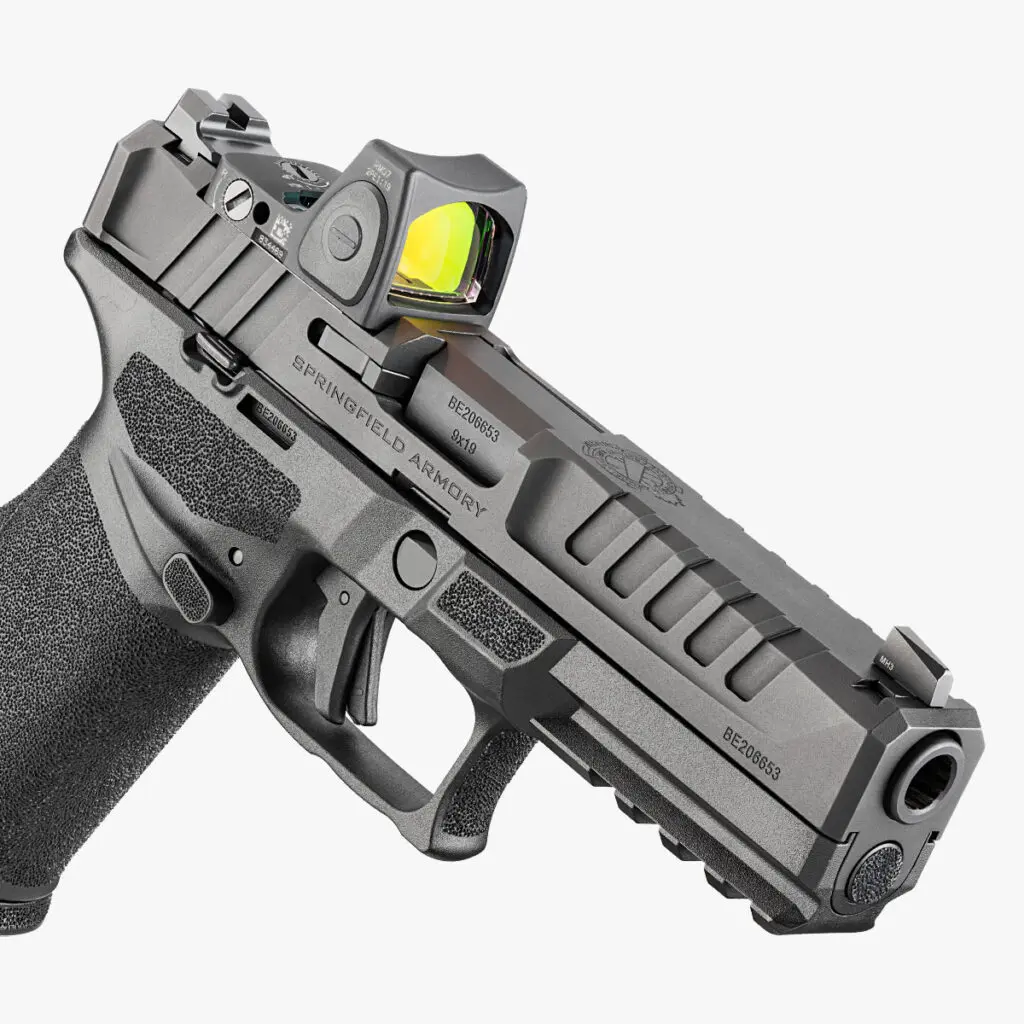
The Springfield Echelon has quickly become one of the most talked-about striker-fired pistols in the modern handgun market. It is not just another polymer-frame 9mm with an optic cut. Springfield built the Echelon around a modular chassis system, strong optics integration, aggressive slide geometry, ambidextrous controls, and several size/configuration options that make the lineup a lot deeper than it may look at first glance.
In this article, we are going to do two things.
First, we are going to review the Echelon platform in general from a real ownership perspective. We have had one for about a year and put roughly 400 rounds through it. That is enough for a practical first-owner review, but not enough to pretend it is a 10,000-round endurance test. Think of this as an honest early-to-mid ownership review from someone who has actually lived with the gun, shot it, mounted an optic, handled the controls, and compared it mentally against other popular striker-fired pistols.
Second, we are going to break down the major Echelon variants: the 4.5F, 4.0C, 4.0FC, Comp models, Alpha, COA, threaded-barrel models, Gear Pac models, and California-compliant versions. The Echelon lineup has grown, and the best model depends on what you want the pistol to do.
Shop Springfield Echelon Pistols
If you are comparing the Echelon against Springfield’s smaller carry pistols, you may also want to look at the Hellcat line:
Shop Springfield Hellcat Pistols
Shop Springfield Hellcat Pro Pistols
Quick Take: What Is the Springfield Echelon?
The Springfield Echelon is a modular, striker-fired 9mm pistol built around what Springfield calls the Central Operating Group, or COG. The easiest way to understand it is this: the Echelon takes the modular chassis idea that made the SIG P320 famous, blends it with the duty-size feel of something like a Glock 17, adds some of the grip and slide confidence people like from the Walther PDP, and wraps it all in Springfield’s own design language.
That does not mean it is a clone of any of those pistols. It has its own identity.
The Echelon is a modern duty-style 9mm handgun with:
A serialized Central Operating Group chassis
Modular grip options
Three backstraps
Ambidextrous controls
Aggressive slide serrations
Springfield’s Variable Interface System for optics
U-Dot or white-dot sight configurations depending on model
17+1 / 20+1 capacity in full-size models
15+1 / 18+1 capacity in compact models
Standard, compact, hybrid, compensated, Alpha, COA, and compliant variants
The full-size 4.5F is the original Echelon most people think of first. The 4.0C is the compact version. The 4.0FC is a hybrid that pairs a compact slide with a full-size grip. Comp models add an integral compensator. Alpha models offer a more accessible entry point into the platform. COA models come equipped with the Aimpoint COA closed-emitter optic from the factory.
That is a lot of ground for one pistol family.
Is 400 Rounds Enough for a Springfield Echelon Review?
It depends on what kind of review we are talking about.
Four hundred rounds is not enough to make some dramatic claim like, “This pistol is bombproof forever and will survive anything.” Nobody should pretend that a few hundred rounds equals a full duty-gun torture test.
But 400 rounds is absolutely enough to talk about how the pistol feels, how the trigger breaks, how the grip texture works, how the slide handles, how the controls feel, how the optic mounting system behaves, whether there have been obvious reliability issues, and whether the gun leaves a good impression after repeated range trips.
So this review is not a military procurement trial. It is a real-world ownership review.
After about a year with the Echelon and roughly 400 rounds through it, the short version is this: the pistol feels well thought out, the grip system is excellent, the slide is one of the easiest to manipulate in its class, the optic system is genuinely impressive, and the trigger is solid for a factory striker-fired gun.
It is not perfect. The slide stop/release could be better, and some shooters may want a stronger tactile reset. But as a modern 9mm platform, the Springfield Echelon is very easy to take seriously.
The Best Way to Describe the Echelon
If you have handled a lot of modern striker-fired pistols, the Echelon feels familiar and different at the same time.
A fair way to describe it is this:
Take some of the duty-pistol size and simplicity of a Glock 17, add the ergonomic confidence and slide texture people like from a Walther PDP, then add a modular serialized chassis concept similar in broad idea to a P320. The result is the Springfield Echelon.
That comparison is not perfect, but it gives you a good mental picture.
The Echelon is not as plain as a Glock.
It is not as aggressively “swoopy” as a PDP.
It is not visually defined by the chassis the way some P320 builds are.
It lands somewhere in the middle: modern, modular, optic-ready, clean-looking, and very usable.
One of the nicest details is that the COG does not visually ruin the look of the pistol. On some modular pistols, the chassis/FCU color can stand out against an all-black gun. The Echelon’s Central Operating Group stays visually subtle, especially on black models. That may sound like a small thing, but on a pistol that is supposed to look modern and cohesive, it matters.
And yes, looks matter. Maybe they should not matter as much as reliability and performance, but they do. A pistol that feels good and looks good is easier to get attached to, easier to train with, and frankly more enjoyable to own.
Central Operating Group: Why the COG Matters
The Central Operating Group is one of the core reasons the Echelon is different from a traditional polymer-frame striker-fired pistol.
On many polymer pistols, the serialized firearm is the grip/frame itself. With the Echelon, the serialized portion is the internal chassis. Springfield calls it the Central Operating Group, and it serves as the foundation of the pistol.
The benefit is modularity.
The COG can be moved between grip modules, which lets the shooter tune the pistol around hand size, grip preference, and intended use. That is one of the things that makes the Echelon feel like a modern platform rather than a single fixed pistol.
From an owner perspective, the modularity is not just marketing. The Echelon gives you three backstraps, and grip modules are available in different sizes. That means you can build the pistol around your hand instead of just accepting whatever the factory grip happens to be.
The backstraps are also clever because they include an integrated punch. It is a small detail, but it shows that Springfield thought about the user actually changing the parts. It is one of those “nice, they actually considered that” features.
If you have very small hands or very large hands, the Echelon is worth handling in person. With the combination of grip module sizes and backstraps, there is a better chance of finding a setup that feels right.
Grip Texture and Ergonomics
The Echelon grip texture is one of the best parts of the pistol.
It is not so aggressive that it feels like sandpaper against your skin, but it gives enough traction to maintain control with sweaty hands. That is exactly where a duty/carry-style pistol should be. A grip that feels great for five minutes at the gun counter but chews up your side during carry is not ideal. A grip that feels comfortable but gets slick when you actually shoot is also not ideal.
The Echelon finds a good middle ground.
The texture is also everywhere Springfield could reasonably put it. There is traction on the main grip surfaces, textured indexing points, and a ledge area on both sides that can work as a thumb reference point. Some shooters may use that ledge almost like a gas pedal. Others may simply use it as a consistent reference for support-hand pressure.
The trigger guard also deserves credit. The double undercut helps the pistol sit well in the hand, and the texturing in that area gives the support hand more to work with. Combined with the beavertail and grip angle, the Echelon does a good job encouraging a high, controlled grip.
This is one of the reasons the pistol shoots well. The grip does not fight you.
Slide Serrations: One of the Echelon’s Best Features
The slide serrations on the Echelon are excellent.
That may sound like a small thing, but it matters every single time you load, unload, press check, clear a malfunction, or manipulate the gun under stress. The Echelon has deep, functional serrations at the front and rear, and the slide has scalloped engagement surfaces that are hard to miss.
The rear of the slide flares slightly, giving your hand more purchase. The forward trench cut gives you a natural place to index when manipulating the front of the slide. The result is a slide that feels easy to grab from multiple angles.
This is one area where the Echelon really does feel like Springfield looked at what people liked from other modern pistols and then made it their own. The slide feels purpose-built instead of decorated.
For shooters who struggle with slide manipulation on some pistols, the Echelon is worth handling. The cuts are not just there for looks.
Controls: Mostly Good, One Complaint
The Echelon’s controls are mostly good, but there is one clear weak point.
The ambidextrous magazine release works fine. It is easy to reach and useful for left-handed shooters or anyone who trains support-hand-only manipulations. It does have a slightly odd tactile feel. The best way to describe it is that it can feel and sound a little clicky or twig-like. That is not a functional problem, but it is noticeable.
The bigger complaint is the slide stop/release.
It is small and not as easy to feel when pressing upward. Sending the slide home is not a big issue, but locking the slide back manually can be less tactile than it should be. Compared with something like a Glock 17 Gen 5 extended slide stop or a larger P320-style control, the Echelon’s slide stop feels more subdued.
Is it a dealbreaker? No.
Would an extended or improved slide release be nice? Absolutely.
This is one of the first upgrades some owners may consider. The good news is that the pistol is strong enough overall that this feels like a preference issue, not a fatal flaw.
Sights: Better Than Expected
The Echelon’s iron sights are better than many factory pistol sights.
Depending on the model, Echelon pistols may come with a tactical rack U-Notch rear sight and tritium front sight with a luminescent ring, while Gear Pac configurations may use white-dot sights. The U-Dot/tritium setup is one of the better factory sight pictures in this price class.
The front sight is easy to pick up. The rear U-notch is fast. The sight picture is clean. For a pistol that is also strongly optic-ready, it is nice that Springfield did not completely neglect the irons.
Some shooters may prefer a traditional three-dot setup. That comes down to personal preference. But the factory U-Dot/tritium arrangement is hard to complain about. It feels like a useful sight system, not a placeholder part you immediately have to replace.
Optic Mounting: The Variable Interface System Is a Big Deal
The Echelon’s optic mounting system is one of the platform’s biggest advantages.
Springfield calls it the Variable Interface System, or VIS. Instead of forcing the shooter into one footprint or relying on a stack of adapter plates for everything, the VIS uses self-locking pins and mounting holes to support a wide range of optics directly to the slide.
In plain English: the Echelon was built from the start to run optics well.
For many optics, that means a lower and cleaner mount than a traditional plate system. A lower optic can improve sight picture, co-witnessing, and the overall feel of the gun.
There are some exceptions. For example, if you are running an ACRO-footprint optic like a Steiner MPS, you may still need an adapter plate. That was the case with the review pistol. The Echelon’s system did not direct-mount the MPS without an adapter, but once mounted, the optic held zero through the shooting we did.
That is an important distinction. The Echelon’s optic system is excellent, but not magic. You still need to match your optic footprint and hardware correctly.
For RMR, DeltaPoint Pro, and Shield RMS-style optics, the Echelon system is especially appealing. If you are shopping for a pistol specifically to run a red dot, this is one of the strongest reasons to look at the Echelon.
Trigger: Solid Factory Striker-Fired Performance
The Echelon trigger is good.
Not custom-1911 good. Not competition-only good. But for a factory striker-fired pistol, it is very solid.
The flat-face trigger has a safety blade, similar in concept to many modern striker-fired guns, but the actual break feels cleaner than a lot of factory polymer pistols. The pull feels roughly in the 4-5 pound range by feel, though that is not from a gauge. The break is soft but crisp enough to shoot well.
The reset is the one part that may divide shooters. It is light. Almost too light if you prefer a very audible, forceful reset. Some pistols push your finger forward more aggressively. The Echelon does not really do that. Some shooters will like the smoother reset. Others may want more tactile feedback.
For practical shooting, the trigger works well. It does not feel like a liability. It feels like a good duty/carry trigger that balances safety, consistency, and shootability.
Reliability After Roughly 400 Rounds
After about 400 rounds, there have been no major complaints from our experience.
That round count is enough to form a useful early impression. It tells you whether the gun has obvious problems, whether the optic mounting is staying put, whether the controls are annoying, whether the grip texture works, and whether the pistol is enjoyable enough to keep shooting.
It is not enough to make a lifetime durability claim.
The review Echelon has been shot with an optic mounted since the first range day. The Steiner MPS has not lost zero in our use, and the gun has continued to feel solid. The slide, grip, and trigger all make the pistol feel more refined than you might expect if your only reference point is Springfield’s older XD-era reputation.
The Echelon feels like a serious modern pistol, not an afterthought.
How the Echelon Compares to a Glock 17
The Glock 17 is the obvious comparison because it is the default full-size striker-fired 9mm for many shooters.
Compared with a Glock 17, the Echelon feels more modern out of the box. The grip texture is more detailed, the slide serrations are much more aggressive, the optic system is more advanced than a basic MOS setup, and the modular grip/chassis system gives it more configurability.
The Glock still wins on aftermarket support, holster availability, long-term track record, and institutional familiarity. If you want the safest, most proven ecosystem, the Glock 17 is hard to beat.
But if you want a pistol that feels more feature-rich from the factory, the Echelon has a strong argument.
This is especially true if you care about optics. The Echelon’s VIS system is one of the biggest reasons someone might choose it over a Glock MOS model.
How the Echelon Compares to a Walther PDP
The Walther PDP is another natural comparison because it is known for its ergonomics, trigger, and excellent slide serrations.
The Echelon and PDP both feel modern and easy to manipulate. The PDP may still have the better factory trigger depending on personal preference, but the Echelon feels more modular and arguably more duty-oriented. The Echelon’s COG system gives it a platform advantage that the PDP does not approach in the same way.
Where the PDP feels like a refined evolution of a traditional polymer pistol, the Echelon feels like a newer modular platform.
If you are choosing between them, it comes down to what you value more: PDP trigger feel and established ergonomics, or Echelon modularity and optic mounting.
How the Echelon Compares to a SIG P320
The P320 comparison comes up because both pistols use a serialized internal chassis concept.
The Echelon’s COG gives it a similar broad modular idea, but the pistol feels very different in the hand. The Echelon grip texture, slide cuts, and overall visual design feel more cohesive than many factory P320 configurations.
Aesthetically, the Echelon also does a good job hiding the chassis visually. The COG does not jump out against the rest of the gun, which helps the pistol look more like a complete design.
The P320 has a huge aftermarket and a long head start in modularity. The Echelon is newer, but it feels like Springfield learned from what shooters liked about modular pistols and built a cleaner, more modern package around that concept.
Springfield Echelon 4.5F: The Original Full-Size Model
The Echelon 4.5F is the full-size version and the model most people think of first when they hear “Springfield Echelon.”
This is the one to look at if you want the most traditional duty-size Echelon. It has the longer 4.5-inch barrel, full-size grip, and 17+1 / 20+1 capacity configuration depending on the magazine. It is the best fit for home defense, range use, duty-style setups, and buyers who simply prefer a larger pistol.
The 4.5F is also the best starting point if you want the Echelon’s original feel. It shows off the platform’s strengths clearly: modular chassis, excellent slide serrations, strong optic system, good sights, and a full grip that gives you plenty of control.
Choose the 4.5F if concealment is not your top priority and you want the most complete full-size Echelon.
Springfield Echelon 4.5F Comp
The Echelon 4.5F Comp takes the full-size platform and adds an integral compensator. This model is for shooters who want the longest standard Echelon format with added recoil control.
The compensator uses a port in the slide and barrel to redirect gas upward, helping reduce muzzle rise. The benefit is faster recovery between shots and flatter tracking during rapid fire.
The 4.5F Comp makes sense for range training, home defense setups, and shooters who want the softest-shooting full-size Echelon option. It is not the smallest or simplest model, but it may be the most fun to shoot hard.
If you are choosing between the standard 4.5F and the 4.5F Comp, the question is simple: do you want the cleanest full-size model, or do you want added recoil control?
Springfield Echelon 4.0C: The Compact Carry Model
The Echelon 4.0C is the compact version of the platform. This is the model to look at if you want the Echelon’s modularity and optic system in a more carry-friendly size.
The 4.0C uses a compact frame and shorter 4-inch barrel. It is more concealable than the full-size 4.5F, while still offering serious capacity and shootability. It is arguably the best all-around Echelon for buyers who want one pistol to cover both carry and range use.
The 4.0C is also where the Echelon starts competing more directly with compact carry pistols like the Glock 19, SIG P320 Compact/XCompact variants, and other modern optics-ready 9mm handguns.
Choose the 4.0C if you want the Echelon platform but actually plan to carry it.
Springfield Echelon 4.0C Comp
The 4.0C Comp is one of the most interesting models in the lineup. It gives you the compact Echelon size with an integral compensator for recoil control.
This is the model for someone who wants a carry-sized Echelon but does not want to give up the benefits of a comp. It is smaller than the full-size Comp, but flatter-shooting than the standard 4.0C.
The 4.0C Comp makes a lot of sense for shooters who train regularly and want a carry gun that stays flatter during recoil. It may also appeal to people who like the idea of a compensated compact pistol but do not want to deal with an aftermarket barrel/comp setup.
Choose the 4.0C Comp if you want the most controllable compact Echelon.
Springfield Echelon 4.0FC: Compact Slide, Full-Size Grip
The Echelon 4.0FC is a hybrid model. It pairs a 4-inch compact slide assembly with a full-size grip.
This setup makes a lot of sense once you understand the role. The shorter slide makes the pistol feel quicker and easier to carry or maneuver, while the full-size grip gives you more control and capacity.
The 4.0FC is for shooters who do not necessarily need the smallest possible grip for concealment. If you can conceal a full-size grip but want the shorter slide, this model is a very practical compromise.
It is also a strong home-defense and range option for shooters who prefer a shorter slide cycle but still want a full grip in the hand.
Choose the 4.0FC if you want compact slide handling with full-size control.
Springfield Echelon Alpha
The Echelon Alpha is Springfield’s more accessible entry point into the Echelon ecosystem. It keeps the core platform ideas — including the COG and optic-ready VIS system — but is positioned as a more budget-conscious version.
That matters because the Echelon lineup has grown into a wide range of models, some of which are more expensive due to optics, compensators, or special configurations. The Alpha gives buyers a cleaner, more approachable way into the platform.
This is a good model to consider if you want the Echelon’s modularity and optic readiness but do not need every premium feature.
Choose the Alpha if value matters and you still want the Echelon platform.
Springfield Echelon COA Models
The Echelon COA models are factory-equipped with the Aimpoint COA closed-emitter red dot using Springfield’s A-CUT interface.
These models are important because they solve the optic question at the factory level. Instead of buying a pistol, choosing an optic, ordering the right plate, installing everything, and confirming the setup, the COA models arrive as a purpose-built optic-equipped package.
A closed-emitter optic is especially appealing for duty, carry, and harsh-weather use because the emitter is enclosed and better protected from debris, moisture, and environmental problems.
Choose a COA model if you already know you want a serious optic-equipped Echelon and prefer a factory-integrated setup.
Springfield Echelon Threaded Barrel Models
Threaded-barrel Echelon models are for shooters who want suppressor or muzzle-device flexibility.
A threaded barrel is not necessary for everyone. If you do not plan to run a suppressor or muzzle device, a standard barrel or Comp model may make more sense. But if you already own suppressors or want the option to configure the pistol later, a threaded model is worth considering.
When shopping threaded-barrel Echelon pistols, compare the barrel length, thread pitch, sights, optic setup, and included accessories. These details matter because threaded models can have slightly different overall dimensions and use cases than standard pistols.
Choose a threaded-barrel model if suppressor-host potential matters.
Springfield Echelon California-Compliant Models
The keyword list shows strong search demand for springfield echelon california and springfield echelon california compliant, so this is worth addressing clearly.
California-compliant Echelon models are configured for buyers who need a version that meets California requirements. These models may differ in capacity, safety features, and exact configuration compared with standard listings.
If you live in California or another restricted state, do not assume that every Echelon listing is available to you. Check the exact product page, capacity, compliance notes, and state restrictions before ordering.
Choose a California-compliant Echelon only when that configuration matches your local requirements.
Springfield Echelon Gear Pac Models
Gear Pac models are bundle-style packages that may include extra magazines, range gear, optics, or other accessories depending on the exact listing.
These can be a strong value if you want more than just the pistol. Extra magazines matter, especially if you plan to train regularly. A Gear Pac can help you start with a more complete setup rather than immediately buying add-ons after the pistol arrives.
Always check the exact Gear Pac contents before ordering. Two Gear Pac listings can look similar but include different accessories.
Choose a Gear Pac if the included extras match what you would have bought anyway.
Springfield Echelon Grip Modules and Fit
One of the biggest advantages of the Echelon is grip fit.
The pistol can be configured with different grip modules and backstraps. In practical terms, that means shooters with smaller or larger hands have a better chance of finding a comfortable setup.
The review pistol came with the medium frame and three backstraps. The large backstrap gives the grip more palm swell and changes how the pistol indexes in the hand. The backstraps also include that integrated punch, which is a small but clever feature.
The grip texture is strong without being miserable. It locks into the hand well during recoil, even with sweat, but it does not feel overly sharp. The texturing on the index points and the ledges on both sides of the frame give the support hand useful reference points.
This is one of the reasons the Echelon feels more refined than many striker-fired pistols in its price range.
Springfield Echelon Review: What We Like
The first thing we like is the grip system. The Echelon feels like it was built for real hand fit rather than one-size-fits-all compromise. The backstraps, grip modules, texture, and undercut trigger guard all work together.
The second thing we like is the slide. The serrations are excellent, the flare at the rear helps, and the forward trench cut gives you an easy place to grab. It is one of the most confidence-inspiring slides on a modern striker-fired pistol.
The third thing we like is the optic system. The Variable Interface System is not just a marketing feature. It gives the Echelon one of the stronger factory optic-mounting setups in the striker-fired market.
The fourth thing we like is the sight setup. The U-Dot/tritium setup is fast and practical. For a pistol that is obviously built with red dots in mind, the factory irons are still useful.
The fifth thing we like is the overall build feel. The Echelon feels solid. It does not feel cheap, hollow, or rushed. That matters.
Springfield Echelon Review: What Could Be Better
The slide stop/release could be better.
It is functional, but it is not as tactile as we would like when pressing up to lock the slide. Sending the slide home is easier, but the control itself could be more prominent.
The reset could also be more tactile. The trigger break is good, but the reset is light enough that some shooters may want more feedback. That is personal preference, but it is worth mentioning.
Aftermarket support is also something to think about. The Echelon is newer than Glock, P320, and M&P platforms, so it does not have the same bottomless aftermarket yet. That will likely improve over time, but buyers who want maximum parts and holster ecosystem support should keep it in mind.
None of these issues ruin the pistol. They are just the main areas where the Echelon is not perfect.
Who Should Buy the Springfield Echelon?
Buy the Springfield Echelon if you want a modern striker-fired 9mm with strong ergonomics, excellent slide serrations, serious optic support, modular grip options, and several size/configuration choices.
It makes sense for:
Shooters who want a modern duty-style pistol
Buyers who plan to run a red dot
People who want grip modularity
Shooters comparing Glock 17, PDP, M&P, and P320-style options
Buyers who want full-size, compact, and compensated variants in the same family
Anyone who wants a pistol that feels more feature-rich out of the box
Do not buy it if you want the smallest possible carry gun. That is more of a Hellcat or Hellcat Pro conversation.
Shop Springfield Hellcat Pistols:
Shop Springfield Hellcat Pro Pistols
Also do not buy it if you specifically want a hammer-fired 1911-style pistol. Springfield has plenty of those, but the Echelon is a modern striker-fired platform.
Which Springfield Echelon Model Should You Buy?
If you want the original full-size Echelon, buy the 4.5F.
If you want the flattest-shooting full-size model, look at the 4.5F Comp.
If you want a compact carry Echelon, look at the 4.0C.
If you want a compact carry model with recoil control, look at the 4.0C Comp.
If you want a compact slide with a full-size grip, look at the 4.0FC.
If you want the most budget-conscious entry into the platform, look at the Echelon Alpha.
If you want a factory-equipped closed-emitter optic, look at the COA models.
If you want suppressor-host flexibility, look at threaded-barrel models.
If you need restricted-state compatibility, look at California-compliant or low-capacity models.
The best Echelon depends on role. The 4.5F is the full-size standard. The 4.0C is the carry model. The 4.0FC is the hybrid. The Comp models are for recoil control. The Alpha is for value. The COA is for optic integration.
Shop Springfield Echelon Pistols:
Final Verdict: Is the Springfield Echelon Worth It?
Yes, the Springfield Echelon is worth taking seriously.
After about a year and roughly 400 rounds, the Echelon comes across as one of Springfield’s strongest modern handgun designs. The grip is well thought out. The slide is excellent. The optic system is impressive. The trigger is good. The modularity is real. The pistol looks good, feels solid, and shoots well.
It is not perfect. The slide stop could be better, the trigger reset could be more tactile, and the aftermarket is still catching up compared with older platforms.
But the core pistol is strong.
The Echelon feels like Springfield took the modern striker-fired pistol category seriously and built something that actually belongs in the conversation with Glock, Walther, SIG, and Smith & Wesson.
If you are on the fence, the best advice is simple: go handle one. Try the grip. Try the trigger. Rack the slide. Look at the optic system. If it fits your hand, there is a good chance it will make a very strong impression.
For buyers looking for a modern 9mm pistol with modularity, optic readiness, and a serious duty/carry feature set, the Springfield Echelon deserves a spot near the top of the list.
Shop Springfield Echelon Pistols:
Springfield Echelon FAQ
What is the Springfield Echelon?
The Springfield Echelon is a modular striker-fired 9mm pistol platform built around Springfield’s serialized Central Operating Group, modern optic mounting system, ambidextrous controls, and interchangeable grip/backstrap options.
Is the Springfield Echelon good?
Yes. Based on our experience, the Echelon is a strong modern 9mm pistol with excellent slide serrations, good grip texture, useful sights, a solid trigger, and one of the better factory optic systems in its class.
Is 400 rounds enough to review the Springfield Echelon?
It is enough for a practical ownership review, but not enough for a full endurance test. Four hundred rounds can reveal a lot about handling, ergonomics, controls, optics, and early reliability, but long-term durability requires much higher round counts.
What is the Springfield Echelon COG?
COG stands for Central Operating Group. It is the serialized internal chassis of the Echelon and serves as the foundation of the pistol’s modular grip system.
What is the Springfield Echelon VIS optic system?
VIS stands for Variable Interface System. It is Springfield’s optic mounting system that allows many popular red dots to mount directly to the slide without a traditional adapter plate setup.
What is the difference between the Echelon 4.5F and 4.0C?
The 4.5F is the full-size model with a 4.5-inch barrel and full-size grip. The 4.0C is the compact model with a 4-inch barrel and compact frame for easier carry.
What is the Springfield Echelon 4.0FC?
The 4.0FC pairs a compact 4-inch slide with a full-size grip. It is a hybrid model for shooters who want compact slide handling with full-size control and capacity.
What is the Springfield Echelon Comp?
Echelon Comp models include an integral compensator designed to reduce muzzle rise and improve control during faster shooting.
What is the Springfield Echelon Alpha?
The Echelon Alpha is a more accessible version of the Echelon platform. It keeps major platform features like the COG and VIS optic system while using a more streamlined configuration.
What is the Springfield Echelon COA?
The Echelon COA is a factory optic-equipped model that uses the Aimpoint COA closed-emitter red dot with Springfield’s A-CUT interface.
Is the Springfield Echelon better than a Glock 17?
It depends on what you value. The Glock 17 has a longer track record and larger aftermarket. The Echelon offers stronger factory modularity, excellent slide serrations, and a more advanced optic mounting system out of the box.
Is the Springfield Echelon good for concealed carry?
The compact 4.0C is the best Echelon model for concealed carry. The full-size 4.5F can be carried by some users, but it is better suited for range, duty-style, or home-defense use.
Which Springfield Echelon should I buy?
Choose the 4.5F for full-size use, 4.0C for carry, 4.0FC for a hybrid setup, Comp models for recoil control, Alpha for value, COA for a factory optic, and California-compliant models where required.