
Springfield Kuna Review: Why This Roller-Delayed 9mm Stands Out
The Springfield Kuna is not just another large-format 9mm pistol.
That is the easy way to describe it, but it does not really do the platform justice. On the surface, the Kuna looks like a compact PDW-style pistol with modern controls, a threaded barrel, M-LOK slots, hybrid sights, and brace-ready configurations. That alone would make it interesting. But the real reason people are paying attention to the Springfield Kuna is the operating system.
The Kuna uses a roller-delayed system.
That phrase gets thrown around a lot because of firearms like the HK MP5, the G3, and the CETME rifles, but roller delay is more than just a cool buzzword. It is a very specific mechanical answer to a problem that has existed in pistol-caliber firearms for a long time: how do you make a compact blowback-style firearm shoot smoother without simply adding a massive, heavy bolt?
That is where the Kuna gets interesting.
The Springfield Kuna takes an old mechanical idea with serious Cold War roots and puts it into a modern, compact, ambidextrous 9mm pistol platform. It gives shooters something that feels familiar enough to understand quickly, but mechanically different enough to stand apart from the sea of simple blowback pistol-caliber carbines and large-format pistols.
For current models, variants, and availability, you can shop our Springfield Kuna collection here:
Shop Springfield Kuna Pistols at Deerford Defense
What Is the Springfield Kuna?
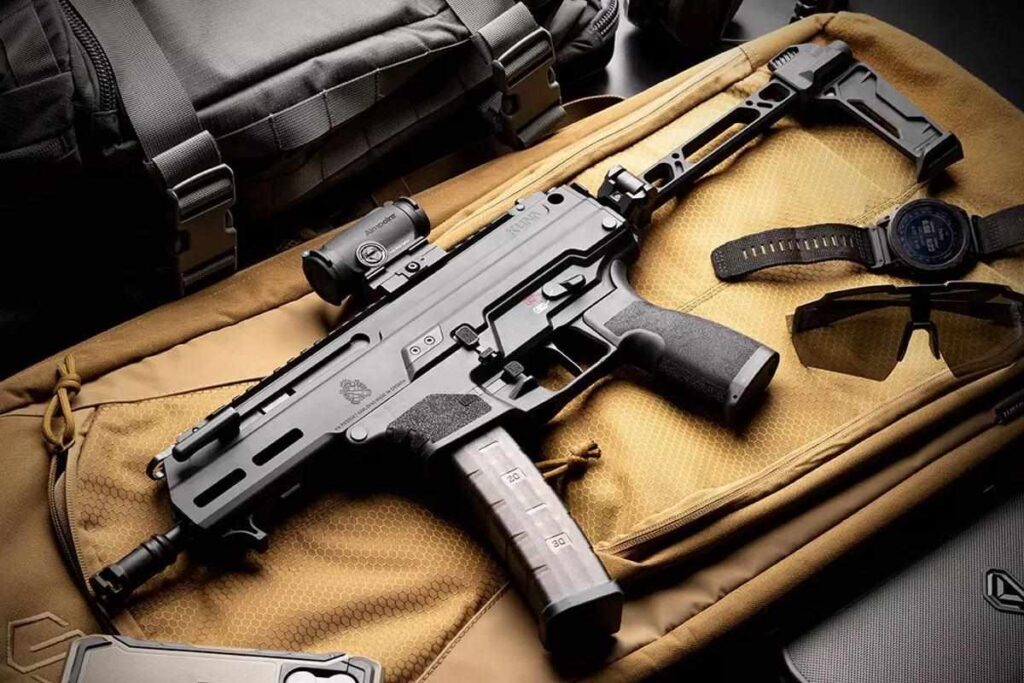
The Springfield Kuna is a compact PDW-style pistol from Springfield Armory. It is built around a roller-delayed operating system and designed to give shooters more control, stability, and shootability than a typical handgun while remaining much more compact than a full-size pistol-caliber carbine.
The core 9mm Kuna platform includes:
- Roller-delayed operation
- 6-inch threaded barrel
- Multi-port muzzle brake
- Hybrid flip-up sights
- Monolithic aluminum upper
- M-LOK accessory space
- AR-pattern grip
- Reversible, non-reciprocating charging handle
- Ambidextrous safety, magazine release, and bolt release
- Translucent magazines with metal feed lips
- Brace and no-brace configurations depending on model
That is a strong feature list, but the Kuna’s biggest selling point is not just the spec sheet. It is how those features come together.
A lot of pistol-caliber platforms feel like big pistols or chopped-down carbines. The Kuna feels more purpose-built than that. It is meant to be small, controllable, and easy to configure. The top rail gives you room for an optic, the M-LOK slots allow for accessories, and the threaded barrel gives the platform muzzle-device flexibility.
The Kuna is also available in different configurations, including FSA brace models, no-brace models, 30-round models, and low-capacity variants. Our Springfield Kuna collection may also include .40 S&W listings depending on current product availability, but the main platform identity most shooters associate with the Kuna is the roller-delayed 9mm version.
The Short Review: Who Is the Springfield Kuna For?
The Springfield Kuna makes the most sense for the shooter who wants a compact defensive-style pistol platform that is smoother and more refined than a basic direct-blowback PCC.
It is not trying to replace a micro-compact concealed carry pistol. It is also not trying to be a traditional 16-inch carbine. The Kuna sits in that middle lane: compact, stable, optics-ready, accessory-friendly, and built for fast handling.
The best buyer for the Kuna is someone who wants:
- A compact PDW-style pistol
- Softer recoil than many simple blowback 9mm platforms
- Ambidextrous controls
- A threaded barrel
- A modern optics-ready layout
- A brace-ready or brace-included configuration
- Something different from the usual AR9 or Scorpion-style option
The Kuna is also attractive because roller-delayed firearms have historically been expensive, niche, or tied to older military-style designs. The Kuna brings that operating concept into a more modern Springfield package.
If you are comparing it to a simple blowback 9mm pistol or PCC, the Kuna’s biggest advantage is control. If you are comparing it to an MP5-style firearm, the Kuna’s advantage is modern ergonomics, accessory mounting, familiar controls, and overall practicality.
A Quick History of Roller-Delayed Firearms
To understand why the Springfield Kuna matters, you have to understand where roller-delayed firearms came from.
Roller-delayed blowback has its roots in German firearm development during World War II. The concept grew out of work at Mauser, where engineers were experimenting with roller systems and trying to simplify firearm operation without giving up reliability. One of the most important early roller-delayed designs was the StG 45(M), also known as the Gerät 06H.
The StG 45(M) was developed late in the war and never saw the widespread service life it might have had if history had gone differently. But mechanically, it was extremely important. It helped prove that a firearm could use angled surfaces, rollers, and careful timing to delay bolt movement without needing a traditional gas system or a fully locked rotating bolt.
After the war, that design knowledge did not disappear.
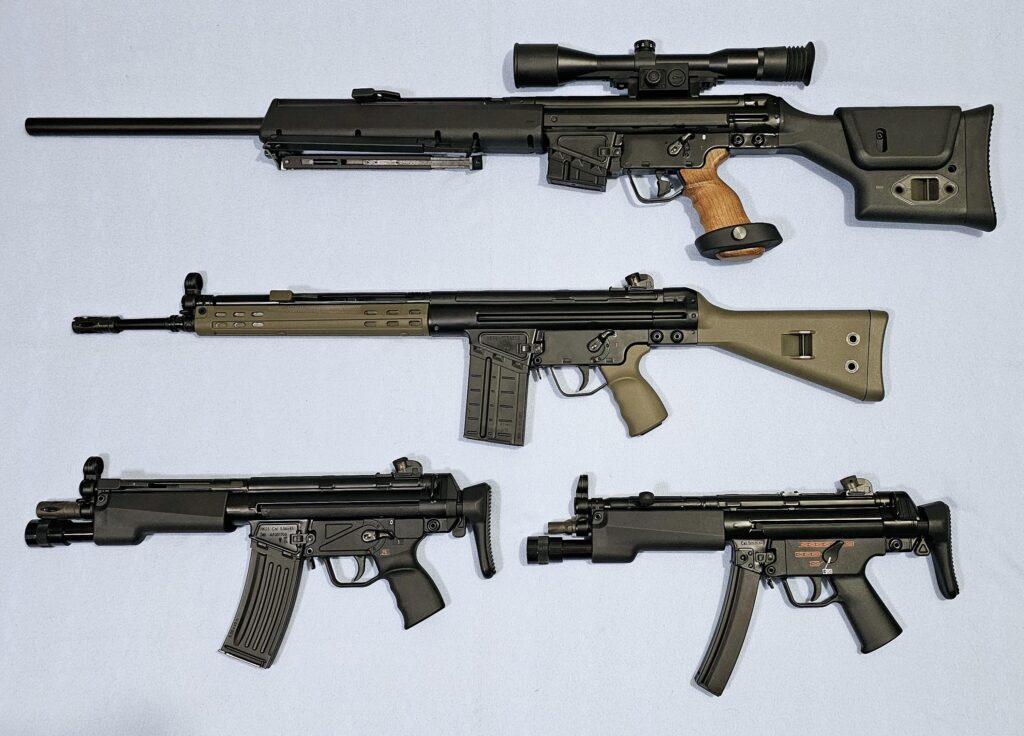
Engineers connected to that development work carried roller-delay concepts into postwar Europe. The system influenced French prototypes, then Spanish CETME rifle development, and eventually the German G3. From there, Heckler & Koch built an entire family of firearms around roller-delayed operation.
That family includes some of the most recognizable roller-delayed firearms ever made:
- CETME rifles
- HK G3
- HK33
- HK91
- HK93
- HK21
- HK MP5
The MP5 is probably the firearm most people think of when they hear “roller delayed.” It earned its reputation because of how controllable and smooth it was compared with many other submachine guns of its era. While plenty of modern platforms have passed it in terms of accessory mounting and modularity, the MP5’s operating system is still a major part of why people love it.
That is the background the Kuna walks into.
The Springfield Kuna is not an MP5 clone. It is not pretending to be a retro subgun. It is a modern Springfield Armory pistol that uses a roller-delayed system to solve the same basic problem: how to keep a compact 9mm firearm controllable without relying on a heavy, clunky bolt.
Roller-Locked vs. Roller-Delayed: What Is the Difference?
This is where people often get tripped up.
A roller-delayed firearm is not the same thing as a roller-locked firearm.
In a roller-locked firearm, the rollers truly lock the action closed. The gun needs some other mechanical movement, usually recoil or barrel movement, to unlock the system before the bolt can travel rearward.
In a roller-delayed firearm, the system is different. The rollers delay the bolt from opening too quickly, but they do not lock the action in the same way a rotating bolt or tilting barrel locks a firearm. The bolt can move, but the geometry of the rollers, locking piece, bolt head, and carrier creates a mechanical disadvantage. That mechanical disadvantage slows the opening of the action long enough for pressure to drop.
That delay is the whole point.
In simple terms:
A direct-blowback firearm resists opening mostly through bolt mass and spring tension.
A roller-delayed firearm resists opening through mechanical geometry.
That is why roller-delayed firearms can often use less reciprocating mass than a basic blowback system. Less reciprocating mass usually means less of that heavy “chunk” feeling as the bolt moves back and forth.
This is one of the reasons roller-delayed guns often feel smoother than people expect.
How a Simple Blowback 9mm Works
Before getting into the Kuna’s system, it helps to look at the simpler design it improves on.
Many 9mm PCCs and large-format pistols use simple blowback operation. In a direct-blowback gun, there is no gas piston, no rotating bolt, no tilting barrel, and no true mechanical lockup. When the round fires, chamber pressure pushes the bullet forward and also pushes the case rearward against the bolt face.
The bolt wants to move backward immediately.
To keep that from happening too quickly, the firearm relies on a heavy bolt and recoil spring. The bolt needs enough mass to resist rearward movement until pressure drops to a safer level. This works. It is simple, reliable, and inexpensive to manufacture.
But it has downsides.
Because the bolt has to be heavy, the gun can feel sharper than expected. The shooter feels that mass moving rearward and then slamming forward again. That movement can disturb the sight picture, increase felt recoil, and make the firearm feel less refined.
That is why some 9mm blowback guns feel strangely harsh despite firing a pistol cartridge.
The cartridge itself may not be powerful, but the operating system can make the gun feel jumpy.
How the Springfield Kuna Roller-Delayed System Works
The Springfield Kuna takes a different approach.
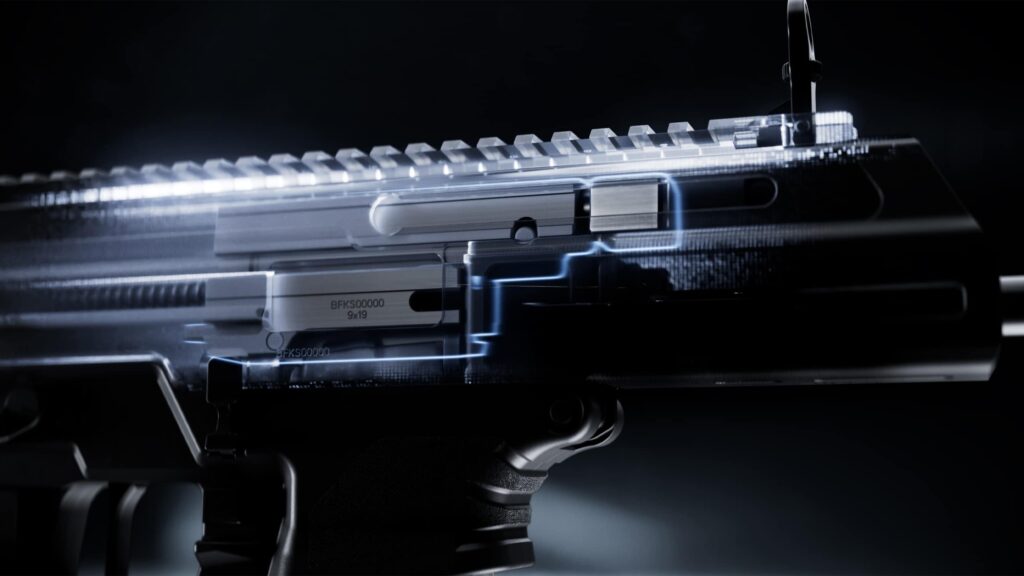
Instead of relying only on a heavy bolt and spring, the Kuna uses a roller-delayed operating system to slow the rearward movement of the bolt. The idea is to delay extraction and bolt travel long enough for pressure to drop, while allowing the firearm to use less reciprocating mass than a simple blowback design.
Here is the basic sequence.
When a round is chambered, the bolt is forward and the system is in battery. The cartridge is seated in the chamber, the bolt face is behind it, and the roller-delay system is positioned to resist immediate rearward bolt movement.
When the round fires, expanding gas pushes the bullet forward down the barrel. At the same time, the case pushes rearward against the bolt face. In a simple blowback gun, that rearward force would immediately start pushing the heavy bolt backward.
In the Kuna, that rearward force has to work through the roller-delay system.
The roller acts as a delaying element. As rearward pressure is applied, the roller interacts with angled internal surfaces. Those angled surfaces force the system to move in a controlled sequence rather than simply letting the bolt fly open all at once.
The important part is mechanical leverage.
The bolt head cannot simply move rearward freely. The roller and angled geometry force energy into the carrier assembly, making one part of the system move faster than another. That means the bolt face itself is delayed for a brief moment while the carrier begins moving. This brief delay gives chamber pressure time to drop before extraction really gets underway.
That delay may be extremely short, but it matters.
By the time the case begins extracting, pressure is lower, the system is moving in a more controlled way, and the shooter feels less violent bolt movement compared with many direct-blowback designs.
That is the magic of roller delay. It is not magic in the mystical sense. It is math, timing, and geometry.
The Kuna’s Single-Roller Design
One interesting detail is that the Kuna is not simply an MP5 copy.
The classic HK roller-delayed system most people picture uses two side rollers. The Kuna’s design has been described as using a single vertical roller. That matters because it shows the Kuna is not just trying to recreate an old pattern. It is using the same general mechanical idea in a more modern layout.
The point is still the same: delay bolt movement, reduce the need for excessive bolt mass, and create a smoother shooting cycle.
What changes is how the manufacturer packages that concept.
The Kuna has a modern receiver layout, modern controls, an AR-pattern grip, M-LOK slots, a top rail, and hybrid flip-up sights. It is clearly not a retro gun. It is a current-production Springfield Armory pistol using a classic operating principle in a new format.
That is why the Kuna is so interesting. It gives shooters some of the mechanical appeal of a roller-delayed firearm without forcing them into a clone-correct MP5 world.
Why Roller Delay Feels Softer
The softer feel of a roller-delayed firearm comes from a few things working together.
First, the system delays bolt opening. That helps avoid the abrupt rearward movement found in many simple blowback designs.
Second, the system can reduce reciprocating mass. A heavy bolt moving back and forth inside a compact firearm can make the gun feel bouncy. If the design can use geometry instead of raw weight, the cycle can feel smoother.
Third, the delay changes how recoil is delivered to the shooter. Instead of one sharp impulse from a heavy bolt moving rearward quickly, the movement feels more controlled.
This does not mean a roller-delayed 9mm has no recoil. It also does not mean every roller-delayed gun feels identical. Bolt weight, spring rate, locking geometry, suppressor use, ammunition, muzzle devices, and overall firearm weight all matter.
But as a category, roller-delayed 9mm firearms have a reputation for being smoother than simple blowback guns. The Kuna leans into that reputation.
Why the Kuna Does Not Need a Gas System
Another benefit of the Kuna’s operating system is simplicity in the front end.
The Kuna does not need a gas block, gas tube, piston, or rotating bolt system to cycle. It is not an AR-15. It is not a short-stroke piston gun. It does not tap gas from the barrel and send it into a separate operating system.
Instead, it uses the rearward pressure from the cartridge case, controlled through the roller-delay mechanism.
That keeps the platform mechanically compact. It also allows the barrel to remain fixed, which can help with consistency. A fixed barrel is one of those details that sounds boring until you understand why it matters. Less barrel movement can support better consistency from shot to shot, especially on a compact firearm where stability is the whole point.
The Kuna pairs that fixed barrel with a threaded muzzle and brake, giving the shooter a compact system that is easy to configure.
Is the Springfield Kuna a Good Suppressor Host?
The Springfield Kuna has a lot going for it as a suppressor host.
It has a threaded barrel, a fixed barrel layout, and a roller-delayed operating system. That combination makes it a natural candidate for suppressed shooting. Many shooters are drawn to roller-delayed 9mm platforms specifically because they tend to suppress well and feel smoother than basic blowback designs.
That does not mean every suppressor and ammo combination will feel the same. Suppressor backpressure, ammo pressure, bullet weight, and muzzle device setup can all change how a firearm behaves. But as a platform, the Kuna has the right foundation.
A threaded 9mm PDW-style pistol with roller delay is exactly the type of firearm many people look at when they want a compact host for subsonic 9mm.
As always, suppressors are regulated NFA items. Buyers should follow all federal, state, and local laws before purchasing or configuring any suppressor setup.
Springfield Kuna Features That Matter
The operating system gets most of the attention, but the Kuna’s feature set is also a major part of the review.
Monolithic Aluminum Upper
The Kuna uses a rugged upper design with integrated accessory space. This gives the platform a solid foundation and helps support optics, sights, and accessories.
M-LOK Accessory Slots
M-LOK slots give users room to configure the front end with compatible accessories. For a PDW-style pistol, that matters. Lights, hand stops, and sling mounting points can make a compact firearm much more practical.
Hybrid Flip-Up Sights
The Kuna’s hybrid sights are a smart feature. When folded, they provide a lower-profile pistol-style sight picture. When flipped up, they provide a more traditional aperture-style sight setup. This gives the shooter backup sights without forcing them to immediately buy an optic.
Reversible Non-Reciprocating Charging Handle
The charging handle is reversible and non-reciprocating. That means it does not move back and forth while firing, and it can be configured for left- or right-side use. For left-handed shooters or anyone who likes to set up a gun around personal preference, that is a real advantage.
Ambidextrous Controls
The safety, magazine release, and bolt release are ambidextrous. That makes the Kuna easier to run from either side and gives it a more modern feel than older roller-delayed platforms.
AR-Pattern Grip
The AR-pattern grip gives the Kuna a familiar feel. It also opens the door to grip customization depending on compatibility and user preference.
Threaded Barrel and Muzzle Brake
The 9mm Kuna uses a 6-inch threaded barrel and ships with a muzzle brake. The threaded barrel gives the platform flexibility, while the brake helps control muzzle movement.
Translucent Magazines With Metal Feed Lips
The Kuna ships with translucent magazines that use metal feed lips. The translucent body gives a quick visual reference for remaining rounds, while metal feed lips add durability where it matters most.
Springfield Kuna With FSA Brace vs. No-Brace Models
One of the biggest choices in the Kuna lineup is whether to buy a brace-equipped model or a no-brace model.
The FSA brace models include the Strike Industries FSA folding brace. These are the more complete PDW-style versions for shooters who want added stability right out of the box. The folding design also helps keep the package compact for storage and transport.
No-brace models keep the platform simpler. They make sense for buyers who want the base Kuna pistol and prefer to configure it themselves.
The best choice depends on what you want from the platform.
Choose the FSA brace model if you want the most complete setup from the start.
Choose the no-brace model if you want the cleaner base pistol or plan to configure the rear end your own way.
Either way, the core appeal of the Kuna remains the same: compact size, roller-delayed operation, modern controls, and accessory-ready layout.
Springfield Kuna 9mm vs. .40 S&W Listings
The 9mm Kuna is the main version most shooters are going to look at first. It gives you broad ammo availability, softer recoil, and the clearest expression of what the Kuna platform is designed to be.
Our Springfield Kuna collection may also include .40 S&W product listings depending on inventory and distributor availability. These models are worth comparing if you specifically prefer .40 S&W or already stock that caliber.
For most buyers, the 9mm version is the natural starting point. It is easier to feed, easier to train with, and better aligned with the broader market for compact PDW-style pistols.
The .40 S&W variants are more niche, but they can still make sense for the right buyer.
Springfield Kuna vs. MP5-Style Firearms
It is impossible to talk about a roller-delayed 9mm without mentioning the MP5.
The MP5 is the legend. It is one of the most iconic submachine guns ever made, and the roller-delayed system is a huge reason why. It is smooth, controllable, and historically important.
But the Kuna is not trying to be an MP5 clone.
That is a good thing.
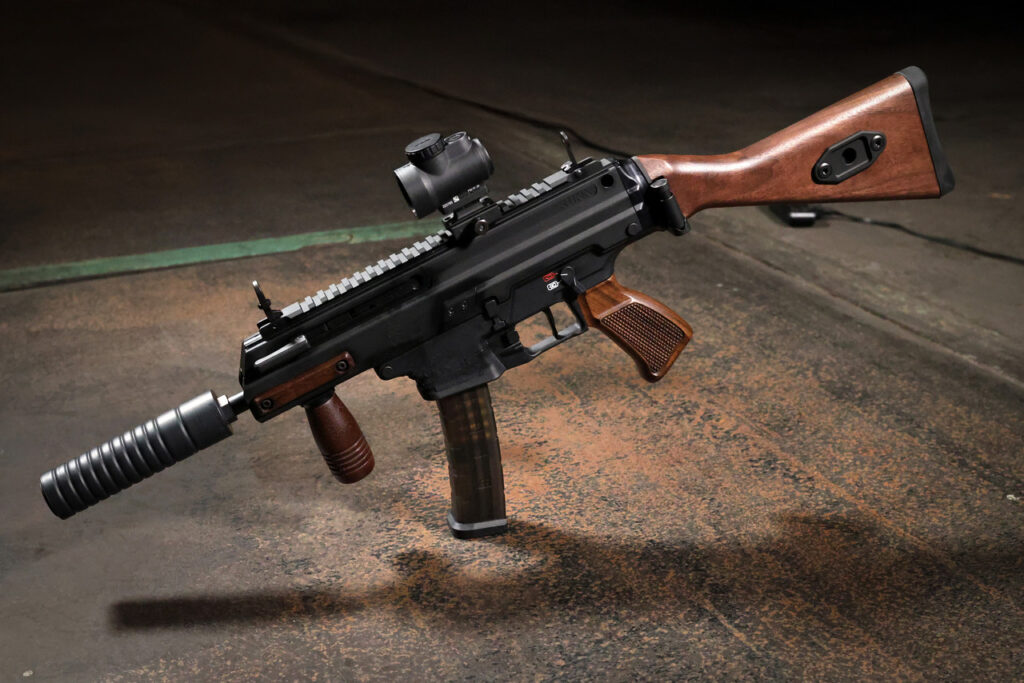
The Kuna gives you modern controls, a modern accessory layout, M-LOK support, a top rail, hybrid sights, an AR-pattern grip, and a more straightforward setup for today’s shooter. It borrows the broad mechanical lesson of roller delay, but it does not force you into an older manual of arms.
Compared with an MP5-style firearm, the Kuna feels more modern and easier to configure.
Compared with a simple blowback PCC, the Kuna feels more mechanically interesting and potentially smoother.
That is the lane it occupies.
Springfield Kuna vs. Direct-Blowback PCCs
Many 9mm PCCs and large-format pistols are direct blowback. That design is common for a reason. It is simple, durable, affordable, and easy to manufacture.
But direct blowback can feel rougher than people expect.
A 9mm direct-blowback firearm often needs a heavy bolt. That bolt moves back and forth during firing, and the shooter feels that mass. In a compact platform, that movement can make the gun feel more violent than the cartridge suggests.
The Kuna uses roller delay to reduce that problem.
Instead of relying only on bolt weight, the Kuna uses mechanical delay to control when and how the bolt moves. That helps reduce felt recoil and muzzle movement, especially during quick strings of fire.
That is the main reason to consider the Kuna over a basic blowback 9mm platform.
If all you care about is the lowest possible price, a simple blowback gun may be enough.
If you care about smoothness, recoil impulse, mechanical design, and overall shootability, the Kuna becomes much more compelling.
What We Like About the Springfield Kuna
The biggest thing we like about the Springfield Kuna is that it actually has a reason to exist.
A lot of modern pistol-caliber firearms feel like slight variations of the same idea. The Kuna brings something more interesting to the table. It combines a roller-delayed operating system with modern controls and accessory support.
The ambidextrous layout is another major plus. The controls are not an afterthought. The reversible charging handle, ambi safety, ambi mag release, and ambi bolt release make the platform easier to run for more shooters.
The threaded barrel is also a big deal. A compact 9mm platform without muzzle-device flexibility would feel incomplete. The Kuna avoids that problem.
The hybrid sights are a smart touch too. Many firearms ship with either bad sights or no sights. The Kuna gives you usable built-in sights while still leaving room for optics.
Most importantly, the Kuna takes the roller-delayed concept and makes it feel current. It is not a museum piece. It is not a clone project. It is a modern Springfield Armory pistol with a historically proven mechanical idea at its core.
What To Consider Before Buying
The Kuna is not for every buyer.
First, it is still a large-format pistol. It is more compact than a rifle or full-size PCC, but it is not a traditional concealed carry handgun. If you are looking for something to carry in a holster every day, a Hellcat, Hellcat Pro, or Echelon is a more realistic place to start.
Second, the Kuna uses dedicated magazines. That is not necessarily a problem, especially since the magazines are part of the platform design, but buyers should know that this is not a Glock-mag PCC.
Third, buyers need to pay attention to state restrictions, magazine capacity, brace configuration, and local laws. Some models may be 30-round versions while others are low-capacity variants. Some include a brace while others do not.
Fourth, inventory can change. The Kuna is a newer and popular platform, so specific models may move in and out of stock.
That is why it is worth checking the collection page directly before choosing a model:
Browse Springfield Kuna Pistols
Which Springfield Kuna Should You Buy?
The best Springfield Kuna depends on how you plan to use it.
If you want the most common and broadly useful setup, start with a 9mm model.
If you want the most complete PDW-style configuration, look at a Kuna with the Strike Industries FSA folding brace.
If you want a simpler base pistol, choose a no-brace model.
If magazine capacity restrictions matter where you live, compare the low-capacity models first.
If you specifically prefer .40 S&W, check whether .40 S&W listings are currently available in the collection.
For most shooters, the 9mm FSA brace model will be the most complete version of the Kuna concept. It gives you the core roller-delayed platform, the compact PDW layout, and added stability right out of the box.
For buyers who prefer to build out the platform themselves, the no-brace model is the cleaner starting point.
Final Thoughts: The Kuna Makes Roller Delay Modern Again
The Springfield Kuna is exciting because it brings roller-delayed operation into a modern, accessible, compact pistol platform.
Roller delay has a serious history. It traces back through Mauser development, the StG 45, CETME rifles, the HK G3, and the MP5. For decades, it has been associated with some of the most recognizable and respected firearms in the world.
The Kuna does not copy those guns. It takes the lesson and applies it in a modern way.
That is what makes it worth paying attention to.
It gives shooters a compact 9mm platform with smoother recoil characteristics than many direct-blowback designs, modern ambidextrous controls, a threaded barrel, hybrid sights, M-LOK support, and brace-ready configurations.
If you want another basic 9mm blowback pistol, the Kuna may be more gun than you need.
If you want a modern roller-delayed PDW-style pistol with real mechanical personality, the Springfield Kuna deserves a serious look.
Shop Springfield Kuna Pistols at Deerford Defense
Springfield Kuna FAQ
What is the Springfield Kuna?
The Springfield Kuna is a compact PDW-style pistol platform from Springfield Armory. It uses a roller-delayed operating system and features a threaded barrel, ambidextrous controls, hybrid sights, M-LOK accessory space, and modern defensive-style ergonomics.
Is the Springfield Kuna roller delayed?
Yes. The Springfield Kuna uses a roller-delayed operating system. This system delays bolt movement during firing, helping reduce felt recoil and muzzle movement compared with many simple direct-blowback designs.
How does the Springfield Kuna roller-delayed system work?
The Kuna’s roller-delayed system uses a roller and angled internal geometry to slow the rearward movement of the bolt. When the round fires, the bolt does not simply fly open like a basic blowback gun. Instead, the roller-delay mechanism creates a mechanical disadvantage that briefly delays opening until pressure drops.
Is the Springfield Kuna the same as an MP5?
No. The Kuna is not an MP5 clone. Both platforms use roller-delay principles, but the Kuna is a modern Springfield Armory design with different controls, layout, accessory mounting, and overall ergonomics.
Is the Springfield Kuna good for suppressed shooting?
The Kuna has several features that make it appealing as a suppressor host, including a threaded barrel, fixed-barrel layout, and roller-delayed operation. Suppressors are regulated items, so buyers should follow all applicable laws before purchasing or configuring a suppressor setup.
Does the Springfield Kuna use Glock magazines?
No. The Kuna uses dedicated magazines. Current 9mm models are commonly associated with translucent magazines with metal feed lips.
What is the difference between the Kuna FSA brace model and the no-brace model?
The FSA brace model includes a Strike Industries FSA folding brace for added stability and compact storage. The no-brace model keeps the pistol simpler and is better for buyers who want to configure the platform separately.
Which Springfield Kuna should I buy?
Most buyers should start with the 9mm model. Choose an FSA brace model if you want the most complete PDW-style setup, a no-brace model if you want a cleaner base pistol, and a low-capacity model if magazine restrictions apply.