
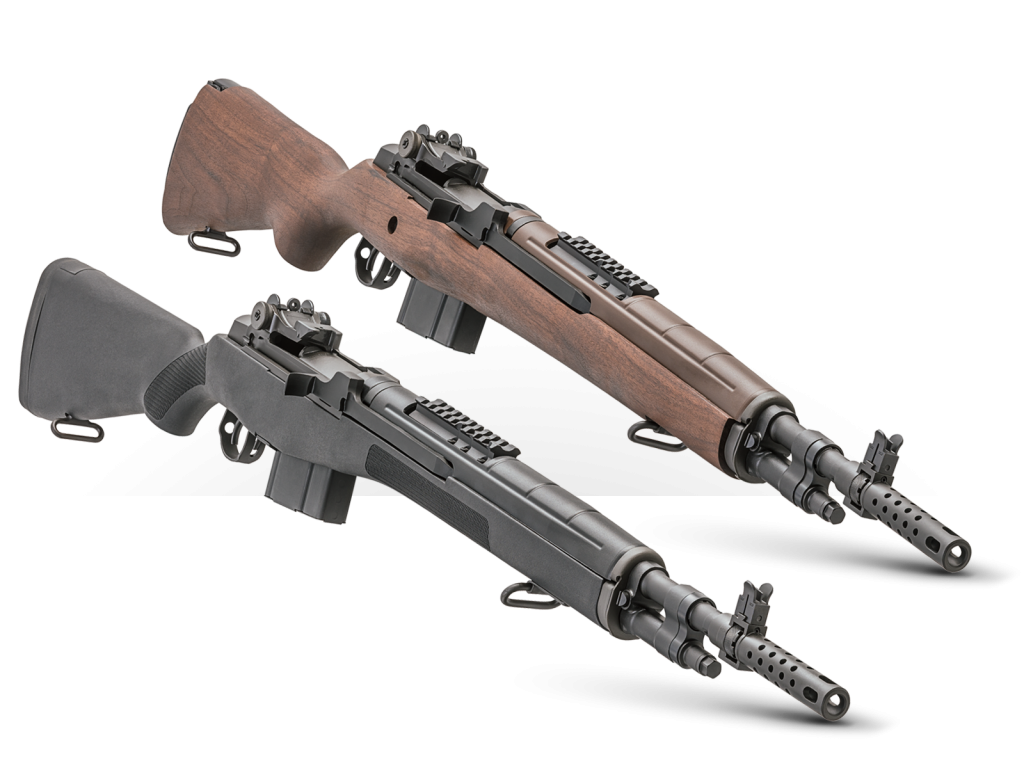
The Springfield M1A is one of those rifles people do not buy purely because it makes spreadsheet sense.
On paper, there are lighter rifles, cheaper rifles, easier rifles to mount optics on, and more modern semi-auto .308 options. If you are only looking at weight, accessory support, cost, and modularity, the M1A is not the obvious modern answer.
But that is also missing the point.
The M1A is popular because it gives civilian shooters a semi-automatic rifle inspired by the U.S. M14, one of the most recognizable American battle rifles of the Cold War era. It has the look, feel, operating character, iron sights, and .308 / 7.62 NATO authority that made the M14 famous. It is not a perfect clone of the military rifle, and it is not select-fire like the real M14, but it is the closest mainstream commercial rifle most buyers will ever realistically own in that family.
This article is going to cover two things.
First, we are going to compare the Springfield M1A to the real U.S. military M14: what is the same, what is different, and what buyers should understand before calling the M1A a “civilian M14.”
Second, we are going to break down the major Springfield M1A models, including Standard Issue, Loaded, Loaded Precision, Scout Squad, SOCOM 16, Tanker, National Match, and 50th Anniversary models.
Quick Answer: Is the Springfield M1A a Real M14?
No, the Springfield M1A is not a real military M14.
The original M14 was a U.S. military select-fire battle rifle chambered in 7.62x51mm NATO. It was adopted in the late 1950s as the replacement for the M1 Garand and used a detachable 20-round box magazine. The rifle could fire semi-automatically and automatically, although its weight and recoil made automatic fire difficult to control.
The Springfield M1A is the civilian semi-automatic version inspired by that platform. It keeps the general M14 pattern, operating feel, detachable magazine system, iron-sight tradition, and .308 Win. / 7.62 NATO chambering, but it is not select-fire.
That distinction matters.
A real M14 is a military rifle.
A Springfield M1A is a civilian semi-auto rifle based on the M14 pattern.
For most buyers, though, the M1A is close enough to scratch the itch. It gives you the experience people want from the M14 family without getting into the legal and practical impossibility of owning a true select-fire military M14.
Why the M14 Matters
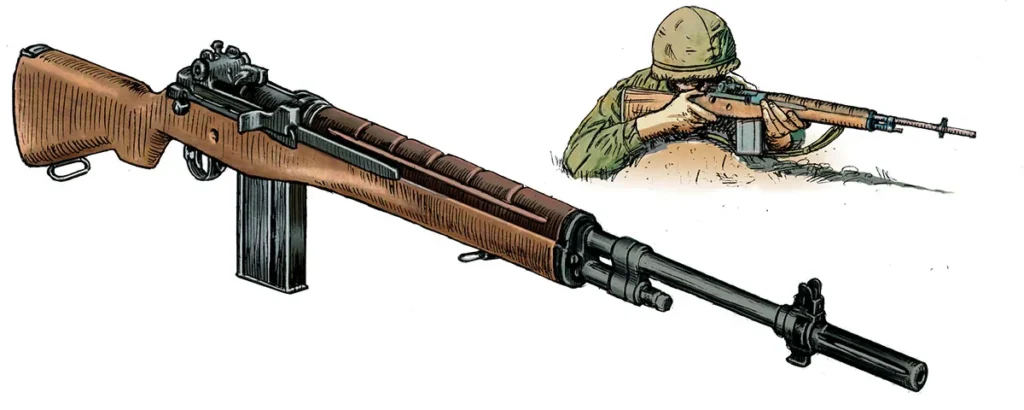
To understand why the M1A matters, you have to understand the M14.
The M14 was developed as the successor to the M1 Garand. The idea was to modernize the American service rifle around a new NATO cartridge, detachable magazine, and selective-fire capability while keeping some of the strengths of the Garand-style operating system. The Army Historical Foundation notes that NATO adopted the T65E3 cartridge as the 7.62mm NATO round in December 1953 while the T44 rifle series, which led to the M14, was being tested and refined.
The M14 had a lot going for it. It was powerful. It was accurate. It used a detachable 20-round magazine instead of the M1 Garand’s eight-round en bloc clip. It had excellent sights. It felt like a serious rifle because it was one.
But it also arrived at a strange moment in small-arms history.
The military was moving away from full-power battle rifles and toward lighter intermediate-caliber rifles. Britannica summarizes the problem clearly: the M14 performed well as a self-loading rifle, but it was heavy for close-quarters use and difficult to control in automatic fire because of the recoil generated by the NATO cartridge.
That is why the M14 had a relatively short run as the standard U.S. service rifle before the M16 took over. Still, the rifle never really disappeared. The M14 platform continued to be used in specialized roles, including designated marksman, sniper, competition, and ceremonial applications.
That legacy is exactly why the M1A has survived as a civilian rifle.
What the Springfield M1A Gets Right
The Springfield M1A gets the feel right.
That is the most important thing.
A modern AR-10 pattern rifle may be more modular. It may be easier to mount optics. It may be easier to configure with rails, lights, adjustable stocks, suppressor systems, and modern accessories. But it does not feel like an M14.
The M1A does.
The rifle gives you that long operating rod feel, aperture sights, exposed charging handle, detachable box magazine, wood or composite stock options, and .308 Win. / 7.62 NATO recoil impulse. It feels mechanical in a way many modern rifles do not.
Springfield’s Standard Issue M1A is the clearest example. It uses a 22-inch barrel, two-stage trigger, National Match front sight, military aperture rear sight, and flash suppressor, with wood or composite stock options depending on configuration.
That is the M1A at its most traditional.
If you want the closest normal-production Springfield M1A experience to the classic military rifle, the Standard Issue is where you start.
What the M1A Does Not Copy from the M14
The biggest difference is fire control.
The M14 was a select-fire rifle. The Springfield M1A is semi-automatic only. That means the M1A does not have the automatic fire capability of the military M14.
For most civilian buyers, that is not a disadvantage. The M14’s full-auto capability was never the platform’s strongest feature anyway. Britannica specifically notes that the M14’s recoil made it essentially unmanageable as an automatic rifle.
The M1A also exists in many configurations that the original M14 did not. The SOCOM 16, Scout Squad, Tanker, Loaded Precision, and modern chassis-style rifles are not trying to be perfect clones of the original service rifle. They are Springfield’s way of adapting the M1A platform for different civilian roles.
So the M1A is best understood as two things at once:
A civilian semi-auto recreation of the M14 idea.
A modern Springfield rifle family with its own model variants and use cases.
That is why the lineup is so broad.
M1A vs M14: Main Differences
The most important differences are straightforward.
The M14 was a U.S. military service rifle chambered in 7.62 NATO, fed by a detachable 20-round magazine, and built with selective-fire capability. It was adopted to replace the M1 Garand but was eventually replaced as the standard service rifle by the M16.
The M1A is Springfield Armory’s civilian semi-automatic version inspired by the M14 platform. It is offered in .308 Win. / 7.62 NATO, with some Loaded models also available in 6.5 Creedmoor depending on configuration. Springfield’s own Loaded page lists the M1A Loaded in 7.62 NATO / .308 Win. and 6.5 Creedmoor.
The M14 was built for military service.
The M1A is built for civilian buyers, collectors, range shooters, hunters, competitors, and enthusiasts who want the M14-style experience.
The M14 is historically important.
The M1A is the rifle most modern buyers can actually purchase.
What Makes the M1A Still Appealing?
The M1A is appealing because it is different.
Most modern semi-auto rifle discussions eventually turn into AR-15 vs AR-10 comparisons. That is fine. The AR platform is dominant for a reason.
But the M1A offers something else.
It has a traditional rifle feel.
It has excellent iron sights.
It has .308 / 7.62 NATO power.
It has historic character.
It has a strong connection to the M14.
It can still be configured for range, scout, compact, precision, or collector roles.
The M1A is not trying to be the most modular rifle on the wall. It is trying to carry forward the M14 pattern in a way that still works for civilian shooters.
For the right buyer, that matters more than raw practicality.
Springfield M1A Standard Issue: Closest to the Classic M14 Feel
The Springfield M1A Standard Issue is the model to start with if you want the most traditional M1A experience.
This is the version that most closely delivers the “civilian M14” feel. It typically uses a 22-inch barrel, two-stage trigger, National Match front sight, military aperture rear sight, flash suppressor, and wood or composite stock depending on the exact model. Springfield’s Standard Issue page highlights the 22-inch barrel, 2-stage trigger, National Match front sight, military aperture rear sight, and flash suppressor as core features.
The walnut-stock version is the one that looks the part most strongly. If you grew up seeing photos of M14 rifles or simply want the classic wood-and-steel look, the walnut Standard Issue is the model that makes the emotional case.
The composite-stock version is more practical. It gives up some of the traditional appearance but offers a more weather-resistant stock setup.
Who should buy the Standard Issue?
Buy it if you want the classic M1A experience.
Buy it if you care about M14 heritage.
Buy it if you want a 22-inch .308 rifle with great irons.
Buy it if walnut and steel make your heart beat a little faster.
The Standard Issue is not the most compact M1A. It is not the most precision-oriented M1A. It is not the most tactical M1A.
It is the classic one.
Springfield M1A Loaded: The Accuracy-Focused Upgrade
The M1A Loaded is for shooters who like the classic platform but want more precision-focused features.
Springfield’s Loaded page describes the line as available in 7.62 NATO / .308 Win. and 6.5 Creedmoor, with a National Match tuned 4.5- to 5-pound two-stage trigger. Springfield also notes that Loaded models use a 22-inch National Match air-gauged premium barrel, National Match front sight, and match-grade aperture rear sight.
That is the point of the Loaded series.
It is still an M1A. It still feels like the M14 family. But it adds features that make more sense for range accuracy and longer-distance work.
The Loaded model is a smart choice if you want:
A more accuracy-oriented M1A
National Match-style features
A 22-inch barrel
A more refined trigger setup
.308 or 6.5 Creedmoor options depending on model
A rifle that feels traditional but shoots closer to a precision role
If the Standard Issue is the heritage rifle, the Loaded is the more serious range rifle.
Springfield M1A Loaded Precision: The Modernized Accuracy Option
The Loaded Precision takes the Loaded concept and adds a precision adjustable stock.
That changes the rifle’s personality.
A traditional M1A stock is beautiful and historic, but it does not offer the same adjustability as a modern precision stock. The Loaded Precision gives shooters a better way to dial in cheek weld, length of pull, and optic alignment. Springfield’s Loaded Precision .308 page lists a 22-inch National Match medium-weight barrel, National Match front sight, match-grade rear aperture, precision adjustable stock, and .308 Win. / 7.62 NATO chambering.
This is the M1A for someone who wants the old action in a more modern precision-oriented package.
The Loaded Precision is not the rifle for the buyer who wants maximum M14 nostalgia. It is the rifle for the buyer who wants to shoot the M1A platform more seriously with optics and a repeatable stock setup.
Buy the Loaded Precision if accuracy and adjustability matter more than classic appearance.
Springfield M1A Scout Squad: The Balanced Practical Model
The Scout Squad is one of the most practical M1A variants.
It uses an 18-inch barrel, making it shorter and handier than the 22-inch Standard Issue or Loaded rifles, but not as short as the SOCOM 16. Springfield’s Scout Squad page lists an 18-inch 1:11 right-hand six-groove carbon steel barrel and a forward scout-style Picatinny rail for mounting optics.
That makes it a strong middle ground.
The Scout Squad gives you more maneuverability than a full-size M1A while still keeping more barrel length than the SOCOM 16. It also adds scout-style optic flexibility, which fits the model’s purpose.
This is the M1A for buyers who want:
A handier rifle
An 18-inch barrel
Scout-style optic mounting
.308 power in a more portable package
A balance between classic rifle and compact carbine
If the Standard Issue feels too long, but the SOCOM 16 feels too specialized, the Scout Squad may be the sweet spot.
Springfield M1A SOCOM 16: Compact .308 Power
The SOCOM 16 is the compact powerhouse of the M1A family.
Springfield’s SOCOM 16 page lists a 16.25-inch barrel with 1:11 twist, and the specific SOCOM 16 .308 page describes the rifle as using a 16.25-inch carbon steel barrel with a proprietary muzzle brake, tritium-enhanced front sight, and ghost ring rear sight.
This is not the M1A for someone chasing the classic 22-inch rifle profile.
The SOCOM 16 is for shooters who want the M1A action in a shorter, faster-handling package. It is louder, more aggressive, and more specialized than the Standard Issue. It gives up some of the traditional full-length rifle feel but gains maneuverability.
The SOCOM 16 makes sense if you want:
A compact .308 semi-auto
A 16.25-inch M1A
Fast handling
Ghost ring sights
A defensive or brush-gun style rifle
A modernized short M1A experience
It is not subtle.
That is part of why people like it.
Springfield M1A SOCOM 16 CQB: The Modern Tactical Branch
The SOCOM 16 CQB pushes the compact M1A into a more modern tactical direction.
Springfield’s SOCOM 16 CQB listing describes a 16.25-inch premium carbon steel 1:11-twist barrel inside an Archangel composite chassis with a collapsible stock and more accessory room.
This is one of the least traditional-looking M1A models.
That can be good or bad depending on what you want. If you want walnut and M14 nostalgia, this is probably not your first stop. If you want a compact M1A with modern furniture, adjustability, and accessory support, the CQB model makes more sense.
The SOCOM 16 CQB is for the buyer who wants the M1A action but does not want the traditional rifle layout.
Springfield M1A Tanker: Compact but Classic
The Tanker is one of the coolest M1A variants because it gives you compact SOCOM-style handling while keeping a classic walnut-stock look.
Springfield’s M1A Tanker page lists a 16.25-inch carbon steel barrel with 1:11 right-hand twist, six-groove rifling, tritium-powered front sight, ghost ring rear aperture, and walnut stock.
That combination gives the Tanker its appeal.
It is shorter and handier like a SOCOM, but it does not look as modern or tactical as some CQB configurations. It feels like a compact “what if” version of the classic M1A.
The Tanker makes sense if you want:
A 16.25-inch compact M1A
Walnut-stock character
Ghost ring sights
A rifle that feels classic and handy at the same time
A more nostalgic alternative to the SOCOM 16
The Tanker is not the purest M14-style rifle, and it is not the most modern M1A either. It lives in the middle, and that is what makes it interesting.
Springfield M1A National Match: Competition Heritage
The National Match models lean into the accuracy and competition side of the M1A platform.
Springfield’s National Match page highlights 22-inch barrel options and a classic walnut stock, while the National Match .308 listing includes a 22-inch National Match medium-weight barrel, glass-bedded walnut stock, National Match front blade, match-grade hooded rear aperture, and National Match tuned trigger.
This is the M1A for shooters who care about the rifle’s match legacy.
It is not the most compact. It is not the lightest. It is not the easiest to modernize.
But if you want an M1A that honors the rifle’s competition heritage, the National Match models are the ones to study.
Springfield M1A 50th Anniversary: The Collector’s Rifle
The M1A 50th Anniversary Rifle is not just another model variant. It is a commemorative rifle aimed at collectors.
Springfield’s 50th Anniversary page highlights the commemorative medallion in the hand-selected walnut stock and a GI-style 22-inch carbon steel barrel. Other reporting on the release notes that the rifle was limited to 1,974 units in recognition of the M1A’s original 1974 launch, and included a display crate, sling, cleaning kit, and M14 technical manual.
This is the one you buy because the M1A means something to you.
It is for collection, display, history, and pride of ownership. You can shoot it, but the point of the model is not pure utility. It is a tribute to 50 years of Springfield’s M1A.
If you are shopping for a hard-use range rifle, buy a Standard Issue, Loaded, Scout Squad, or SOCOM. If you want a milestone piece, the 50th Anniversary model is the collector option.
M1A vs M14: How Close Does It Feel?
The M1A feels close where it matters to most civilian shooters.
It gives you:
The M14-style operating system feel
The profile and handling character
The detachable magazine setup
The aperture sight tradition
The .308 / 7.62 NATO recoil impulse
The wood-stock option
The classic American battle rifle identity
It differs where it legally and practically must:
It is semi-auto only.
It is commercially produced.
It is offered in many modernized variants.
It may use civilian-market configuration changes.
Some models are shortened, chassis-equipped, or precision-oriented in ways the original service rifle was not.
If you want a perfect military M14, the M1A is not that.
If you want a civilian rifle that captures the M14 experience better than almost anything else on the commercial market, the M1A is exactly that.
M1A vs AR-10: The Practical Comparison
The uncomfortable truth is that an AR-10 pattern rifle is usually more practical for the modern shooter.
An AR-10 is generally easier to mount optics on. It is easier to configure with lights, rails, stocks, grips, triggers, suppressors, and modern accessories. It has broader parts support and a more familiar manual of arms for AR shooters.
The M1A wins on character.
It wins on iron sights.
It wins on historic appeal.
It wins on the M14 feel.
It wins on being something different.
That is why people still buy it.
If you want maximum modern practicality, an AR-10 may make more sense.
If you want a rifle that feels like American battle rifle history, buy the M1A.
M1A vs SAINT Victor .308
Inside Springfield’s own catalog, the SAINT Victor .308 is the more modern semi-auto .308 option.
The SAINT Victor is AR-based. The M1A is M14-based. They serve very different buyers.
The SAINT Victor .308 makes more sense if you want AR ergonomics, modern accessory support, easier optic mounting, and a familiar AR-style control layout.
The M1A makes more sense if you want iron sights, classic feel, M14 heritage, and a rifle that feels less like everything else on the rack.
Shop Springfield SAINT Victor Rifles & Pistols
Is the Springfield M1A Good for Hunting?
The M1A can be used for hunting where legal, especially in .308 Win. configurations.
That said, it is heavier and more traditional than many modern hunting rifles. If your goal is a lightweight mountain rifle, the M1A is not the best tool. If your goal is a powerful semi-auto .308 with character, it can make sense.
For hunting, the Scout Squad, Tanker, or SOCOM 16 may appeal because they are handier than the 22-inch models. The Loaded and National Match rifles are better suited to accuracy-focused range work than carrying through thick brush all day.
Know the role before choosing the model.
Is the Springfield M1A Good for Long-Range Shooting?
The M1A can absolutely be used at distance, but expectations matter.
The Loaded, Loaded Precision, and National Match models are the strongest long-range candidates because they include National Match barrels, tuned triggers, match sights, or precision stock features depending on the model.
However, the M1A is not as easy to scope and tune as a modern precision AR-10 or bolt gun. It can be accurate, but it takes more commitment to get the most from the platform.
If you want the M1A platform and plan to shoot farther, look at Loaded, Loaded Precision, or National Match models.
If you want the easiest path to modern precision, another rifle may be more efficient.
Is the Springfield M1A Good for Home Defense?
This is where the answer gets complicated.
A .308 semi-auto rifle is powerful, loud, heavy, and not always ideal indoors. The SOCOM 16 and Tanker are the most compact M1A variants, but they are still .308 rifles. That means blast, recoil, penetration concerns, and weight all matter.
Could someone use an M1A defensively? Yes.
Is it the simplest home-defense recommendation in 2026? Not usually.
For home defense, many buyers would be better served by a 5.56 rifle, a 9mm carbine, or a quality handgun depending on their situation.
The M1A is better thought of as a range rifle, collector rifle, scout-style rifle, hunting-capable semi-auto, or historic enthusiast rifle.
Which Springfield M1A Should You Buy?
Here is the cleanest breakdown.
Buy the M1A Standard Issue if you want the classic civilian M14 experience.
Buy the M1A Loaded if you want more accuracy-focused features while keeping a traditional rifle layout.
Buy the M1A Loaded Precision if you want adjustability and a more modern precision stock setup.
Buy the M1A Scout Squad if you want the best balance of portability and rifle performance.
Buy the M1A SOCOM 16 if you want the shortest, most aggressive standard M1A configuration.
Buy the M1A SOCOM 16 CQB if you want a compact M1A with modern tactical furniture.
Buy the M1A Tanker if you want compact handling with walnut-stock character.
Buy the M1A National Match if you want match-focused M1A heritage.
Buy the M1A 50th Anniversary if you want a collector piece.
Final Verdict: Is the Springfield M1A Worth It?
Yes — but only if you understand what you are buying.
The Springfield M1A is not the lightest .308 rifle. It is not the cheapest .308 rifle. It is not the easiest rifle to modernize. It is not the most modular semi-auto platform. It is not a perfect copy of the military M14.
But it is one of the most satisfying civilian rifles you can own if you appreciate the M14 lineage.
The M1A has soul. That sounds corny, but it is true. It has an operating feel, sight picture, recoil impulse, and historical connection that modern rifles often lack.
If you want the classic experience, buy the Standard Issue.
If you want precision, buy the Loaded, Loaded Precision, or National Match.
If you want handier handling, buy the Scout Squad.
If you want compact .308 authority, buy the SOCOM 16 or Tanker.
If you want a collector rifle, buy the 50th Anniversary model.
The M1A is not for everyone. But for the buyer who wants a semi-auto rifle with real M14 flavor, it still makes a very strong case.
Springfield M1A FAQ
Is the Springfield M1A the same as an M14?
No. The M1A is a civilian semi-automatic rifle based on the M14 pattern. The original M14 was a military select-fire rifle chambered in 7.62 NATO.
What caliber is the Springfield M1A?
Most Springfield M1A rifles are chambered in .308 Win. / 7.62 NATO. Some Loaded models are also available in 6.5 Creedmoor depending on configuration.
What is the closest Springfield M1A to the M14?
The M1A Standard Issue is the closest current-production model to the classic M14-style experience, especially in walnut-stock form with a 22-inch barrel.
What is the difference between the M1A Standard Issue and Loaded?
The Standard Issue is the classic model, while the Loaded adds more accuracy-focused features such as a National Match air-gauged barrel, National Match trigger, and match-grade sighting setup.
What is the Springfield M1A SOCOM 16?
The SOCOM 16 is a compact M1A variant with a 16.25-inch barrel, proprietary muzzle brake, and shorter handling profile.
What is the Springfield M1A Scout Squad?
The Scout Squad is an 18-inch M1A with a forward scout-style Picatinny rail, balancing portability with more barrel length than the SOCOM 16.
What is the Springfield M1A Tanker?
The Tanker is a compact 16.25-inch M1A with walnut-stock styling, ghost ring rear sight, tritium front sight, and classic visual appeal.
Is the Springfield M1A good for long-range shooting?
The Loaded, Loaded Precision, and National Match models are the best M1A options for longer-range shooting because they include match-focused barrels, triggers, sights, or stock systems depending on the model.
Is the Springfield M1A worth buying?
Yes, if you want the civilian M14-style experience. It is not the most modern or modular .308 rifle, but it offers history, character, excellent iron sights, and a shooting feel that modern AR-style rifles do not duplicate.
Where can I shop Springfield M1A rifles?
Shop Springfield M1A Rifles