The Trijicon SRO vs Holosun 507Comp decision starts with two different ways to build a large-window optic. The SRO gives you a single dot in a broad, rounded window, with automatic or manual brightness. The 507COMP gives you a wider, more rectangular window and a selectable reticle system at a lower advertised price.
Both deserve a closer look than a quick feature count. A selectable circle is valuable only if you like having it in the view. Automatic brightness matters more to someone who wants that convenience than to someone who prefers to choose a setting manually. Window shape, battery access, and physical clearance can be more useful deciding factors than the number of modes.
Our main comparison uses the 2.5 MOA Trijicon SRO and the red Holosun 507COMP. We also cover the other SRO dot sizes and 507COMP colors, so you can choose a configuration rather than just a brand.
In This Guide
- Trijicon SRO: A Large Window and a Simple Dot
- Holosun 507COMP: More Reticle Choice in a Wider Window
- Trijicon SRO vs Holosun 507Comp: Key Differences
- Window Shape and Reticle Preference
- Battery Convenience and Physical Fit
- Which Offers Better Value?
- Frequently Asked Questions
Trijicon SRO: A Large Window and a Simple Dot
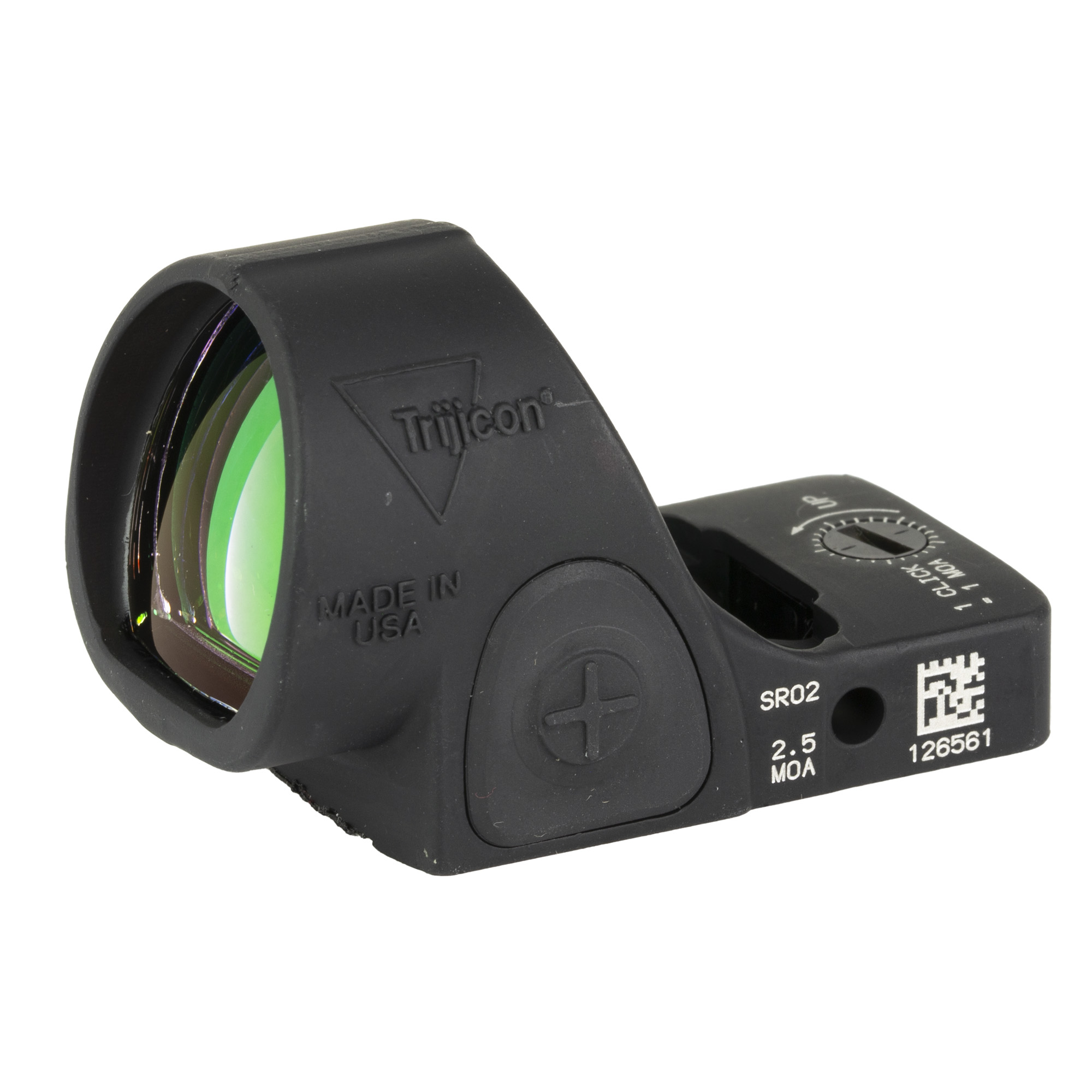
The SRO’s most recognizable feature is its rounded window. Trijicon lists the viewing area as 0.98 by 0.89 inch. Rather than filling that space with a selectable circle, the SRO presents a single red dot. The result is a straightforward visual arrangement for buyers who want the window without a more elaborate reticle.
You choose the dot size when you choose the optic: 1 MOA, 2.5 MOA, or 5 MOA. These are separate models, not three modes in one sight. The 2.5 MOA version sits in the middle of the range; the smaller and larger versions change the apparent size of the illuminated dot while keeping the same basic SRO design.
Brightness control is a meaningful part of the SRO’s appeal. You can use automatic adjustment or select a manual level. Lock-In preserves the chosen manual setting, while Lock-Out keeps the optic in automatic operation and prevents unintended button changes. Those are different functions, so it is worth deciding whether you want automatic adjustment or simply want your manual preference left alone.
The CR2032 battery is accessed from the top. Routine replacement therefore does not require removing the optic to reach a compartment underneath it. Trijicon lists more than three years of continuous operation at setting 4 of 8 and 70 degrees Fahrenheit. That is a specified-condition figure, not a promise for every brightness setting or temperature.
The SRO uses an open emitter and the RMR mounting footprint. Its forward-projecting housing still needs adequate clearance on the intended platform. The footprint tells you where the mounting interface belongs; it does not describe every part of the body above it. Our Trijicon SRO collection brings the dot-size options together.
Holosun 507COMP: More Reticle Choice in a Wider Window
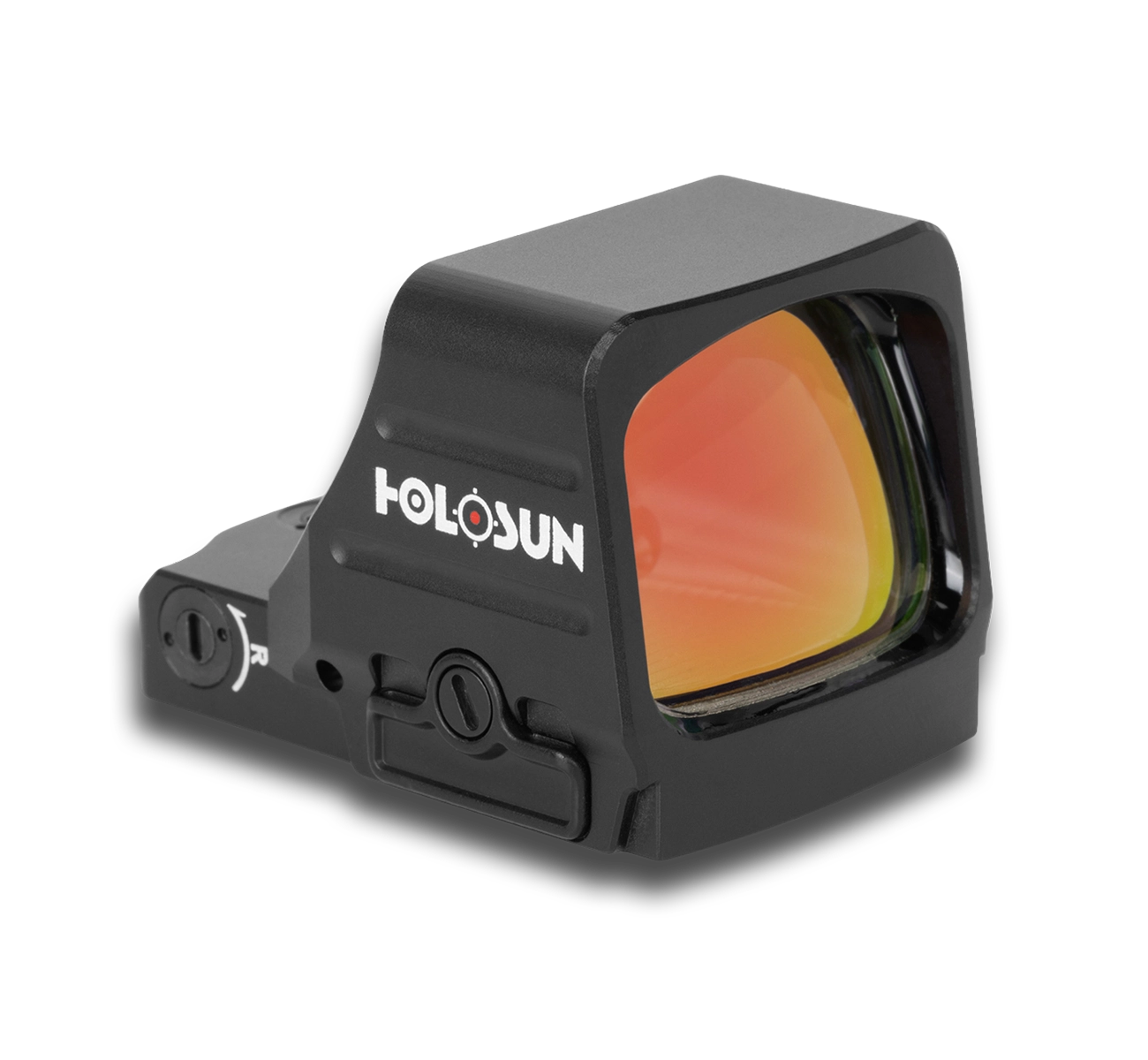
The 507COMP has a 1.1-by-0.87-inch viewing window. It is wider and slightly shorter than the SRO’s published window dimensions, with a more rectangular outline. Width and height alone do not fully describe how either optic looks through the glass, but they explain why two similarly sized sights can give different impressions.
Its reticle is the other major distinction. Holosun’s current Performance Reticle System, or PRS, uses a 2 MOA center dot with selectable 8, 20, and 32 MOA circle components. That gives you more visual choices than the SRO’s fixed single dot. You can select a plain dot or a circle combination without changing optics.
Older 507COMP documentation calls this the Competition Reticle System, or CRS. The naming difference does not, by itself, mean that a listing describes a different hardware generation. Compare the actual reticle components and exact model. Also avoid assuming that every special edition has the same configuration as the standard 507COMP.
The standard model uses manual brightness, with a lockout function to prevent accidental changes. It also has Shake Awake, which manages illumination during inactivity and wakes the optic when movement is detected. Motion activation is not automatic brightness: one concerns whether the illumination is active, while the other concerns how bright it is.
A CR1632 battery sits in a side tray. Like the SRO’s top-access arrangement, it can be reached without removing the optic. Holosun rates runtime at up to 50,000 hours at setting 6. Unlike Holosun models with Solar Failsafe, the 507COMP does not have a solar panel.
The standard family includes red, green, and gold reticle options. Color is a model choice, not a setting that turns the red version green. Explore the Holosun 507COMP collection for the available configurations.
Trijicon SRO vs Holosun 507Comp: Key Differences
| Feature | Trijicon SRO | Standard Holosun 507COMP |
|---|---|---|
| Window dimensions | 0.98 x 0.89 inch | 1.1 x 0.87 inches |
| Reticle | Single dot; separate 1, 2.5, and 5 MOA models | 2 MOA dot with selectable 8, 20, and 32 MOA circle components |
| Brightness approach | Automatic or manual | Manual |
| Battery access | Top; CR2032 | Side tray; CR1632 |
| Emitter | Open | Open |
| Mounting pattern | RMR | RMR |
| Compared version | 2.5 MOA, black | Red PRS, black |
| Advertised item price, September 18, 2026 | $542.58 | $369.99 |
The 507COMP offers greater reticle flexibility at a lower advertised price. The SRO is the closer match if automatic brightness and a particular fixed dot size are the features you want. Which advantage matters more depends on your preferences.
Window Shape and Reticle Preference
A large window can look inviting in a photograph, but shape deserves attention alongside size. The SRO has a rounded upper profile; the 507COMP emphasizes horizontal width. If you can compare them in person, look at the complete view, including the housing and the visual space around the reticle, rather than choosing from a single dimension.
Do the same with the reticle. A buyer who knows they want a 5 MOA dot has a direct SRO option. A buyer who wants to compare a central dot with several surrounding circle sizes has a direct reason to choose the 507COMP. Those are distinct preferences, not steps on a ladder from basic to advanced.
Reticle color is similarly personal. Green and gold alternatives can be appealing, but no color guarantees a perfectly round dot for every eye. An online reticle diagram cannot show how your vision will interpret an illuminated image, particularly if you notice streaking or distortion in other LED sights.
Battery Convenience and Physical Fit
Both designs avoid the inconvenience of a bottom-access battery. The SRO uses the larger CR2032 cell, while the 507COMP uses a CR1632 in its side tray. If your other devices already use one size, keeping the same battery on hand may be convenient, but battery commonality alone is rarely the strongest reason to choose an optic.
The headline runtime figures are not a direct controlled test: Trijicon’s SRO figure uses setting 4, while Holosun’s uses setting 6 under its own conditions. Brightness scales are not standardized between manufacturers. Treat both as useful maintenance information rather than translating the numbers into a guaranteed real-world advantage.
A shared RMR pattern does not guarantee compatibility with every plate or holster. The SRO’s forward overhang is especially important to check. The 507COMP’s wider upper body also needs room. Confirm the exact optic and required hardware in the accessory manufacturer’s fit information before purchasing.
Which Offers Better Value?
On September 18, 2026, the public advertised item prices were $542.58 for our 2.5 MOA SRO and $369.99 for the red 507COMP, before shipping. The $172.59 difference is substantial. These are displayed prices, not a promise about a future promotion or an email quote; the linked product pages show current purchase options.
Choose the 507COMP if the lower advertised price, wider window, and selectable reticles line up with your preferences. Its value is especially clear when those are features you want, rather than features you will leave unused. It does not need to imitate the SRO to be a compelling alternative.
Choose the SRO if you prefer its rounded view, want automatic brightness, or already know which of its three fixed dot sizes suits you. The premium buys a different experience, not a universal promise of better performance. Compare the exact SRO models and 507COMP options with those priorities in mind.
Frequently Asked Questions
Its published window is wider: 1.1 by 0.87 inches versus the SRO’s 0.98 by 0.89 inch. The SRO is slightly taller, and the different window shapes affect how each view looks.
No. Those are three separate SRO models. The dot size is fixed for the model you buy, although brightness can be adjusted.
Holosun currently uses Performance Reticle System, or PRS, for the standard 507COMP. Older documentation used Competition Reticle System, or CRS. Check the actual 2 MOA dot and circle options rather than assuming the name alone identifies different hardware.
The standard 507COMP discussed here has manual brightness and no solar panel. Shake Awake manages illumination during inactivity; it does not adjust brightness to surrounding light.
Both use the RMR mounting pattern. Their external bodies differ, so plate compatibility, clearance, hardware, and holster fit still need to be confirmed for the exact optic.
No. Both are open-emitter designs. Their electronics have environmental protection, but the light path between the emitter and lens is not sealed inside an enclosed optical chamber.
Manufacturer references: Trijicon SRO2 specifications, current Holosun 507COMP specifications, and Holosun’s earlier 507COMP manual.