
The Trijicon MRO SD vs MRO HD choice is mainly a decision about reticles, color, and battery life. The current SD gives you a simple 2 MOA dot, with separate red and green versions. The HD adds a selectable circle around its red dot. Both sit within the MRO family, but their power consumption and package options deserve a closer look before you choose.
Our take: the MRO SD is the more straightforward purchase if a single dot is all you want. The MRO HD earns its higher price when its circle-and-dot display is a feature you will actually use. Do not confuse a current SD with every older sight sold under the original MRO name, and do not compare a bare optic with a magnifier bundle as though the difference were only the sight.
In This Guide
- Trijicon MRO SD: The Current Single-Dot Model
- Trijicon MRO HD: A Dot With an Optional Circle
- MRO SD vs MRO HD: The Useful Differences
- What If You Want a Magnifier Later?
- Price and Value: When Does the HD Make Sense?
- MRO SD vs MRO HD FAQs
- Manufacturer References
Trijicon MRO SD: The Current Single-Dot Model
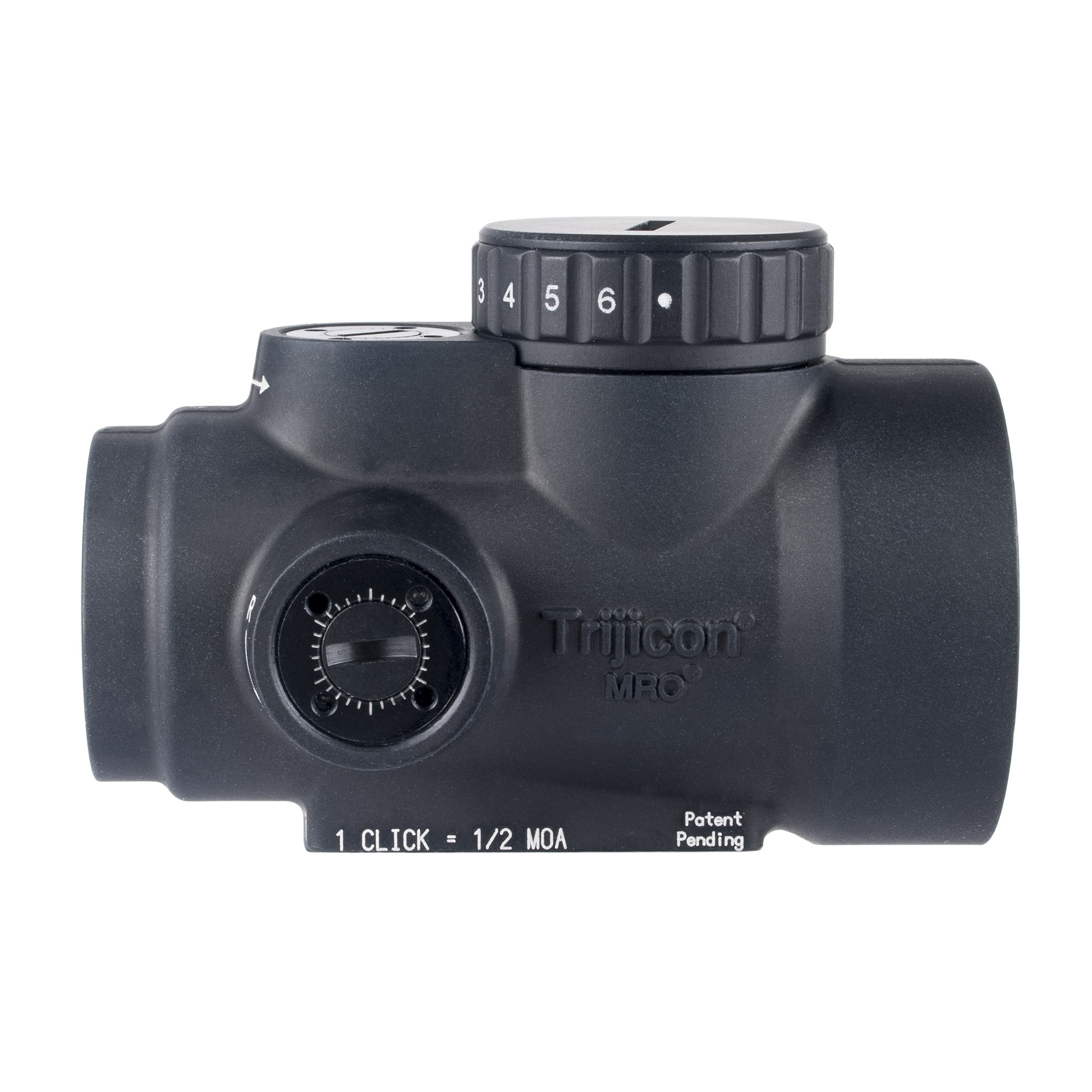
A Simple Reticle in the Updated SD
The MRO-C-2200300 is a current MRO SD with a 2 MOA red dot. Its single-dot display is a useful distinction from the HD’s more detailed reticle, but SD should not be read as shorthand for every previous MRO model. Trijicon introduced the SD with updated optical performance and magnifier compatibility, while retaining the MRO mounting footprint.
That matters when you read older comparisons. A discussion of a legacy MRO’s optical characteristics is not automatically a review of this exact SD. Compare the model number and generation first, particularly when considering older inventory or secondhand listings.
The SD is a 1x sight with a 25 mm objective, not a variable-power scope. Its dot remains a dot; there is no selectable circle hidden in the brightness control. Buyers who prefer a clean, uncluttered reticle do not need to regard that as a missing feature.
Red and Green Are Separate Purchases
Trijicon offers red and green SD variants. Our green, no-mount MRO SD is a different product from the red model pictured above. Neither changes illumination color through a setting.
The color choice also affects the published runtime. Trijicon rates the red SD for up to six years of continuous use at daylight setting three and 70 degrees Fahrenheit. The green version’s corresponding rating is up to one year. Those specifications should not be merged into a claim that every MRO SD runs for six years.
Choose the color you prefer to look through, but make that decision with the different battery specifications in mind. The red model’s longer rating may be attractive if minimizing battery consumption is a priority; it does not establish that red will appear clearer to every person.
Controls, Housing, and the Mount You Actually Receive
The SD uses a CR2032 battery and a top-mounted brightness control. Its forged 7075-T6 aluminum housing and sealed construction are part of the optic itself. A mounting base is a separate package distinction, not something implied by the MRO family name.
The no-mount model makes sense if you already have a compatible base or want to choose one separately. Other SD listings include low, full co-witness, lower 1/3 co-witness, or Q-LOC mounting arrangements. The bases affect installed height, package weight, and price, so an unusually cheap listing may simply omit something another listing includes.
The MRO SD collection groups those choices together. Check the listed mount and finish as well as the reticle color before treating two offers as equivalent.
Trijicon MRO HD: A Dot With an Optional Circle
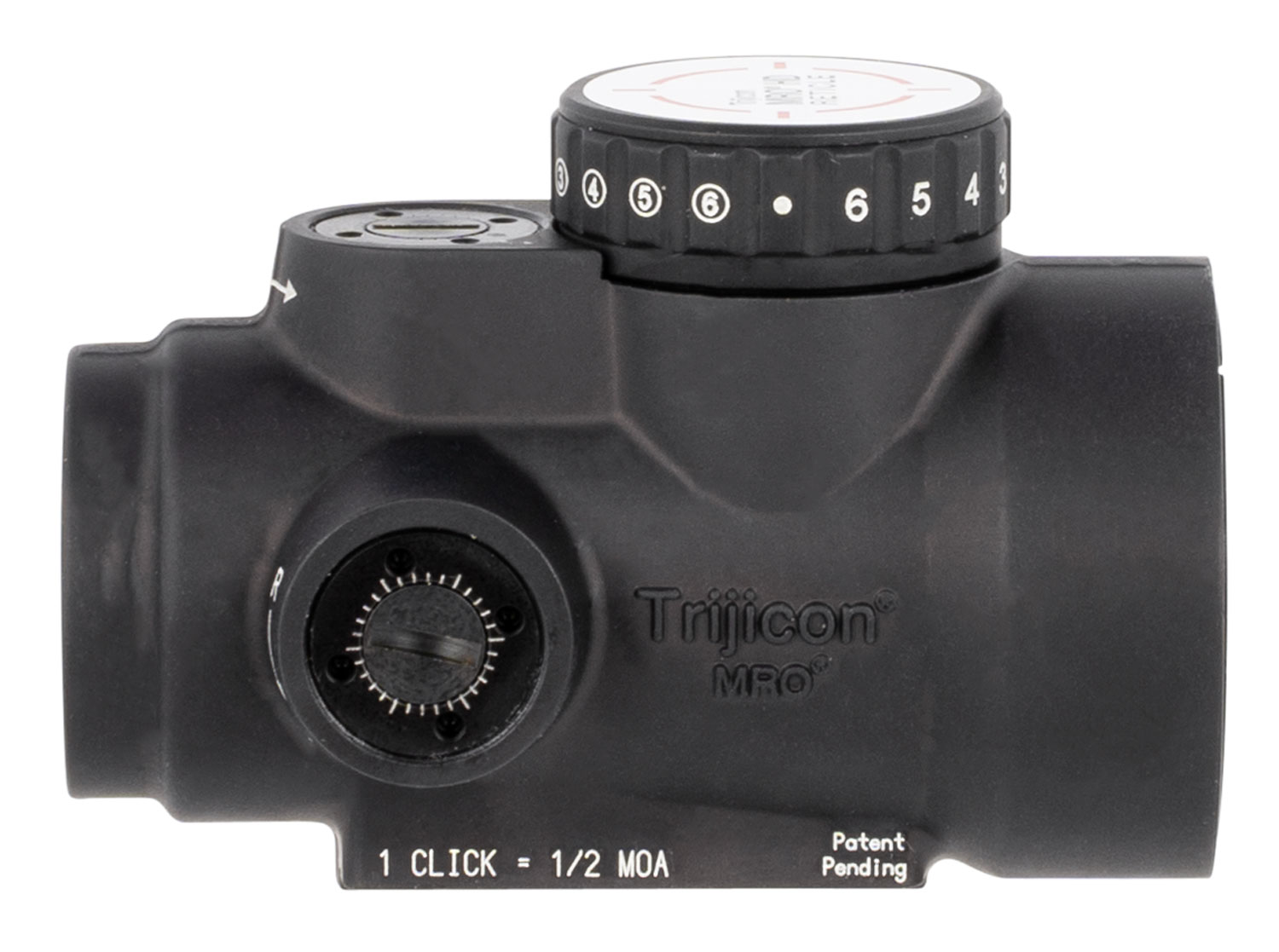
What Makes the HD Different
The MRO-C-2200050 combines a 2 MOA red center dot with a selectable 68 MOA segmented circle. It remains a non-magnifying sight with a 25 mm objective. HD does not mean that the sight itself zooms, and a magnifier shown in a different package is not built into this model.
The main attraction is choice within the same optic. You can use the simpler dot-only display or the more detailed circle-and-dot pattern. The center dot does not become larger when the circle is selected; these are different surrounding displays rather than interchangeable center-dot sizes.
That distinction also makes the buying decision more specific. If you already know you prefer a plain dot and have no interest in the circle, the SD gives you that format directly. If you want to try both displays without changing optics, the HD offers something the SD does not.
Read the HD Battery Ratings by Reticle Mode
The HD takes a CR2032, but its published runtime depends substantially on the selected reticle. Trijicon lists up to 2.5 years with the dot only and 75 days with the complex reticle, at daylight setting three and 70 degrees Fahrenheit. If you intend to leave the circle enabled, plan battery maintenance around that shorter rating.
The circle adds illuminated elements and changes the power demand. If that display is why you are buying the HD, weigh its visual appeal against more frequent battery replacement. If you prefer dot-only operation, the longer rating is the relevant starting point.
The control provides eight brightness settings for each reticle mode, including two night-vision-compatible settings per mode. The often-quoted total of 16 counts both modes together. It does not mean there are 16 independent brightness levels for every reticle.
Standard HD, Patrol, and Magnifier Packages
The standard HD should also be distinguished from HD Patrol and combo packages. Patrol configurations add accessories such as caps and an anti-reflection device; particular mounted packages include a Q-LOC base. A no-mount Patrol listing should not be assumed to contain a base merely because another Patrol package does.
A sight-and-magnifier combo includes two separate optical components and their specified mounting hardware. Compare the weight and dimensions of the complete setup, including both mounts, rather than using the sight-only figure to judge a bundle.
Our MRO HD collection lists the individual configurations. Start with the reticle you want, then decide whether an included mount, Patrol accessories, or a magnifier is worth the package price to you.
MRO SD vs MRO HD: The Useful Differences
| Feature | MRO SD | MRO HD |
|---|---|---|
| Basic display | 2 MOA dot | 2 MOA dot with selectable 68 MOA segmented circle |
| Illumination color | Separate red and green models | Red in the HD models discussed here |
| Magnification and objective | 1x, 25 mm objective | 1x, 25 mm objective |
| Battery | CR2032 | CR2032 |
| Published continuous runtime | Red: up to six years; green: up to one year | Dot only: up to 2.5 years; complex reticle: 75 days |
| Runtime conditions above | Daylight setting three, 70 degrees Fahrenheit | Daylight setting three, 70 degrees Fahrenheit |
| Mount in the compared listings | None, MRO-C-2200300 | None, MRO-C-2200050 |
| Strongest buying reason | Simple reticle, red/green choice, and longer rated runtime in the red model | Selectable circle-and-dot display |
What If You Want a Magnifier Later?
A magnifier is worth considering as a separate purchase decision, not as proof that you must buy the HD. The current SD was also designed for magnifier compatibility. The relevant questions are the exact optic, the magnifier model, and a mounting combination that gives the correct alignment and clearance.
Trijicon’s 3x magnifier is a separate accessory. Buying a bare MRO does not include it, and a picture of an MRO combo elsewhere on the site does not change the contents of a sight-only listing.
For a planned complete setup, compare the cost of the correct combo against the optic, base, and magnifier purchased separately. Compare the same components before deciding one offer is cheaper. A Q-LOC sight base and a magnifier’s flip-to-side mount serve different components and should not be counted as one shared accessory.
Price and Value: When Does the HD Make Sense?
On September 18, 2026, the black, red, no-mount MRO SD was advertised on our storefront at $500.76. The standard no-mount MRO HD was $626.10. The $125.34 difference compares item prices before shipping for two listings without mounting bases or magnifiers.
That makes the reticle decision concrete. If the circle is something you want, the HD premium buys a feature absent from the SD. If you expect to leave the HD in dot-only mode all the time, the less expensive red SD and its longer rated runtime deserve serious consideration.
Choose the SD for a single-dot display, the option of green illumination, or the strongest published red-dot battery endurance of these examples. Choose the HD for its selectable circle reticle, with a realistic understanding of the runtime in that mode. Then compare the exact mount and accessory package rather than letting the family badge make the entire decision.
MRO SD vs MRO HD FAQs
No. The SD has a 2 MOA dot. The HD has a 2 MOA dot with a selectable 68 MOA segmented circle.
The current SD is an updated model with revised optical performance and magnifier compatibility. Check the complete model number rather than applying every older MRO comparison to it.
No. Red and green SD sights are separate models. Their published battery runtimes differ as well.
Trijicon’s stated rating for the complex reticle is 75 days at daylight setting three and 70 degrees Fahrenheit. The up-to-2.5-year rating applies to dot-only mode under those conditions.
Not unless the exact listing is a combo that specifies one. The no-mount SD and HD examples in this article are sight-only listings.
The red SD is the stronger starting point if you do not want a circle reticle. In our dated no-mount comparison, it cost less and had a longer published continuous-runtime rating.
Manufacturer References
See Trijicon’s MRO-C-2200300 SD specifications, MRO-C-2200050 HD specifications, and the manufacturer-authored MRO Series specification sheet.