
The Trijicon RCR vs Aimpoint ACRO P-2 comparison begins with a shared idea: put the emitter inside a sealed optical chamber rather than leaving its light path exposed. Both are non-magnifying red-dot optics with replaceable CR2032 batteries, manual brightness controls, and a single central dot.
The biggest buying difference is not the small gap between a 3.25 and 3.5 MOA dot. It is the mounting interface. The RCR uses an RMR-pattern arrangement with its own hardware requirements. The ACRO P-2 uses Aimpoint’s ACRO interface. Those are different systems, and the cost and compatibility of the complete setup matter alongside the optic itself.
Here, we compare the Trijicon RCR1-C-3300001 with Aimpoint’s ACRO P-2, item 200691. This is a specification-based buying guide, not a claim that we conducted our own impact or endurance test.
In This Guide
- Trijicon RCR: Enclosure with an RMR-Pattern Interface
- Aimpoint ACRO P-2: A Dedicated Enclosed-Optic Interface
- Trijicon RCR vs Aimpoint ACRO P-2: Core Specifications
- The Mounting Difference Comes First
- Dot Size and Battery Figures in Context
- Cost and the Better Fit for You
- Frequently Asked Questions
Trijicon RCR: Enclosure with an RMR-Pattern Interface
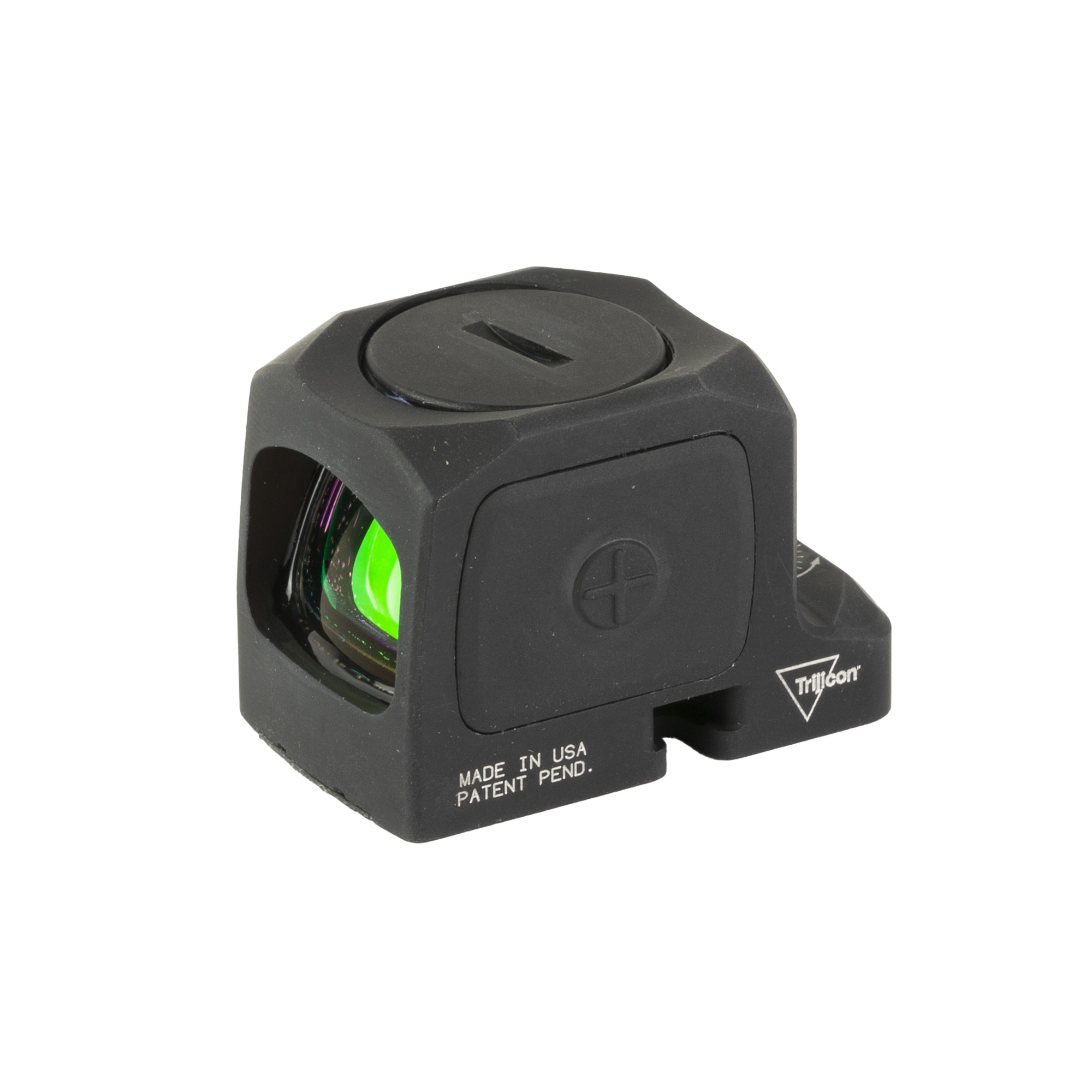
The RCR places a 3.25 MOA red dot inside a compact enclosed design. Its front and rear windows separate the emitter path from the outside environment. This is different from an open-emitter optic with weather-resistant electronics: an exposed cavity can still collect material even when the electronics are protected.
The enclosure does not keep the outside glass permanently clean. Rain, dust, and fingerprints can still affect exterior surfaces. Its purpose is to protect the internal light path, not to eliminate every form of maintenance.
The reticle is a single fixed dot. There is no selectable circle and no choice of multiple center-dot sizes within this model. Brightness is manually adjustable through ten settings, including three night-vision-compatible levels. Buyers who want a straightforward reticle and direct brightness control have a clear reason to consider that simplicity.
A CR2032 battery sits beneath a top cap. You can reach it without removing the optic. Trijicon specifies more than six years of continuous operation at setting 5 of 10 and 70 degrees Fahrenheit. That figure belongs to a defined setting and temperature, not every possible operating condition.
The RMR-pattern base makes the RCR relevant to buyers already considering that mounting family, but its hardware arrangement needs specific compatibility checks. Some plate and slide designs need an RCR-specific solution. The right question is whether your exact combination is supported, not whether both items happen to mention RMR.
See the Trijicon RCR collection for the current model and product details. The RCR’s appeal is the combination of enclosure, single-dot simplicity, and its particular mounting approach.
Aimpoint ACRO P-2: A Dedicated Enclosed-Optic Interface
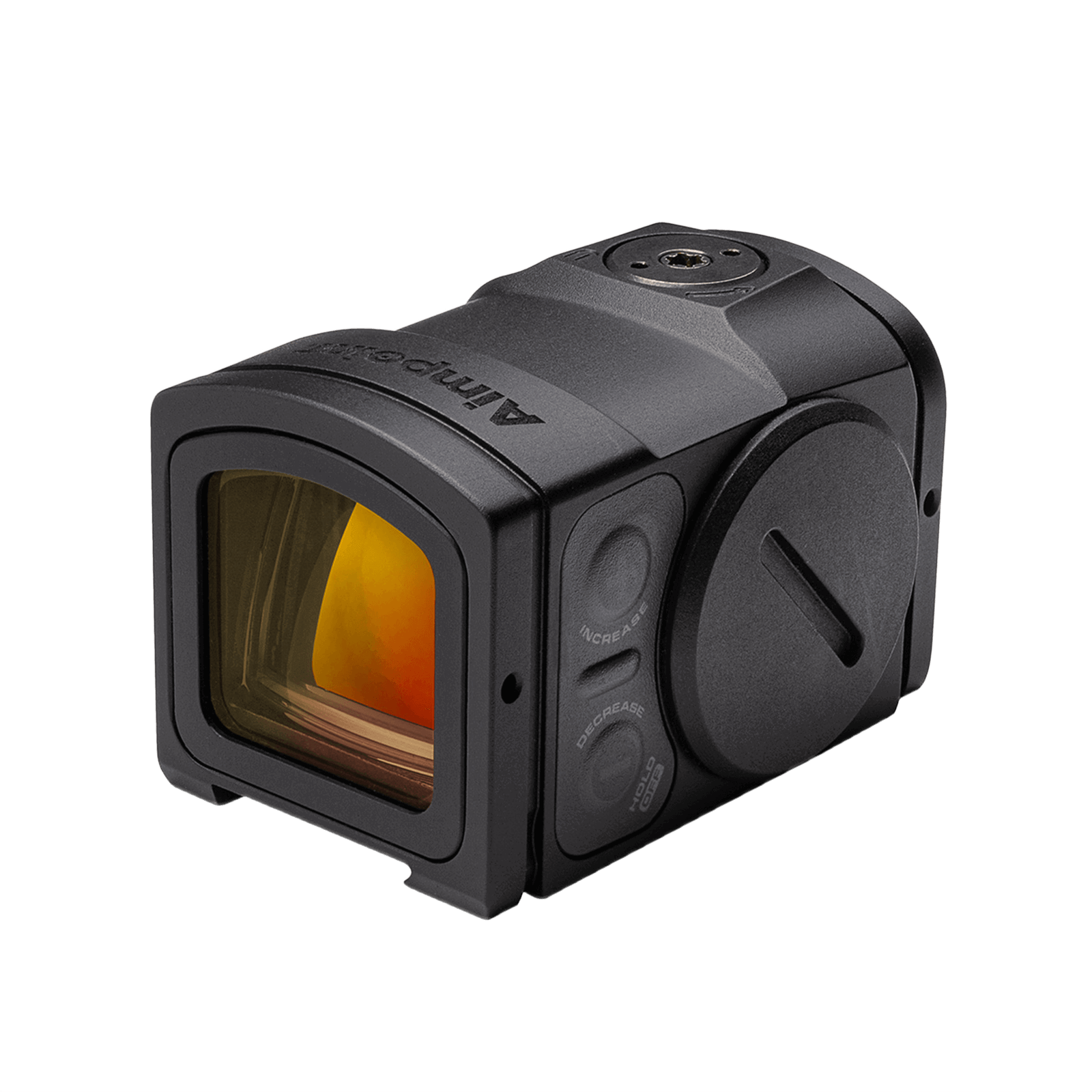
The ACRO P-2 uses a 3.5 MOA red dot in an enclosed optical system. Aimpoint lists a 15-by-15 mm clear aperture and a body measuring 47 by 33 by 31 mm. Its optic-only weight is 61 grams, or about 2.2 ounces. Those are sight dimensions, not the dimensions of a complete sight-and-adapter package.
The rectangular housing gives the P-2 a distinctive appearance. Whether you prefer that view is personal; a square window and a different surrounding body can look quite different from another enclosed optic even when both serve the same general purpose.
The P-2 uses manual brightness controls with six daylight and four night-vision-compatible settings. Like the RCR, it presents a single dot rather than a selectable ring. A buyer looking for multiple reticle patterns should recognize that neither optic in this comparison is built around that feature.
The CR2032 is accessible from the side. Aimpoint specifies 50,000 hours at daylight setting 6, at room temperature and under its stated lighting condition. The manufacturer also lists submersion resistance to 35 meters. Those are published specifications, not a comparative stress test performed for this article.
The ACRO interface is a central part of the purchase. It requires a compatible mounting solution; an existing RMR plate is not automatically an ACRO mount. Aimpoint offers platform-specific options, but the exact plate still needs to match both the intended platform and the sight.
See Aimpoint’s ACRO P-2 page for model details and compatible mounting options. Include the appropriate adapter when comparing the total cost of the two setups.
Trijicon RCR vs Aimpoint ACRO P-2: Core Specifications
| Feature | Trijicon RCR | Aimpoint ACRO P-2 |
|---|---|---|
| Emitter | Enclosed | Enclosed |
| Reticle | 3.25 MOA red dot | 3.5 MOA red dot |
| Brightness | 10 manual settings, including 3 NV | 10 manual settings, including 4 NV |
| Battery access | Top; CR2032 | Side; CR2032 |
| Published runtime | Over 6 years at setting 5 of 10, 70 F | 50,000 hours at setting 6, room temperature |
| Mounting interface | RMR pattern with RCR-specific requirements | ACRO interface |
| Magnification | 1x | 1x |
| Reticle selection | Single fixed dot | Single fixed dot |
The Mounting Difference Comes First
If you already own a suitable mounting solution, compatibility can have a larger effect on the decision than a small specification difference. Reusing a supported plate may simplify the purchase. Replacing it can add cost, change the overall height, and affect the clearance of other accessories.
For the RCR, ask whether the plate maker explicitly supports the RCR’s hardware and body. For the P-2, ask whether the solution is designed for the ACRO interface and the correct platform. Neither question is answered by a generic “optic-ready” description.
Holster compatibility deserves the same exact-model approach. The enclosure and controls can occupy different space from an open-emitter optic. A holster that accommodates a familiar compact dot does not necessarily accommodate every enclosed replacement.
Dot Size and Battery Figures in Context
The nominal dot-size difference is 0.25 MOA: 3.25 for the RCR and 3.5 for the P-2. It is a real specification difference, but it is not a sensible basis for declaring one optic universally better. Your perception of dot shape and brightness can matter more than that small numerical gap.
Neither model offers a circle to turn on or off. If your preference is an uncluttered single dot, both fit that requirement. If you are looking for the RMR HD’s selectable circle or a Holosun multi-reticle system, you are comparing a different feature set.
The runtime numbers are also easy to overread. Manufacturers use different brightness scales and test conditions. Setting 5 on the RCR is not a standardized brightness equal to setting 6 on the Aimpoint. Both provide long published runtimes, but those figures should inform maintenance expectations rather than serve as proof of superiority under identical conditions.
Top versus side battery access is mostly an ownership preference. Both avoid removing the sight just to reach the cell, and both use the widely available CR2032 format. The access location may matter if nearby accessories restrict space, so consider the complete arrangement.
Cost and the Better Fit for You
Our RCR had a public item price of $635.72 on September 18, 2026, before shipping. For a fair comparison, obtain a current price for the exact ACRO P-2 package, including any mount, and compare it with the complete RCR setup you would need.
Comparing complete packages is more useful than comparing a bare optic with a bundle. An included adapter, a particular finish, or a different mounting height can change both price and suitability. Confirm what comes in the box before treating an advertised gap as a saving.
The RCR is the natural starting point when you prefer its RMR-pattern approach and top battery access. The ACRO P-2 is the natural starting point when you prefer the ACRO mounting system and its enclosed design. Both satisfy the central requirement for an enclosed emitter and a manually controlled single red dot. The complete fit is what makes the choice personal.
Frequently Asked Questions
No. The RCR uses an RMR-pattern arrangement with specific hardware requirements. The ACRO P-2 uses Aimpoint’s ACRO interface.
Yes. Both protect the emitter path inside an enclosure. Their external windows can still collect dirt or moisture and need appropriate care.
Yes. The RCR provides top access, while the ACRO P-2 provides side access. Both use a CR2032 battery.
Its nominal size is slightly larger: 3.5 MOA versus 3.25 MOA. That small difference should be considered alongside the complete view, controls, and fit.
No. The models compared here use a single fixed red dot. A circle/dot option requires a different model family.
Not as an equal-brightness test. The stated settings and conditions differ between manufacturers. Both figures describe specific operating conditions rather than guaranteed runtime at every setting.
Manufacturer references: Trijicon RCR specifications and Aimpoint ACRO P-2 specifications.