
The Trijicon RMR HD vs SRO comparison is closer than an older RMR-versus-SRO comparison in one important respect: both have top-loading batteries. You no longer have to choose the SRO simply to avoid removing the optic for battery access. Instead, the decision turns toward reticle choice, brightness controls, window shape, and price.
The SRO offers a large, rounded window with a single dot in one of three fixed sizes. The RMR HD adds a selectable segmented circle, a forward-facing light sensor, and more configurable automatic brightness behavior. Both are open-emitter optics, so the HD name should not be read as an enclosed version of the SRO.
We use the 3.25 MOA RMR HD and 2.5 MOA SRO as the main examples. They are similar enough in center-dot size to make a useful comparison, but they are not identical. The separate 1 MOA HD and the SRO’s 1 and 5 MOA versions add further choices.
In This Guide
- RMR HD: A Configurable Circle-and-Dot Optic
- SRO: A Rounded Window and Three Fixed Dot Sizes
- Trijicon RMR HD vs SRO: Side-by-Side
- Reticle Flexibility vs a Simple View
- Controls and Clearance Matter More Than the Shared Name
- Is the RMR HD Worth the Extra Cost?
- Frequently Asked Questions
RMR HD: A Configurable Circle-and-Dot Optic
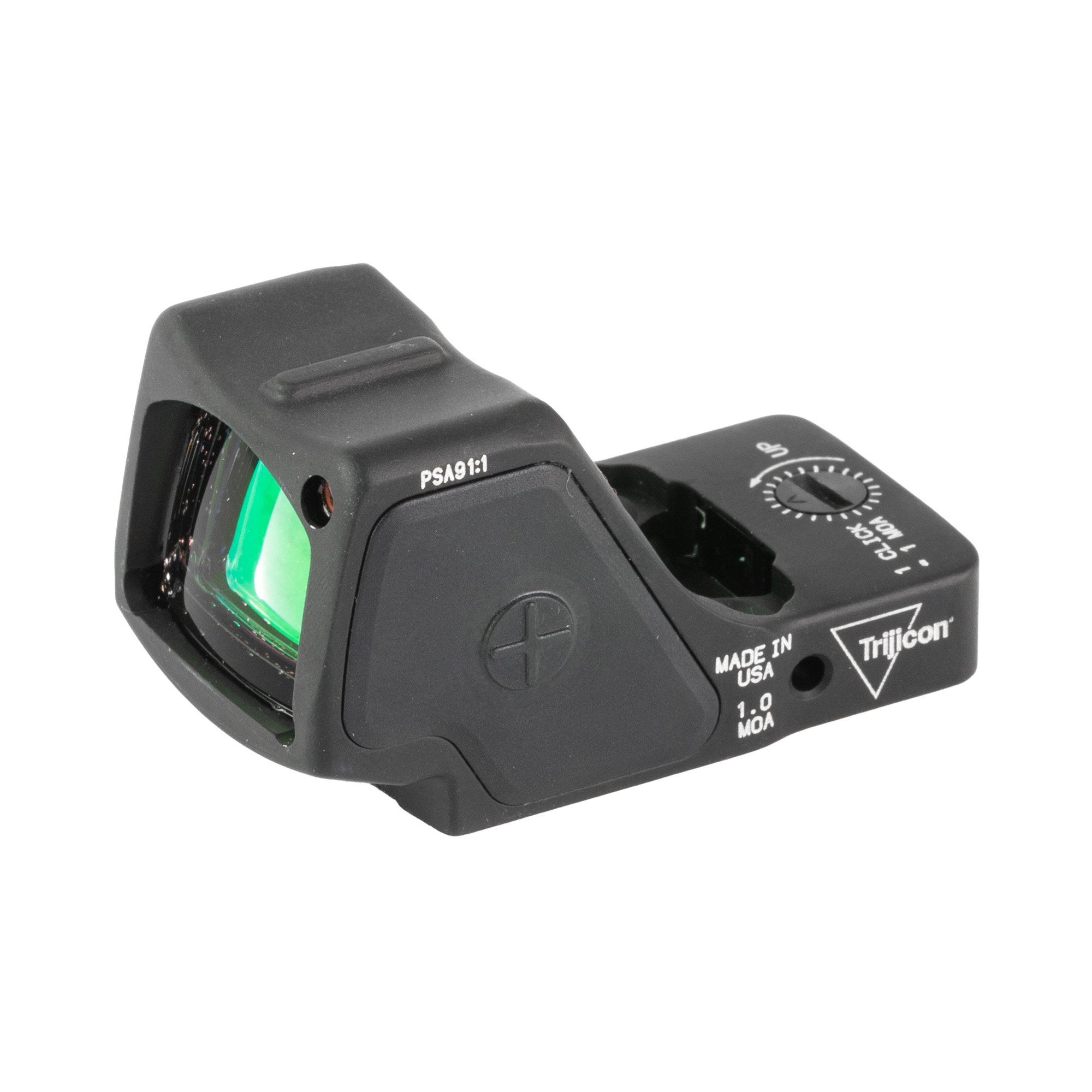
The RMR HD retains the recognizable shaped housing of the RMR family but changes more than the size of the window. Its control system lets you choose between a simple dot and a presentation that includes a 55 MOA segmented circle. The center-dot size is fixed by the model: 1 MOA in the RMHD1 or 3.25 MOA in the RMHD2.
That distinction makes the HD attractive if you want to compare two reticle styles without buying two optics. The circle is an option, not a permanent requirement. A buyer who likes a plain dot can leave the view simple, while someone who prefers a larger surrounding reference has that choice within the same model.
Brightness is another area where the HD goes beyond a basic automatic mode. Its forward-facing sensor measures lighting ahead of the optic, and the automatic response can be configured. Trijicon also provides dot-to-circle contrast adjustment. These are useful distinctions when the relationship between the central dot, circle, and surrounding light matters to your preference.
The HD uses a CR2032 beneath a top cap. The compartment is accessible without removing the optic. Trijicon specifies more than three years of battery life in dot-only mode at setting 5 of 9. Your choice of brightness and reticle can change runtime, so do not assume the same figure applies with the circle enabled.
The body uses the RMR mounting pattern but extends beyond the outline of a Type 2. A compatible mounting interface does not eliminate the need to check the HD’s physical clearance. Browse the RMR HD collection to compare the 1 and 3.25 MOA models.
SRO: A Rounded Window and Three Fixed Dot Sizes
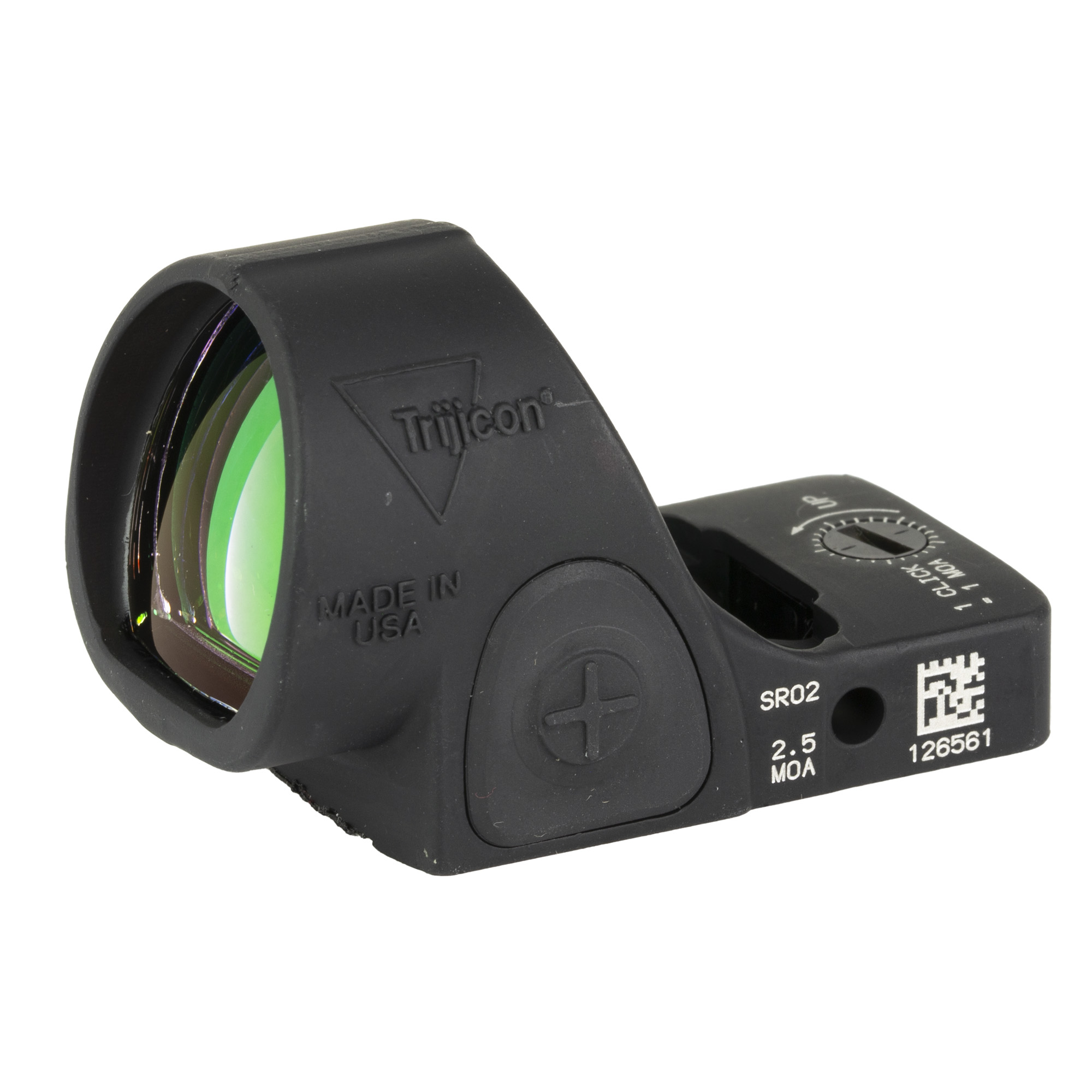
The SRO’s appeal is immediately visible in its shape. Its 0.98-by-0.89-inch window has a broad, rounded upper profile. Rather than pairing that window with a circle reticle, Trijicon offers a single red dot in three separate models: 1 MOA, 2.5 MOA, and 5 MOA.
The 2.5 MOA SRO is a middle-size choice, but it is not a selectable middle mode. Buying that version commits you to its fixed dot size. The 5 MOA model is relevant if you prefer a more prominent single dot, while the 1 MOA version provides a finer-looking illuminated point. Neither changes the fundamental SRO housing or turns it into a circle-dot optic.
The SRO has both automatic and manual brightness. Lock-In preserves a chosen manual level; Lock-Out maintains automatic operation while guarding against accidental button changes. This gives it more flexibility than an optic with manual-only controls, even though it does not have the HD’s forward-sensing and reticle-contrast feature set.
A top-access CR2032 compartment makes battery maintenance straightforward. Trijicon lists more than three years of continuous operation at setting 4 of 8 and 70 degrees Fahrenheit. The SRO and HD both have multi-year published figures, but they use different setting scales and conditions. The figures are not an equal-brightness laboratory comparison.
The SRO also shares the RMR mounting footprint, with an important qualification: its forward overhang needs suitable clearance. An RMR-compatible plate or holster should not be assumed to accommodate the entire SRO body. Explore the SRO collection for the three dot sizes, then confirm the exact fit.
Trijicon RMR HD vs SRO: Side-by-Side
| Feature | RMR HD | SRO |
|---|---|---|
| Reticle choices | 1 or 3.25 MOA center dot by model; selectable 55 MOA circle | Separate 1, 2.5, and 5 MOA single-dot models |
| Brightness | Manual and configurable automatic; forward-facing sensor | Manual and automatic; Lock-In and Lock-Out |
| Battery access | Top; CR2032 | Top; CR2032 |
| Emitter | Open | Open |
| Housing character | Shaped protective upper housing | Large rounded window |
| Mounting pattern | RMR, with HD clearance requirements | RMR, with SRO clearance requirements |
| Compared model | RMHD2-C-3200002, 3.25 MOA | SRO2-C-2500002, 2.5 MOA |
| Advertised item price, September 18, 2026 | $774.00 | $542.58 |
Reticle Flexibility vs a Simple View
The HD has the broader set of reticle options, but the SRO has a fixed 5 MOA dot that the HD does not offer. That alone can settle the question for someone who already knows they prefer that dot size. A circle around a smaller dot is a different presentation, not an exact substitute for a larger single dot.
If you are undecided between a plain dot and a circle/dot arrangement, the HD gives you room to compare both within one optic. If you dislike additional illuminated shapes in the view, the SRO’s simplicity may be more appealing. There is no need to call either preference more advanced.
Window shape deserves its own consideration. The SRO’s rounded profile is part of its appeal, while the HD has a different upper-housing outline. A product photo and a dimension sheet describe shape, but neither can fully convey how the view feels to your eyes. An in-person look is valuable when both options are available to compare.
Controls and Clearance Matter More Than the Shared Name
The HD’s forward-facing sensor is a substantive difference, not just another name for the SRO’s automatic mode. It forms part of a more configurable brightness system. That is a reason to pay attention if automatic response is one of your main requirements; it is less compelling if you intend to use manual brightness exclusively.
Both optics still require physical fit checks. The RMR pattern describes the base interface, not the full shape above it. The SRO and HD can each need more room than a compact Type 2, and an accessory designed around the older outline may not accommodate either.
Battery convenience does not break the tie because both are top-loading. This is where it is particularly easy for older RMR-versus-SRO advice to become misleading: the Type 2’s bottom battery location is not a reason to reject the HD. Compare the named models, not every product with RMR in its title.
Is the RMR HD Worth the Extra Cost?
Our public advertised item prices on September 18, 2026 were $774.00 for the 3.25 MOA RMR HD and $542.58 for the 2.5 MOA SRO, before shipping. The $231.42 difference is enough to deserve a specific reason. The current product pages show up-to-date prices and purchase options.
The HD makes sense when its circle reticle and configurable brightness features are priorities. It is harder to justify that premium solely for top battery access, because the SRO already provides it. Likewise, an enclosed emitter is not a reason to choose the HD; both optics here are open.
The SRO is the more direct choice when you want a large rounded window and a particular fixed dot size at the lower advertised price. The HD is the more configurable choice when you want its specific reticle and sensor features. Begin with those differences, then compare the exact RMR HD and SRO configurations rather than treating the price premium as proof of a universal winner.
Frequently Asked Questions
Yes. Both use a top-access CR2032 battery. The bottom-loading arrangement associated with the RMR Type 2 does not apply to the RMR HD.
No. The SRO models discussed here each have one fixed red dot. The RMR HD adds a selectable 55 MOA segmented circle around its center dot.
No. Both the RMR HD and SRO use open emitters. An enclosed Trijicon design, such as the RCR, is a separate option.
No. The HD has separate 1 and 3.25 MOA center-dot models. Its surrounding circle does not turn either into the SRO’s 5 MOA single dot.
Both use the RMR pattern, but their bodies need different clearance. Confirm support for the exact optic rather than relying only on the footprint label.
In the dated comparison here, the 2.5 MOA SRO had the lower advertised item price. Check the exact product pages for current prices, since different variants and promotions can change the gap.
Manufacturer references: RMR HD RMHD2, RMR HD RMHD1, and Trijicon SRO2.