
The Trijicon Credo vs Credo HX decision is best made by comparing exact scopes, not by assuming that the two family names describe two fixed feature sets. Both ranges include multiple magnifications, reticles, and control layouts. Both also include first- and second-focal-plane models, so “Credo is FFP and HX is SFP” is not a reliable buying rule.
A useful starting point is the 1-6×24 range. The Credo CR624-C-2900015 and Credo HX CRHX624-C-2900020 are closely matched second-focal-plane scopes with red illumination, 30 mm tubes, and capped controls. Their reticles give you a clear reason to prefer one without comparing unrelated magnification ranges.
We will look at each model first, then cover the FFP exceptions and larger HX options. The aim is to help you choose the configuration you want, rather than pay for a family label and discover that it means something different on another model.
In This Guide
- Trijicon Credo 1-6×24: A Segmented-Circle Reticle
- Trijicon Credo HX 1-6×24: The PowerDot Alternative
- Trijicon Credo vs Credo HX: Matched 1-6×24 Models
- FFP and SFP: Do Not Generalize Across Either Family
- What Changes Beyond the 1-6×24 Models?
- Illumination and Value Without the Shortcuts
- Which Credo Should You Choose?
- Frequently Asked Questions
Trijicon Credo 1-6×24: A Segmented-Circle Reticle
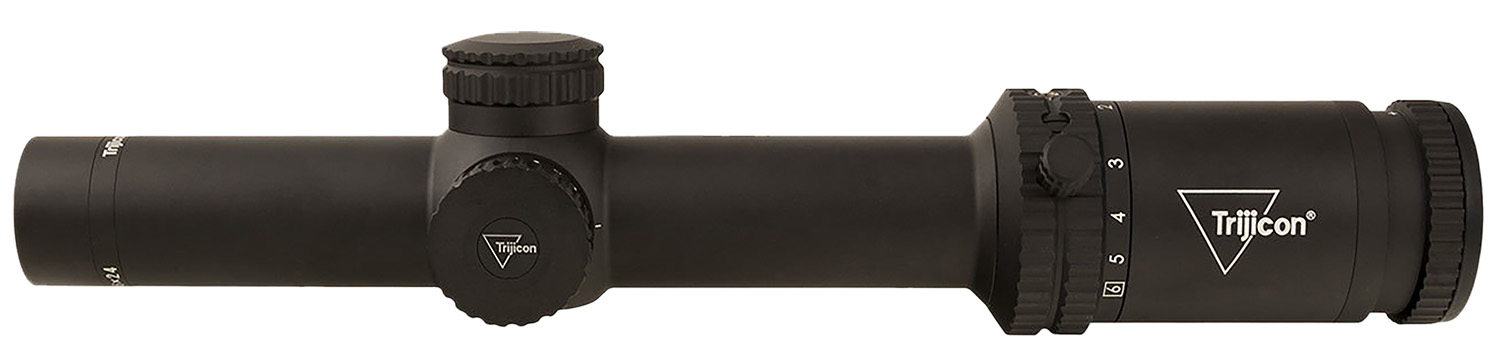
The CR624-C-2900015 pairs a 1-6x magnification range with a 24 mm objective. It has a matte-black finish, a 30 mm tube, and low capped adjusters. Trijicon lists it at 10.9 inches long and 18.9 ounces. Those dimensions make it a useful match for the corresponding 1-6×24 SFP HX rather than a larger scope with a different body.
The red BDC Segmented Circle .223/55-grain reticle is the defining visual feature. Its segmented circle is a more prominent central shape than a plain illuminated dot on a conventional crosshair. The specific calibration is part of the exact model designation; a similar-looking Credo with another reticle is not automatically the same configuration.
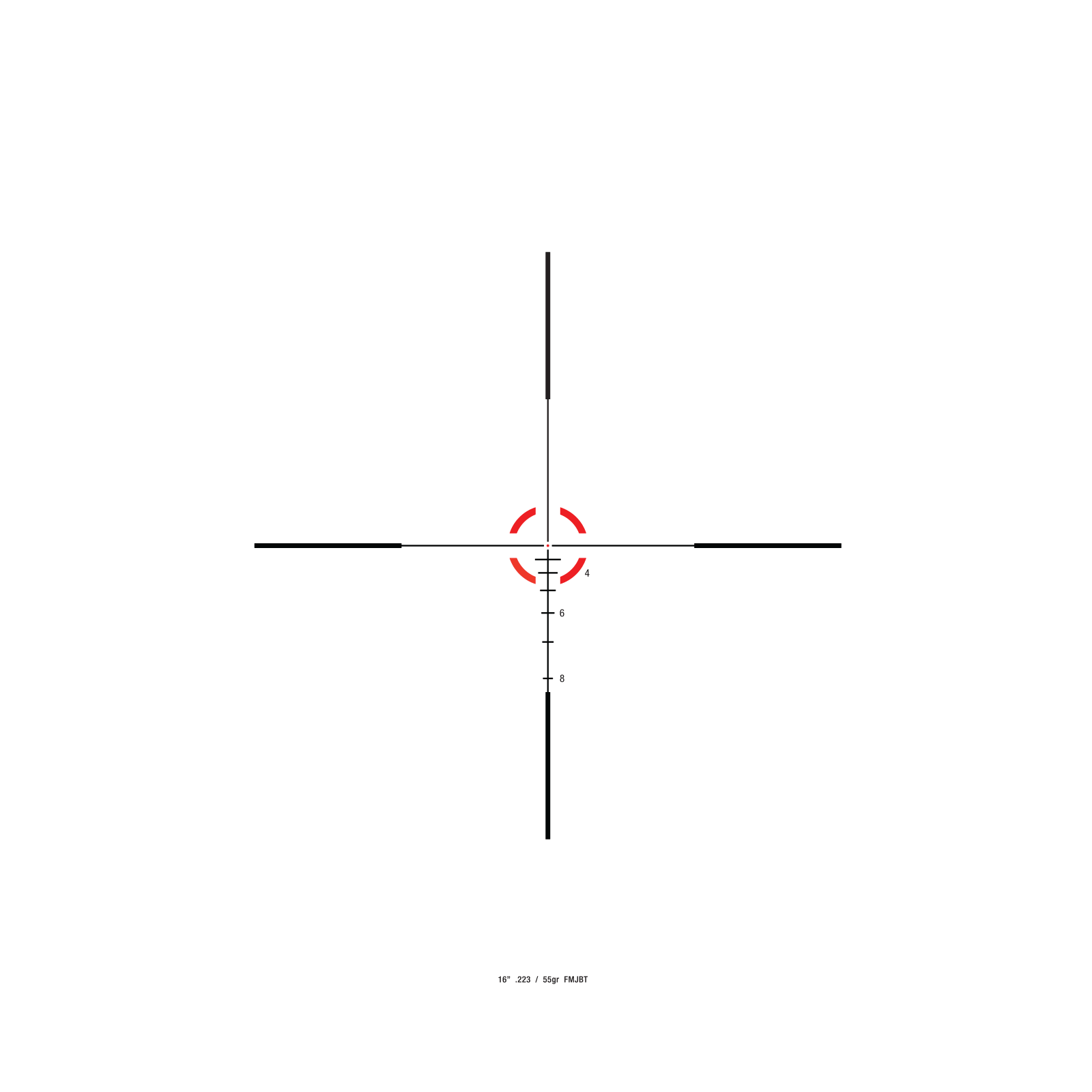
Illumination comes from an LED powered by one CR2032 battery. The brightness control lets you select a level instead of relying on a fiber-optic collector to determine the illuminated appearance. The etched reticle remains part of the optical system when illumination is off; the battery powers the lighting, not the existence of the entire reticle.
This model is SFP, or second focal plane. Its reticle appears the same size as magnification changes. That is a visual characteristic, not a statement that every Credo works the same way. A 1-6×24 FFP Credo with a red MRAD Segmented Circle is a separate choice.
The Credo collection also includes a green SFP version of the matched model. Choose by the full reticle and model description, not just the magnification printed on the side.
Trijicon Credo HX 1-6×24: The PowerDot Alternative
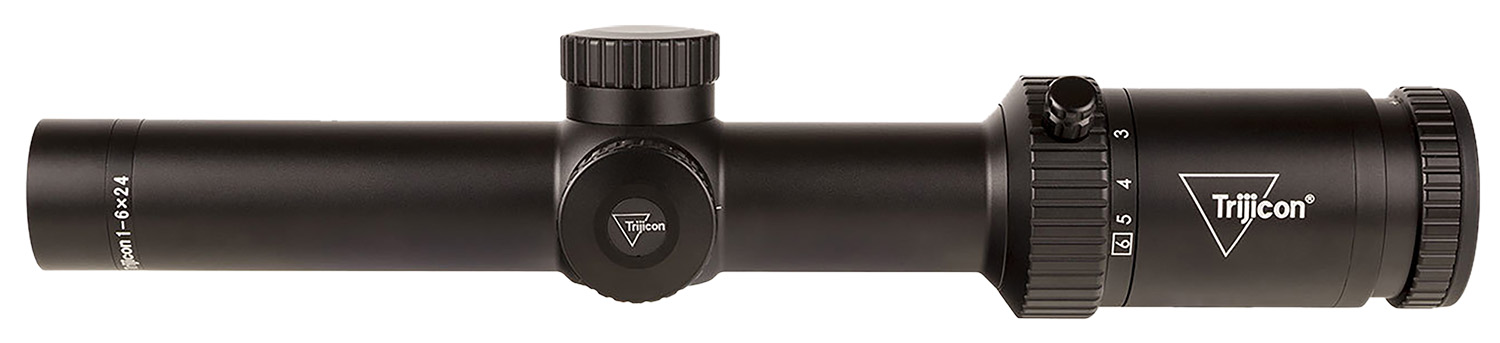
The CRHX624-C-2900020 shares several major dimensions with the Credo above: a 1-6×24 format, 30 mm tube, 10.9-inch length, and 18.9-ounce weight. It also uses low capped adjusters and a second-focal-plane reticle. The finish is satin black rather than the Credo’s matte-black designation.
Its red PowerDot BDC Hunter Holds .223 reticle presents a different central arrangement. The illuminated dot is the visual emphasis, supported by the surrounding reticle pattern. If you prefer a dot-centered presentation to the Credo’s segmented circle, that is a direct reason to consider this HX.
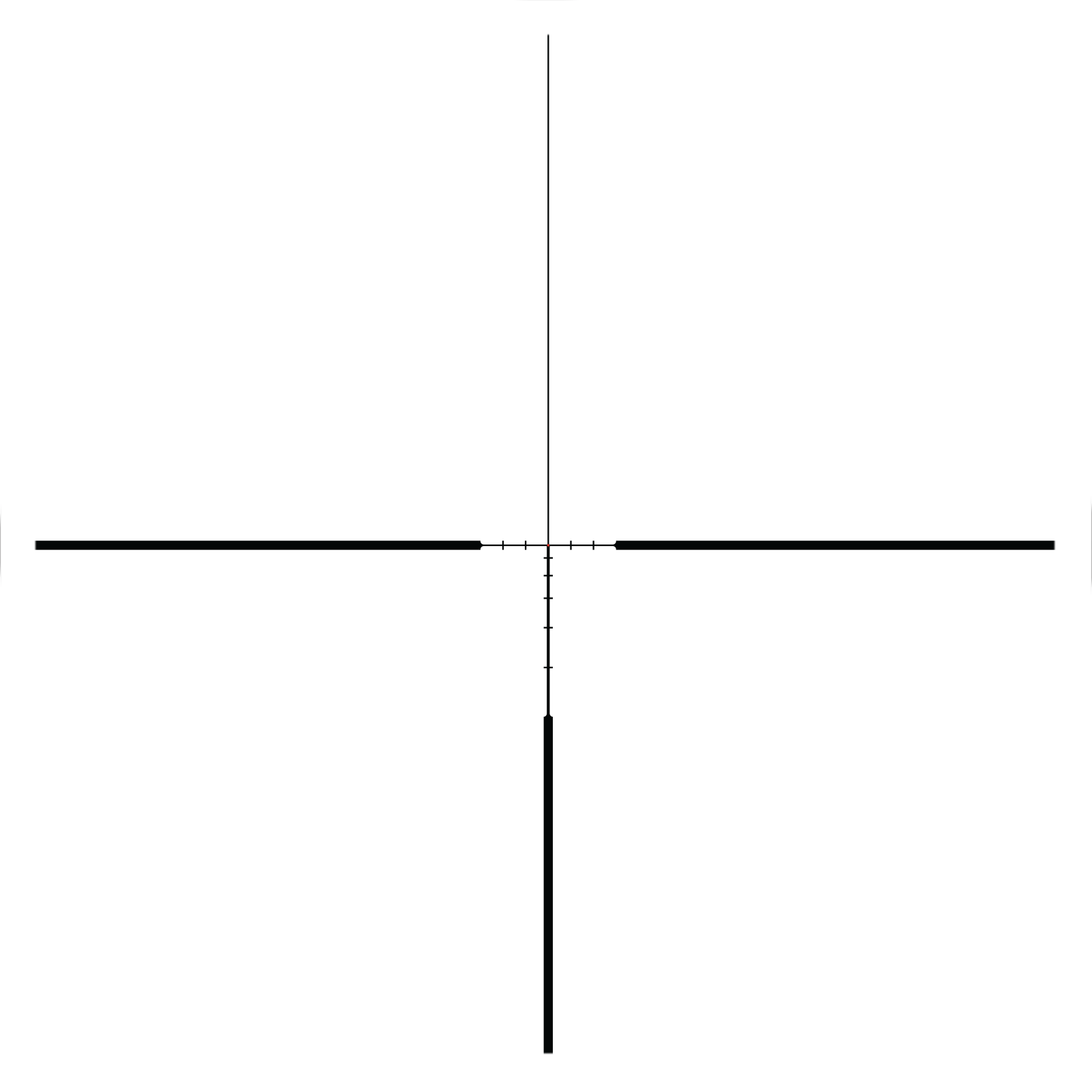
The HX uses CR2032-powered LED illumination, not the battery-free system found in the AccuPoint family. Its controls offer selectable brightness. A buyer attracted to the PowerDot should compare that actual reticle instead of assuming that HX automatically means every model has the same illumination pattern.
There are also separate green PowerDot .223 models and FFP red MOA Segmented Circle models within the HX 1-6×24 range. The latter is particularly important: it is not simply a color variant of the SFP PowerDot. Focal plane and reticle layout change together.
Our Credo HX collection lets you compare those exact configurations. Treat “HX” as the family name, then look for the features specified on the individual scope.
Trijicon Credo vs Credo HX: Matched 1-6×24 Models
| Feature | Credo CR624-C-2900015 | Credo HX CRHX624-C-2900020 |
|---|---|---|
| Magnification / objective | 1-6x / 24 mm | 1-6x / 24 mm |
| Focal plane | Second | Second |
| Reticle | Red BDC Segmented Circle .223/55-grain | Red PowerDot BDC Hunter Holds .223 |
| Tube | 30 mm | 30 mm |
| Length / weight | 10.9 inches / 18.9 ounces | 10.9 inches / 18.9 ounces |
| Illumination power | CR2032 battery | CR2032 battery |
| Adjuster style | Low capped | Low capped |
| Finish | Matte black | Satin black |
| Advertised item price, September 18, 2026 | $1,338.00 | $1,338.00 |
FFP and SFP: Do Not Generalize Across Either Family
In a second-focal-plane scope, the reticle’s apparent size stays constant as magnification changes. In a first-focal-plane scope, it grows or shrinks with the image. Those different appearances can strongly influence which reticle you find comfortable, even before you compare other features.
Both families give you a choice. The Credo CR624-C-2900023 is a 1-6×24 FFP model with a red MRAD Segmented Circle. The HX CRHX624-C-2900021 and CRHX624-C-2900022 are FFP models with red and green MOA Segmented Circle reticles, respectively.
Those examples also show why focal plane alone is not enough to establish equivalence. The Credo example uses an MRAD reticle, while the HX examples use MOA. Compare the whole configuration: focal plane, reticle pattern, illumination color, and controls.
What Changes Beyond the 1-6×24 Models?
The Credo HX 1-8×28 has a 34 mm tube, an FFP MOA Segmented Circle reticle with selectable red/green illumination, and exposed locking controls. It is not just the 1-6×24 PowerDot scope with a little more magnification.
The Credo HX 1-10×28 changes the package again, using an enhanced segmented-circle reticle and a different control arrangement, including return-to-zero elevation. Features such as locking controls and return-to-zero should be checked on the exact model rather than assigned to the whole HX family.
Likewise, a difference in body size or weight between unrelated magnification ranges does not establish a general Credo-versus-HX rule. Start with scopes that meet your preferred magnification and format, then compare the details that remain.
Illumination and Value Without the Shortcuts
Reticle drawings explain layout, but they do not reproduce actual brightness through the glass. The way a segmented circle looks on a white screen is different from seeing an illuminated reticle in person. If illumination is your deciding factor, compare the exact models under the conditions in which you can evaluate them fairly.
There is also no reason to assume that an HX suffix proves a different grade of glass or that one entire family is brighter than the other. Those sweeping statements hide the important exact-model differences and can push you toward the wrong configuration.
On September 18, 2026, both matched red SFP scopes had a public advertised item price of $1,338.00 before shipping. With no price gap in that comparison, reticle preference becomes the clearest deciding factor. Other configurations can cost different amounts, and current product pages show current pricing.
Which Credo Should You Choose?
Choose the matched Credo 1-6×24 SFP if you prefer its segmented-circle presentation and matte-black finish. Choose the Credo HX 1-6×24 SFP if the PowerDot-centered layout is the feature that appeals to you. Both provide battery-powered illumination in a closely matched physical format.
If you want FFP, move to the specific FFP models rather than discarding an entire family. If you want a different magnification range, restart the comparison at the model level. Our Trijicon LPVO collection brings those lower-magnification choices together so you can compare like with like.
Frequently Asked Questions
No. The Credo range includes both first- and second-focal-plane scopes. The CR624-C-2900015 compared here is a second-focal-plane model.
No. Credo HX includes FFP models, including the 1-6×24 MOA Segmented Circle versions and the 1-8×28 and 1-10×28 examples discussed here.
The compared scopes use a CR2032 battery for LED illumination. Their etched reticles remain present without illumination; the battery powers the lighting.
The reticle is the clearest distinction: a red BDC Segmented Circle in the Credo and a red PowerDot BDC Hunter Holds pattern in the HX. Their finish designations also differ.
No. The compared 1-6×24 scopes have capped controls, while other HX models use locking or return-to-zero arrangements. Check the exact model.
No. The matched scopes had the same advertised item price in this dated comparison. Different reticles, magnifications, and current offers can change the price relationship.
Manufacturer references: Credo CR624-C-2900015, Credo HX CRHX624-C-2900020, and the Credo HX specification sheet.