
The EOTECH 512 and 518 keep one feature that many buyers still appreciate: ordinary AA batteries. They also share the familiar ring-and-dot holographic sight picture. The decision between them is less about buying a different optical concept and more about the controls and mount you want around it.
Choose the 512 for a lighter, simpler AA-powered sight. Choose the 518 when its side buttons and raised quick-detach base are worth the extra weight and cost to you. Neither standard model adds dedicated night-vision settings.
We will look at both individually before comparing the specifications. This is a manufacturer-specification buying guide, not a claim that we performed a durability or battery-endurance test.
In this guide
- EOTECH 512: Straightforward and Familiar
- EOTECH 518: The More Convenient Control Layout
- EOTECH 512 vs 518 Specifications
- Battery Convenience: A Shared Reason to Buy Either
- Mount and Height: Which Arrangement Do You Prefer?
- Which Is Better with a Magnifier?
- Reticle and Night Vision: What the 518 Does Not Change
- 512 and 518 vs the Compact XPS and EXPS Families
- Is the 518 Worth the Extra Money?
EOTECH 512: Straightforward and Familiar
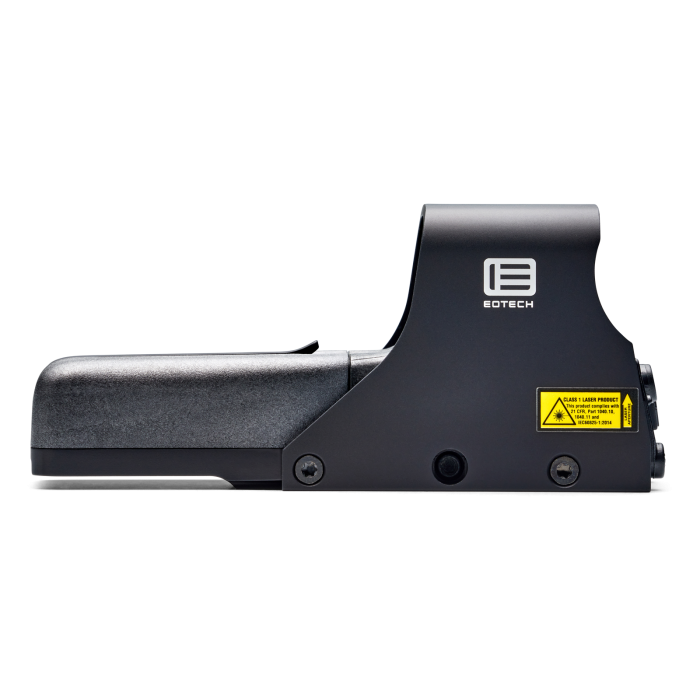
The EOTECH 512 makes a clear case for itself without trying to be the most compact sight in the catalog. It gives you the recognizable EOTECH viewing experience, an AA battery compartment and a simple mounting arrangement.
Its rear controls and cross-bolt mount are the central differences from the 518. With standard AR-height iron sights, its lower arrangement is associated with absolute co-witness. If that geometry is already what you prefer, the 512 offers it without asking you to pay for a raised QD base.
At a published 11.5 ounces, it is the lighter sight in this pair. The 5.6-inch length is worth considering if you are comparing it with a compact XPS or EXPS, but the longer AA-powered format is not inherently a disadvantage if you have no space constraint.
We would put the 512 first on the shortlist for someone who wants a standalone sight, values AA convenience and does not expect the controls or attachment to be a frustration. The reasons to buy it are concrete, not just that it is the less expensive member of a comparison.
EOTECH 518: The More Convenient Control Layout
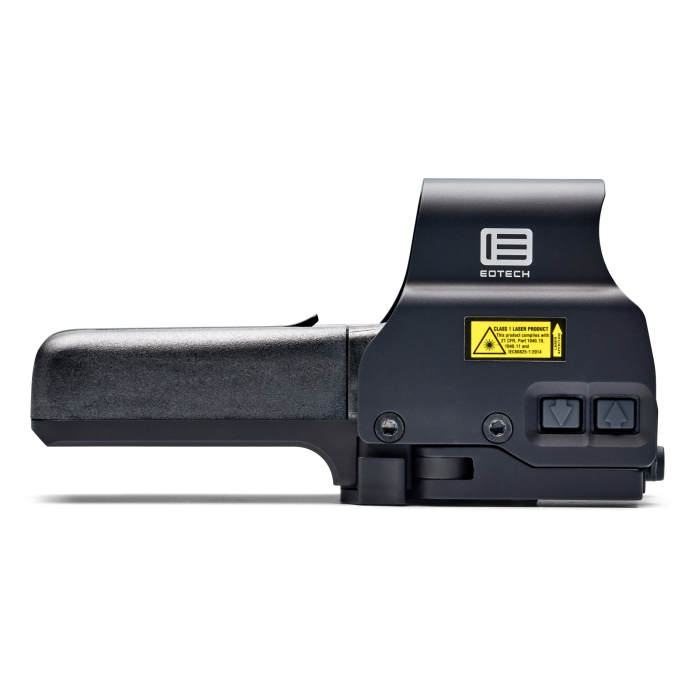
The EOTECH 518 keeps the AA-powered format and changes the parts you interact with. The buttons move to the side, and the base adds a quick-detach lever. Its raised arrangement provides lower-third co-witness with standard AR-height irons.
The side buttons are especially relevant if you intend to place a magnifier behind the sight. They avoid making the rear face the only place to reach the controls. This is a convenience advantage, not evidence that the 512 cannot work with a compatible magnifier.
The cost of those features is a heavier and taller package. EOTECH lists 13.8 ounces, compared with the 512’s 11.5. Both are the same published length, so the 518 does not solve a concern about the AA format taking up too much longitudinal space.
We would choose the 518 for its mount and controls, not because a higher number promises a sharper reticle or a fundamentally different holographic image. If you do not need those additions, the 512 remains a sensible purchase.
EOTECH 512 vs 518 Specifications
| Feature | 512 | 518 |
|---|---|---|
| Battery | Two AA | Two AA |
| Controls | Rear | Side |
| Attachment | Cross-bolt | Quick-detach |
| Length | 5.6 in | 5.6 in |
| Height | 2.5 in | 2.9 in |
| Weight | 11.5 oz | 13.8 oz |
| Dedicated NV settings | No | No |
| Standard AR co-witness | Absolute | Lower-third |
These are the standard model specifications. Co-witness descriptions assume the relevant standard-height iron sights, not every possible firearm or aftermarket arrangement.
Battery Convenience: A Shared Reason to Buy Either
AA power is a reason to consider this pair, but not a reason to favor one over the other. Both use two AA batteries. EOTECH currently lists the same rated runtime for each: 2,500 continuous hours with lithium cells or 2,200 with alkaline cells at the specified nominal setting and room temperature.
Real runtime depends on conditions and use. Those figures are useful for comparing the named models under the same published conditions, not for promising an exact replacement date.
If you already keep suitable AA batteries for other equipment, the format can be convenient. If compact size matters more than sharing a battery type, the XPS and EXPS families deserve a look. The tradeoff is physical packaging and battery preference, not simply old versus new.
Mount and Height: Which Arrangement Do You Prefer?
The 518’s quick-detach lever is a meaningful feature if that attachment style is important to you. The 512’s cross-bolt arrangement is a perfectly coherent choice when you do not need it. We would avoid paying for a QD feature purely because it sounds more premium.
The height difference is just as important. A lower-third relationship puts standard irons lower in the viewing window than absolute co-witness. That is not a quality hierarchy; it is a different visual arrangement.
If you already know which height you find comfortable, use that preference to narrow the choice. If you do not, look through representative setups where possible. A specification table can explain the difference, but it cannot tell you which view feels more natural.
Which Is Better with a Magnifier?
Our preference is the 518 when side-button access is a priority. The controls are easier to account for when shopping for a sight-and-magnifier arrangement, and you already have the raised base rather than planning an additional change around the 512.
That does not make the 512 incompatible with magnification. It means you should compare the complete intended arrangement, including the correct magnifier mount, rather than only the sight price. Neither sight includes a magnifier just because it can be used with one.
Our G33 vs G43 vs G45 guide explains the differences between the magnifiers, while the HHS collection lists complete named packages.
Reticle and Night Vision: What the 518 Does Not Change
The standard 512 and 518 both offer the familiar ring-and-dot image. The 518 is not a magnified version of the 512, and its side buttons do not add night vision. If dedicated NV settings are a requirement, neither of these standard models meets it.
This is why the upgrade should be evaluated on its actual features. A buyer expecting a different reticle technology or electronic capability would be paying for the wrong reason.
For more on the patterns themselves, read our EOTECH reticle guide. For compact NV-compatible options, the XPS3 and EXPS3 families are relevant alternatives.
512 and 518 vs the Compact XPS and EXPS Families
The XPS/EXPS format uses a single CR123 battery in a shorter body. If your main objection to either AA sight is its length, that comparison is more productive than debating 512 versus 518. Both AA models are 5.6 inches long; the standard XPS and EXPS are listed at 3.8 inches.
There is also a familiar parallel: XPS uses rear controls and the lower mounting arrangement, while EXPS uses side controls and a raised QD base. Our XPS vs EXPS guide explains that decision without assuming every buyer needs the more feature-rich body.
Is the 518 Worth the Extra Money?
Yes, if you want its specific mount and control layout. No, not automatically. Compare current prices for the exact configurations and ask whether those features would change your ownership experience.
We would choose the 512 for a lighter AA-powered standalone sight and the 518 for side controls and QD convenience. Spending less on the right configuration is a good outcome. Spending more is also reasonable when it buys the arrangement you wanted in the first place.
Compare the EOTECH 512 and EOTECH 518 at Deerford Defense for current pricing and availability.
Frequently Asked Questions
No. The standard 518 does not have dedicated NV settings, and neither does the standard 512.
No. Both use two AA batteries. Their main differences are the controls, mount, height and weight.
No. Both are listed at 5.6 inches long. The 518 is taller and heavier in the standard comparison.
Yes, with a compatible arrangement. The 518’s side buttons can make control access more convenient when a magnifier is behind the sight.
The 512 is listed at 11.5 ounces, compared with 13.8 ounces for the 518.
Sources
Manufacturer references: 512 specifications, 518 specifications and EOTECH mounting guidance.
Leave a Reply