
Choosing an Osight red dot becomes easier when you separate three decisions: the mounting footprint, whether you want an enclosed emitter, and how you want to power the sight. Model letters alone do not tell the whole story. The SE family now includes RMSc, MOS, and DPP versions, while the XE and XR offer two different battery systems in enclosed RMR optics.
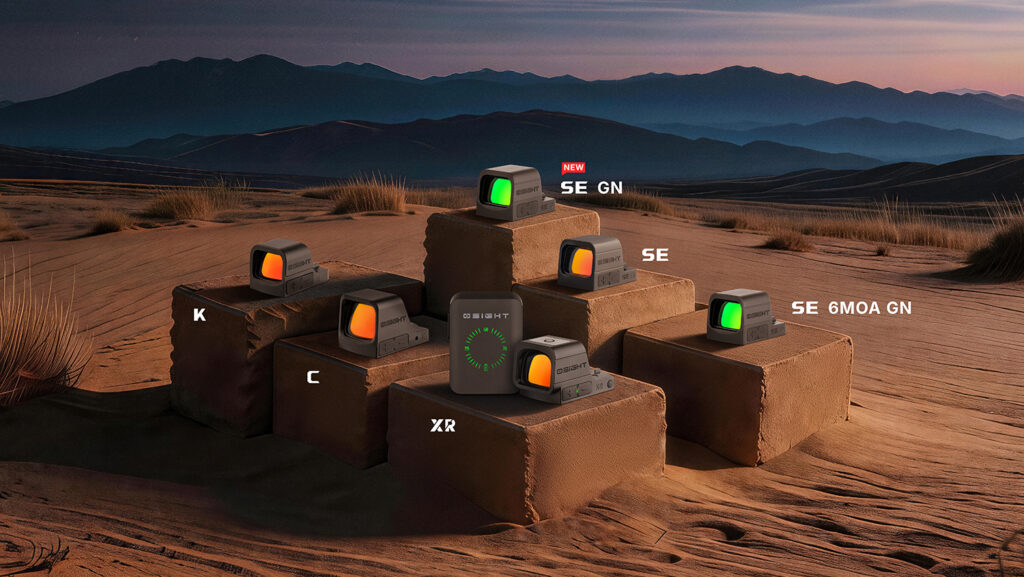
This guide explains the SE, S, K, C, X, XE AMRS, and XR, including the differences within the SE family. Start with the footprint your setup supports, then compare reticles, window size, and battery preference. You can browse the individual versions in our Osight red dot sights selection.
In This Guide
- Quick Osight Model Comparison
- Osight SE: Three Mounting Versions, Not One
- Osight S: Enclosed RMSc with Magnetic Charging
- Osight K: Fixed 6 MOA Red Dot
- Osight C: Open RMR with a Replaceable Battery
- Osight X: Taller Open Window and Rechargeable Power
- Osight XE AMRS: Enclosed RMR with a CR1632
- Osight XR: Enclosed RMR with Magnetic Charging
- Osight SE vs XR: Size, Footprint, and Battery Differences
- Which Osight Model Should You Choose?
- RMSc, RMR, MOS, and DPP: Start with Fit
- The Bottom Line
- Osight Model FAQs
Quick Osight Model Comparison
| Model | Mounting pattern | Emitter | Power system |
|---|---|---|---|
| SE RMSc | RMSc | Enclosed | Side-loading CR1620 |
| SE MOS | Compatible full-size GLOCK MOS | Enclosed | Side-loading CR1632 |
| SE DPP | DeltaPoint Pro | Enclosed | Side-loading CR1620 |
| S | RMSc | Enclosed | Rechargeable; magnetic cover |
| K | RMSc | Open | Side-loading CR1620 |
| C | RMR | Open | Side-loading CR1632 |
| X | RMR | Open | Rechargeable; magnetic cover |
| XE AMRS | RMR | Enclosed | Side-loading CR1632 |
| XR | RMR | Enclosed | Rechargeable; magnetic cover |
A footprint identifies a mounting family, not guaranteed compatibility with every handgun bearing a similar description. The exact slide or plate and the optic’s housing still need to work together.
Osight SE: Three Mounting Versions, Not One
The SE family combines enclosed emitters with side-access batteries. Its appeal is straightforward: you can choose an enclosed design without committing to a charging cover. But the RMSc, MOS, and DPP versions have different dimensions and mounting patterns, so the suffix is an important part of the product name.
SE RMSc: Compact Size and More Reticle Choices
The compact RMSc SE uses a CR1620 and has a 0.83 x 0.55-inch window. Its listed 0.97 oz weight and 1.59-inch body length put it in the same size class as the S and K. Choose between a 2 MOA dot / 32 MOA circle system or a fixed 6 MOA dot, with separate red and green versions.
The red circle-dot SE and green circle-dot SE let you select dot-only, circle-only, or both. The red 6 MOA SE and green 6 MOA SE instead provide one larger fixed dot. These are different models, not reticle colors you can change in a menu.
SE MOS: A Different Direct-Mount Version
The Osight SE MOS is built for compatible full-size GLOCK MOS slides. Its longer 2.44-inch body and CR1632 battery distinguish it from the RMSc SE. It has a red 2 MOA dot and 32 MOA circle system, with a 0.83 x 0.55-inch window.
Do not read MOS as a promise of compatibility with every GLOCK, including slimline models. This is a specific mounting version, not an RMSc SE bundled with a different name.
SE DPP: A Larger Window on the DeltaPoint Pro Pattern
The Osight SE DPP uses the DeltaPoint Pro footprint and a CR1620 battery. Its 0.91 x 0.71-inch window is larger than that of the RMSc SE. The body is 1.83 inches long and weighs 1.34 oz, with a red 2 MOA dot / 32 MOA circle reticle system.
If you are comparing these three SE versions, choose the supported mounting pattern first. The DPP’s larger window does not make it a direct replacement for an RMSc or MOS optic. Our SE collection brings the versions together for comparison.
Osight S: Enclosed RMSc with Magnetic Charging
The Osight S offers an enclosed emitter and red 2 MOA dot / 32 MOA circle system in a compact RMSc body. Its magnetic charging cover replenishes the built-in battery and displays charge levels for the sight and cover. Automatic brightness is another feature to consider if you prefer it to a fixed manual setting.
The S has the same published 0.83 x 0.55-inch window and 0.97 oz optic weight as the RMSc SE. The charging cover is separate. Choose it for the rechargeable routine and battery readout, not because the letter S means a different mounting standard or a much smaller sight.
Osight K: Fixed 6 MOA Red Dot
The Osight K uses an open emitter, RMSc footprint, and side-loading CR1620. Its fixed 6 MOA red dot keeps the reticle choice simple. There is no surrounding circle to select and no charging cover to keep track of.
The K shares the compact group’s 0.83 x 0.55-inch window, but its listed 1.02 oz weight is slightly higher than that of the enclosed SE and S. The reason to choose it is its fixed-dot, open design, not an assumed weight advantage. See our SE vs S vs K guide for the detailed comparison.
Osight C: Open RMR with a Replaceable Battery
The C moves to the larger RMR mounting family and a 0.95 x 0.75-inch window. It uses an open emitter and a side-loading CR1632, with a 3 MOA dot, 32 MOA circle, or combined reticle. Both red C and green C versions are available as distinct products.
This is the model to compare if you want an open RMR optic but prefer a conventional replacement battery. You still get circle-dot choices; you do not have to choose magnetic charging to get them.
Osight X: Taller Open Window and Rechargeable Power
The Osight X combines an open RMR design with a magnetic charging cover and automatic brightness sensing. Its 0.94 x 0.85-inch window is taller than the C’s, and its 1.30-inch body height reflects that difference. The multi-reticle system uses a 3 MOA dot and 32 MOA circle.
The X is a useful alternative to the C when the taller view and rechargeable system appeal to you. The original Osight 3 MOA green-dot model is separate from the X. Do not assume that an original Osight listing includes the X’s circle-dot modes.
Osight XE AMRS: Enclosed RMR with a CR1632
The Osight XE AMRS combines an enclosed RMR body with a replaceable side-loading CR1632. Its five red reticle modes include 2 MOA and 6 MOA dots, a 32 MOA circle, and either dot inside that circle. The 0.91 x 0.71-inch window and Collapsible Backup Rear Sight are shared features with the XR.
The XE is worth comparing if you like the enclosed XR concept but would rather replace a coin cell than charge a built-in battery. It is not a stripped-down fixed-dot model: the reticle flexibility and backup-sight feature remain.
Osight XR: Enclosed RMR with Magnetic Charging
The Osight XR provides an enclosed emitter, RMR footprint, five-mode red reticle system, and magnetic charging cover with a battery display. It also includes the Collapsible Backup Rear Sight. Its listed optic weight is 1.69 oz, excluding the charging cover.
The XE vs XR comparison is the most useful next stop if you have already decided on an enclosed RMR sight. For open alternatives, our XR vs X vs C guide compares their windows, battery systems, and body dimensions.
Osight SE vs XR: Size, Footprint, and Battery Differences
The Osight SE vs XR comparison starts with two enclosed optics built for different mounting families. The compact RMSc SE is smaller and lighter, with a 0.83 x 0.55-inch window and a side-loading CR1620. The RMR-footprint XR has a larger 0.91 x 0.71-inch window and uses a rechargeable battery with a magnetic charging cover.
Choose the compact SE if you prefer its smaller body and replaceable battery. Compare the XR if you want the larger window and magnetic charging. They are not direct substitutes for the same mounting pattern. The separately named SE MOS and SE DPP are different versions from the RMSc SE compared here.
Which Osight Model Should You Choose?
- Compact RMSc, enclosed, replaceable battery: SE RMSc.
- Compact RMSc, enclosed, rechargeable: S.
- Compact RMSc, open, fixed red dot: K.
- Compatible full-size GLOCK MOS or DPP: compare the matching SE MOS or SE DPP version.
- RMR, open, replaceable battery: C.
- RMR, open, rechargeable: X.
- RMR, enclosed, replaceable battery: XE AMRS.
- RMR, enclosed, rechargeable: XR.
RMSc, RMR, MOS, and DPP: Start with Fit
The RMSc group and RMR group are not interchangeable just because both use two mounting screws. The C, X, XE, and XR belong to the RMR family; the compact SE, S, and K belong to RMSc. SE MOS and SE DPP add two further choices with their own dimensions.
Check the exact handgun or plate manufacturer’s compatibility information. A mounting-family name does not establish screw requirements, housing clearance, or compatibility with every model in a pistol series. Getting this part right narrows the shopping list before you compare optional features.
The Bottom Line
There is no single Osight model that wins every comparison. The SE family offers enclosed optics for several mounting patterns. The S and XR bring magnetic charging to compact and larger enclosed designs. The K keeps a fixed-dot layout, while the C and X offer larger open windows. Pick the footprint first, then the power system and reticle you will enjoy using.
Osight Model FAQs
The SE RMSc, SE MOS, SE DPP, S, XE AMRS, and XR are enclosed-emitter models. The K, C, and X use open emitters.
The S, X, and XR use built-in rechargeable batteries with magnetic charging covers. The SE variants, K, C, and XE AMRS use replaceable batteries.
Both are enclosed RMR optics with five reticle modes and a collapsible backup rear sight. The XE uses a side-loading CR1632; the XR uses a rechargeable battery and magnetic cover. Their published weight and brightness settings also differ.
No. The compact SE uses RMSc, while the separately named SE MOS and SE DPP use different mounting patterns and bodies. Check the full model name.
No. The original Osight 3 MOA green-dot sight is a separate model. The X is a multi-reticle model with a 3 MOA dot and 32 MOA circle.
Manufacturer references: SE family, SE MOS, SE DPP, S, K, C, X, XE AMRS, and XR.