
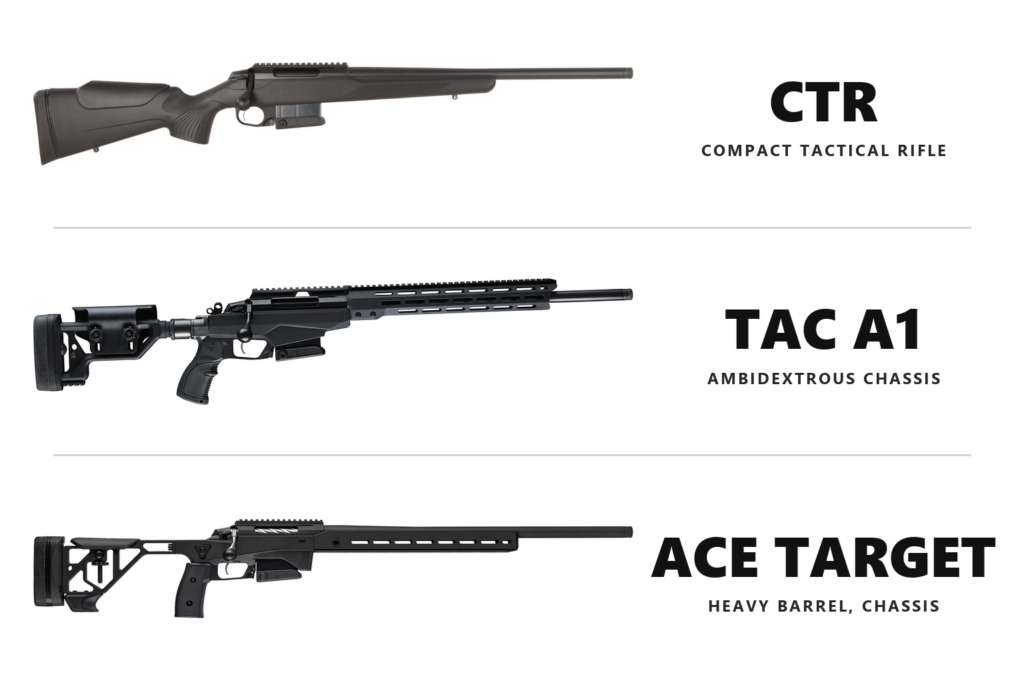
Tikka T3x Ace Game vs Target comes down to the barrel and the trigger. Both rifles use the same modular aluminum chassis, but the Ace Game has a fluted, medium-contour barrel and a single-stage adjustable trigger for precision shooting and hunting, while the Ace Target has a heavy barrel, a two-stage trigger, and a 10-round metal magazine for PRS-style shooting. You can compare both on our Tikka T3x Ace Game page.
The other tactical T3x rifles differ more in layout. The Tikka T3x CTR is a compact version of the TAC A1 in a black synthetic stock. The Tikka T3x TAC A1 is a full aluminum chassis with a two-stage trigger, and the T3x UPR uses a fiberglass stock. This is a design-and-features comparison: we do not have range data, so we describe what Tikka lists for each rifle and who it suits.
The Short Answer: Five Tikka T3x Tactical and Target Rifles
The table sorts the five rifles by the features that most often decide a purchase. Calibers and barrel lengths vary by listing, so use the sections below and each product page for the exact configuration.
| Model | Stock or chassis | Trigger | Magazine |
|---|---|---|---|
| Ace Game | Modular aluminum chassis | Single-stage, adjustable | Detachable; capacity varies by caliber |
| Ace Target | Same modular aluminum chassis | Two-stage, adjustable | 10-round metal |
| CTR | Black synthetic stock | Single-stage, adjustable | 10-round steel |
| TAC A1 | Ambidextrous aluminum chassis | Two-stage | 10-round steel box |
| UPR | Fiberglass stock with carbon fiber bedding surfaces | Single-stage | 10-round |
Tikka T3x Ace Game vs Target
Start with what the two Ace rifles share, because it is a lot. The rear stock adjusts for length of pull, cheek rest, and recoil pad, and it is skeletonized so it can take add-on weights. The thumb rest is adjustable and ambidextrous, and the pistol grip adjusts for angle and position. The magwell is interchangeable, and a 20 MOA Picatinny rail is joined by M-LOK and Arca-Swiss rails. Neither has iron sights, and both have free-floating, cold hammer-forged, threaded barrels.
The Ace Game is the one to look at if you plan to carry the rifle and hunt with it. Tikka says its fluted, medium-contour barrel is designed to reduce vibration and handle heat while staying light to carry, and the trigger is single-stage and adjustable. Barrels are 20 inches in .223 Rem and .308 Win and 24.3 inches in the other calibers we list, which include .22-250 Rem, 6.5 Creedmoor, 6.5 PRC, 7mm PRC, 7mm Rem Mag, and .300 Win Mag. Examples include the .223 Rem Ace Game and the .300 Win Mag Ace Game in Midnight Bronze.
The Ace Target is the one to look at if you shoot from a bench, a bipod, or a barricade. It has a heavy, free-floating barrel, a two-stage trigger that adjusts from 1 to 2 kg (2 to 4 lb) with an Allen key, and a 10-round metal magazine as standard. Tikka markets it for PRS shooters. Barrels are 23.7 inches in .223 Rem and .308 Win and 26 inches in 6.5 Creedmoor. The 6.5 Creedmoor Ace Target with a 26-inch barrel and the .308 Win Ace Target show the range.
The adjustable rear stock also matters in the field. You can set the length of pull for a heavy winter coat or a lighter shirt, raise the cheek rest to suit a new scope, and adjust the recoil pad. Those adjustments are the main reason to pick a chassis over a fixed stock, and both Ace rifles have them.
In short, choose the Game for field use and a lighter feel, and choose the Target for a heavier barrel, a two-stage trigger, and a larger magazine.
Tikka Ace Game Weight: What Adds and Saves Ounces
People ask about Tikka Ace Game weight a lot, but published figures for these rifles vary, so we do not quote a number. What we can tell you is what moves the scale. The fluted medium-contour barrel removes steel compared with a heavy barrel, which is why Tikka calls the Ace Game light to carry. A 24.3-inch barrel weighs more than a 20-inch barrel in the same profile, and the chassis rear stock accepts add-on weights if you want the rifle heavier. The Ace Target starts heavier because of its heavy barrel and longer lengths. A scope, rings, and a bipod add to either rifle.
Barrels and Calibers at a Glance
Barrel length is one of the clearest ways to tell these rifles apart, and we list lengths exactly as Tikka gives them. The Ace Game runs 20 or 24.3 inches, and the Ace Target runs 23.7 or 26 inches. The CTR is listed with 20-inch and 24-inch barrels, and the TAC A1 with 16-inch, 20-inch, and 23.7-inch barrels. Calibers also vary: the Ace rifles cover the widest range, from .223 Rem and .22-250 Rem to .300 Win Mag, while the CTR and TAC A1 focus on .308 Win and 6.5 Creedmoor.
Tikka CTR vs TAC A1
Tikka calls the CTR a compact version of the TAC A1 that is lighter to carry and easier to handle, for hunting and sport shooting. It has a black synthetic stock, a free-floating heavy barrel in blued or stainless steel, a Teflon-coated bolt with an oversized knob, a Picatinny rail, a single-stage adjustable trigger, and a 10-round steel magazine.
The TAC A1 moves everything into an ambidextrous aluminum chassis. It has a quickly adjustable cheek piece, adjustable length of pull, a full-length Picatinny rail, a QD rear sling mount, a two-stage trigger, and a steel 10-round box magazine. The chassis accepts common AR-15 forends, pistol grips, and rear stocks, and Tikka built the rifle for long-range tactical and precision shooting. We list both in .308 Win and 6.5 Creedmoor, such as the .308 Win CTR, the stainless 6.5 Creedmoor CTR, and the 20-inch .308 Win TAC A1.
The CTR comes in blued or stainless steel, so you can choose the finish that suits where you hunt. The right-hand TAC A1 rifles have a black chassis. Both use a threaded muzzle, which is worth knowing if you plan to add a muzzle device.
The CTR makes sense if you want a rifle you can carry afield with a conventional stock feel. The TAC A1 makes sense if you want to adjust the rifle to your body and gear and reuse AR-15 parts. Because the CTR is itself a T3x, it shares the same two-lug bolt, plunger ejector, and removable bolt handle as the TAC A1.
TAC A1 vs Ace Target
These two overlap the most. Both use a chassis, a two-stage trigger, and a 10-round steel or metal magazine, and both have a Picatinny rail. The TAC A1 is built around AR-15 compatibility: you can swap forends, pistol grips, and rear stocks, and the chassis is ambidextrous, so the TAC A1 Left-Hand in .308 Win uses the same design. The Ace Target is built around its own adjustable stock, with a skeletonized rear stock that takes add-on weights, an adjustable thumb rest, and M-LOK and Arca-Swiss rails. It also has a heavy barrel that Tikka markets for PRS shooters.
If you already own AR-15 grips or want a left-hand rifle, the TAC A1 is the more natural fit. If you shoot PRS-style courses and like Tikka’s own rails and thumb rest, look at the Ace Target. Left-hand shooters can see the full set on our Tikka left-handed rifles page.
Where the Tikka T3x UPR Fits
The T3x UPR is the odd one out because it uses a stock rather than a chassis. It has a fiberglass stock with carbon fiber bedding surfaces, a rough coating for grip, a steep pistol grip, and an adjustable cheek piece. It also has a Teflon-coated bolt with an oversized knob, a single-stage trigger, a 20 MOA Picatinny rail, and a 10-round magazine. In this group it suits the shooter who wants adjustability and a rail but prefers a stock to a chassis.
Tikka lists the T3x UPR in .308 Win and 6.5 Creedmoor, and the model is covered on our TAC A1 and UPR page.
Magazines, Calibers, and Scopes
Tikka lists a 10-round magazine for the TAC A1 and CTR, and you can find spare magazines on the Tikka T3x magazines page. If you shop by caliber, the Tikka .308 rifles and Tikka 6.5 Creedmoor rifles pages collect the models above alongside the hunting rifles. The Ace and CTR rifles have no iron sights, so you will need a scope. Our guide to the best scope mounts for the Tikka T3x covers rings, rails, and scope pairings.
Which Tikka Tactical Rifle Should You Buy?
- Hunting and carrying in a chassis: the Ace Game, with its fluted barrel and single-stage trigger.
- PRS-style shooting: the Ace Target, with its heavy barrel and two-stage trigger.
- A lighter, conventional-feeling tactical rifle: the CTR, with its synthetic stock and single-stage trigger.
- An adjustable chassis that takes AR-15 parts: the TAC A1.
- A fiberglass stock with an adjustable cheek piece: the T3x UPR.
A simple rule works for most shoppers. If the rifle will spend more time in your hands than on a bench, lean toward the Ace Game or the CTR. If it will spend more time on a bench, a bag, or a barricade, lean toward the Ace Target or the TAC A1. If you are not sure, remember that every model above has a detachable magazine and a rail, so you can start with the closest fit and add accessories later.
If you are still deciding between families, our guide to Tikka rifle models explains the whole line, including the hunting rifles and the rimfires.
Shop Tikka Tactical and Target Rifles
Every rifle above is part of the Tikka rifles range, and the table above links the model pages. To shop by caliber or hand instead, use these pages.
Related Comparisons
FAQ
They share one modular aluminum chassis. The Ace Game has a fluted medium-contour barrel and a single-stage adjustable trigger, while the Ace Target has a heavy barrel, a two-stage trigger, and a 10-round metal magazine.
Tikka designed the Ace Game’s fluted medium-contour barrel to stay light to carry, and the Ace Target uses a heavy barrel. We do not quote weights because published figures vary, so compare barrel profile and length on each product page.
No. The CTR has a black synthetic stock. Tikka calls it a compact version of the TAC A1, which is the chassis rifle.
The CTR has a synthetic stock and a single-stage adjustable trigger. The TAC A1 has an ambidextrous aluminum chassis that accepts common AR-15 parts and a two-stage trigger.
The T3x UPR has a fiberglass stock with carbon fiber bedding surfaces, an adjustable cheek piece, a single-stage trigger, and a 10-round magazine. It is covered on our TAC A1 and UPR page.
The TAC A1 and the Ace Target. The CTR, the Ace Game, and the UPR have single-stage triggers.
Tikka lists a 10-round magazine for both rifles in .308 Win and 6.5 Creedmoor. Check the fit on the magazine product page before ordering.
Leave a Reply