
The clearest difference in Trijicon Credo vs AccuPoint scopes is how they illuminate the reticle. Credo uses a battery-powered LED with selectable brightness. AccuPoint uses fiber optics and tritium, so its illumination does not depend on a replaceable battery.
That sounds simple, but it leads to a genuine choice rather than an automatic winner. Battery-free illumination is convenient, yet its appearance depends on the available light reaching the fiber-optic system. An LED gives you direct brightness control, but it adds a battery to maintain. Reticle layout and focal plane also vary by model.
For a useful comparison, we focus on the Credo CR624-C-2900015 1-6×24 and AccuPoint TR25-C-200089 1-6×24. Both are second-focal-plane scopes with 30 mm tubes, but their reticles and illumination systems offer distinctly different experiences.
In This Guide
- Trijicon Credo: Battery-Powered, Selectable Illumination
- Trijicon AccuPoint: Fiber Optics and Tritium
- Trijicon Credo vs AccuPoint: Matched 1-6×24 Scopes
- Which Illumination System Makes More Sense?
- Reticle and Focal Plane May Settle the Choice First
- Price and Ownership Considerations
- Which Scope Should You Choose?
- Frequently Asked Questions
Trijicon Credo: Battery-Powered, Selectable Illumination
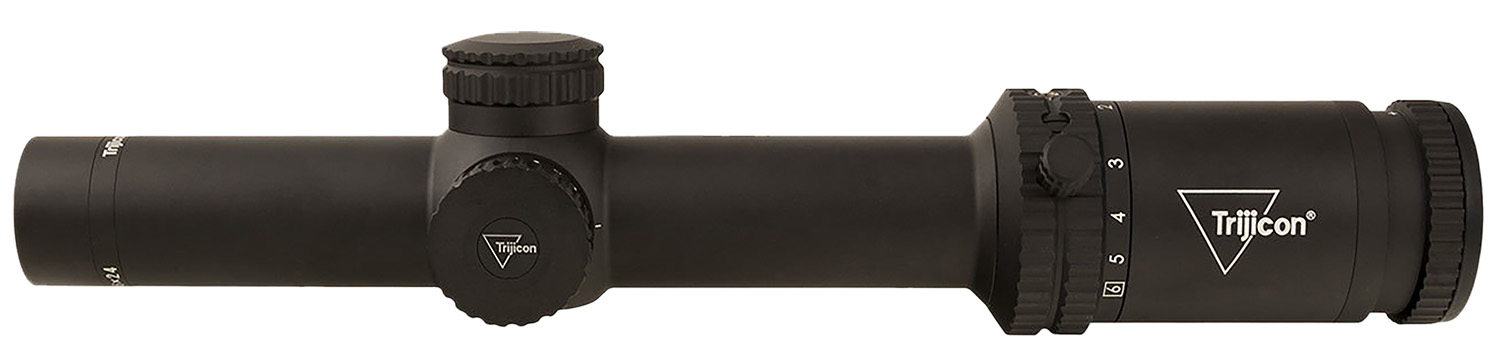
The Credo CR624-C-2900015 is a 1-6×24 scope with a red BDC Segmented Circle .223/55-grain reticle. Its 30 mm tube, capped controls, and matte-black finish make it a straightforward low-power variable configuration. The specified reticle, not just the Credo name, identifies this particular model.
Its LED is powered by a CR2032 battery. A brightness control gives you a choice of intensity instead of asking a fiber-optic collector to establish the illuminated appearance from ambient light. That is the main attraction if you want direct control over how prominent the lit portion of the reticle looks.
The segmented-circle layout is also a meaningful choice. It places a more substantial shape around the center than a plain dot on a crosshair. Buyers who like that appearance have a specific reason to consider this Credo, separate from any opinion about batteries.
This version is second focal plane, so the reticle maintains a constant apparent size while magnification changes. The green SFP version is a separate color configuration. The red MRAD FFP version changes both focal plane and reticle, so it should not be treated as the same scope with a different paint finish.
The etched reticle remains visible without LED illumination. A depleted battery removes the lighting, not the complete reticle pattern. That distinction is important when comparing the Credo with a battery-free scope: the question is how illumination works, not whether the entire optical system requires electricity.
Browse the Credo collection for exact reticle, magnification, and focal-plane choices.
Trijicon AccuPoint: Fiber Optics and Tritium
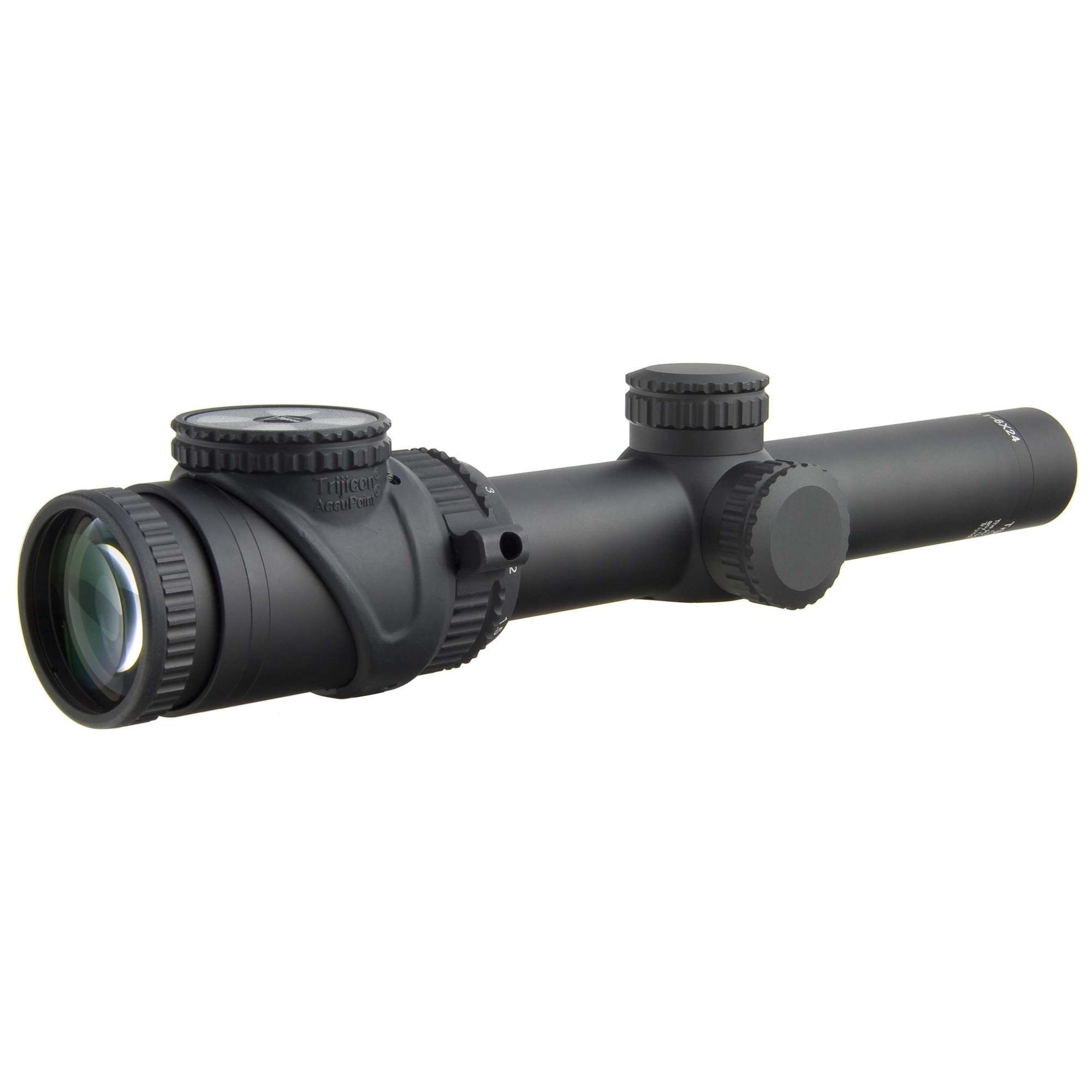
The AccuPoint TR25-C-200089 is a 1-6×24 scope with a green MOA-Dot reticle. It has a 30 mm tube, capped controls, and a matte-black finish. Its central illuminated dot sits within a different reticle arrangement from the Credo’s segmented circle, giving you a distinct visual alternative.
Fiber optics gather ambient light for illumination, while tritium provides a self-luminous source in low light. There is no CR2032 to replace and no LED brightness dial. That battery-free arrangement is the AccuPoint’s defining attraction, especially if you prefer to avoid adding another replaceable cell to your equipment.
Battery-free does not mean that the illumination looks equally bright in every environment. The fiber-optic collector responds to light where the scope is located. When that surrounding light differs from the brightness of the scene viewed through the scope, the illuminated dot can appear more or less prominent than you expect.
The illumination control can regulate how much ambient light reaches the collector. It is not an electrical booster that can create more light than the system has available. That makes it different from selecting a stronger LED setting on the Credo.
The TR25 is second focal plane. Its etched reticle remains visible independently of the illumination’s prominence. This makes a complete explanation of AccuPoint more useful than simply saying it needs no battery: you retain the reticle pattern, while the illuminated portion responds to the characteristics of the fiber-optic and tritium system.
Other TR25 choices include a green-dot duplex and a red triangle-post reticle. Those change the view substantially. Explore the AccuPoint collection by reticle rather than assuming every TR25 has the MOA-Dot pattern.
Trijicon Credo vs AccuPoint: Matched 1-6×24 Scopes
| Feature | Credo CR624-C-2900015 | AccuPoint TR25-C-200089 |
|---|---|---|
| Magnification / objective | 1-6x / 24 mm | 1-6x / 24 mm |
| Focal plane | Second | Second |
| Reticle | Red BDC Segmented Circle .223/55-grain | MOA-Dot with green illuminated dot |
| Illumination source | LED | Fiber optics and tritium |
| Replaceable illumination battery | CR2032 | None |
| Brightness approach | Selectable LED levels | Ambient-light response with collector control; tritium in low light |
| Tube / controls | 30 mm / capped | 30 mm / capped |
| Advertised item price, September 18, 2026 | $1,338.00 | $1,023.47 |
Which Illumination System Makes More Sense?
The Credo is the closer match if you want to choose an LED brightness level directly. It offers a different degree of independence from ambient light at the scope. That does not mean the reticle will look identical in every scene, but it gives you an electrical brightness adjustment rather than a light-gathering system alone.
The AccuPoint makes sense if avoiding battery replacement is a major preference and you like the reticle options. It is not an LED scope that somehow runs indefinitely without a cell; it uses a different illumination mechanism. Understanding that mechanism prevents unrealistic expectations about constant brightness.
Neither design should be reduced to “always brighter” or “always better in low light.” The exact reticle, its illuminated area, the light around the scope, and the background all affect perceived contrast. A manufacturer reticle drawing shows the pattern, not a guaranteed simulation of brightness through the glass.
Reticle and Focal Plane May Settle the Choice First
The matched models are both SFP, but their reticles are not alike. The Credo’s segmented circle and the AccuPoint’s MOA-Dot pattern give different visual emphasis. A buyer who strongly prefers one of those layouts may find the illumination decision secondary.
The AccuPoint’s triangle-post and duplex options broaden the choice further. They are not merely alternate illumination colors of the MOA-Dot. Compare the actual pattern and full model number, especially when photographs show only the exterior of the scope.
If first focal plane is a requirement, the Credo 1-6×24 FFP is a relevant alternative to the SFP Credo discussed here. In an FFP design the reticle changes apparent size with magnification; in SFP it does not. That is another reason not to generalize the entire Credo family from a single comparison.
Price and Ownership Considerations
On September 18, 2026, our advertised item prices were $1,338.00 for the matched Credo and $1,023.47 for the AccuPoint, before shipping. The AccuPoint was $314.53 less. Current prices can change, and other reticles or magnification ranges may have a different relationship.
The lower price does not establish that the AccuPoint has inferior glass, just as the higher price does not prove the Credo is the better fit. The additional cost is worthwhile when the Credo’s reticle and LED control are the features you actually want. It is less persuasive if your strongest preference is battery-free illumination.
Both compared models use a 30 mm tube, but sharing tube diameter does not settle every mounting consideration. Overall dimensions, clearance, and the exact mount still matter. Neither should be assumed to include a complete mounting solution merely because a photograph shows a familiar scope format.
Which Scope Should You Choose?
Choose the Credo if selectable LED illumination and the segmented-circle reticle are priorities. Choose the AccuPoint if you prefer battery-free illumination and one of its dot, duplex, or triangle-based reticle layouts, with a clear understanding of ambient-light behavior.
Compare the exact Credo 1-6×24 and AccuPoint 1-6×24 MOA-Dot, or browse the broader Trijicon LPVO collection. Start with the reticle you want to look through, then decide which illumination system fits your preferences.
Frequently Asked Questions
No. The TR25 models discussed here use fiber optics and tritium for illumination. They do not require a replaceable LED battery.
No. The etched reticle remains visible. The battery powers LED illumination rather than creating the entire reticle pattern.
No. Fiber-optic illumination responds to ambient light at the scope, and tritium provides low-light illumination. Perceived brightness also depends on the scene being viewed.
No. Both matched 1-6×24 models in the main comparison are second focal plane. The Credo family also includes separate FFP configurations.
No. It regulates light reaching the fiber-optic collector. It does not electrically increase illumination in the way a battery-powered LED system can.
No universal family-wide rule applies. The matched Credo was more expensive in this dated comparison, but exact model, reticle, and current pricing determine the actual difference.
Manufacturer references: Credo CR624-C-2900015, AccuPoint TR25-C-200089, and the Trijicon AccuPoint specification sheet.