
The Trijicon RCR vs RMR HD choice comes down to what you want the optic to prioritize. The RCR seals the emitter inside an enclosed housing and keeps the reticle simple. The RMR HD uses an open emitter but adds a selectable circle, more light-sensing features, and a larger window than the familiar RMR Type 2.
These are not two versions of the same product with different covers. Their controls, reticle options, bodies, and published battery-life conditions differ. Both give you top access to a CR2032 battery, so you do not have to accept bottom battery access with either choice.
We compare the RCR1-C-3300001 with a 3.25 MOA dot and the RMR HD RMHD2-C-3200002 with a 3.25 MOA dot and 55 MOA circle. The HD also comes in a separate 1 MOA version; choosing that model changes the center dot, not the basic open-emitter design.
In This Guide
- Trijicon RCR: An Enclosed Optical Path
- Trijicon RMR HD: More Ways to Configure the View
- Trijicon RCR vs RMR HD: The Main Differences
- What an Enclosed Emitter Changes
- Controls, Battery Life, and Maintenance
- Price and Fit Before You Decide
- Which Trijicon Optic Fits Your Priorities?
- Frequently Asked Questions
Trijicon RCR: An Enclosed Optical Path
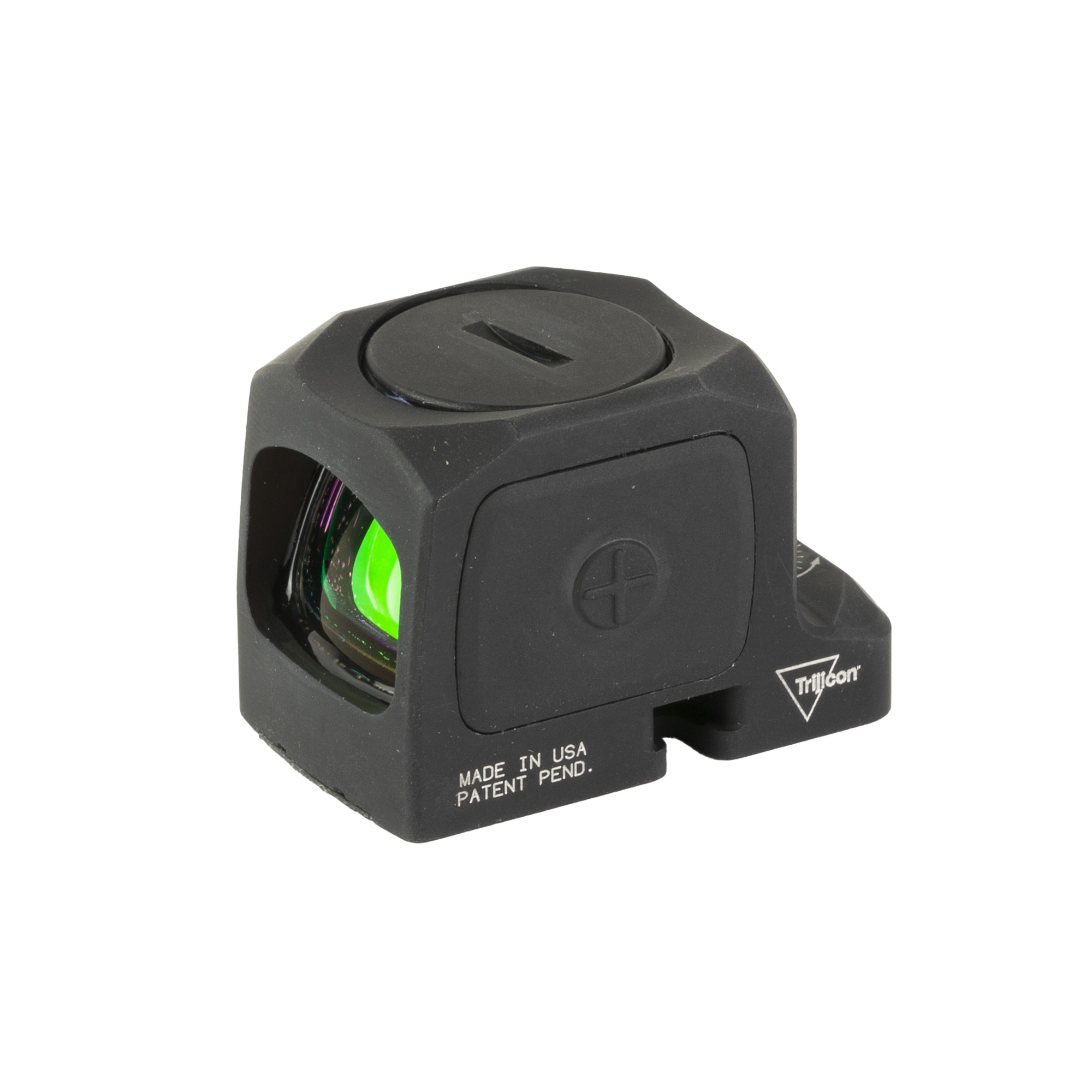
The RCR’s defining feature is its enclosure. The light path is protected within a housing with front and rear windows, rather than spanning an exposed space behind a single lens. That addresses a specific concern with open-emitter sights: material can enter the exposed area even when the electronics themselves are weather-resistant.
An enclosure does not make the outside surfaces immune to rain, dirt, or fingerprints. The windows still need to remain clear. The benefit is the separation between the external environment and the emitter path, not a promise that the optic never requires care.
The RCR uses a fixed 3.25 MOA red dot. It does not offer the HD’s selectable 55 MOA circle. For a buyer who prefers a single central dot and does not want additional reticle modes, that simplicity is a positive feature rather than a missing requirement.
Brightness is manually controlled through ten settings, including three night-vision-compatible levels and a super-bright setting. The CR2032 is accessed from the top, so reaching the battery does not require removing the optic. Trijicon’s specification lists more than six years of continuous use at setting 5 of 10 and 70 degrees Fahrenheit.
The RCR uses an RMR-pattern interface with its own mounting hardware arrangement. That should not be shortened to “fits anything an RMR fits.” Some plate and slide configurations need specific compatibility provisions. Check the exact RCR listing and the plate maker’s guidance before deciding that an existing accessory can be reused.
Our Trijicon RCR collection is the direct place to start if a sealed emitter and a straightforward dot are your priorities.
Trijicon RMR HD: More Ways to Configure the View
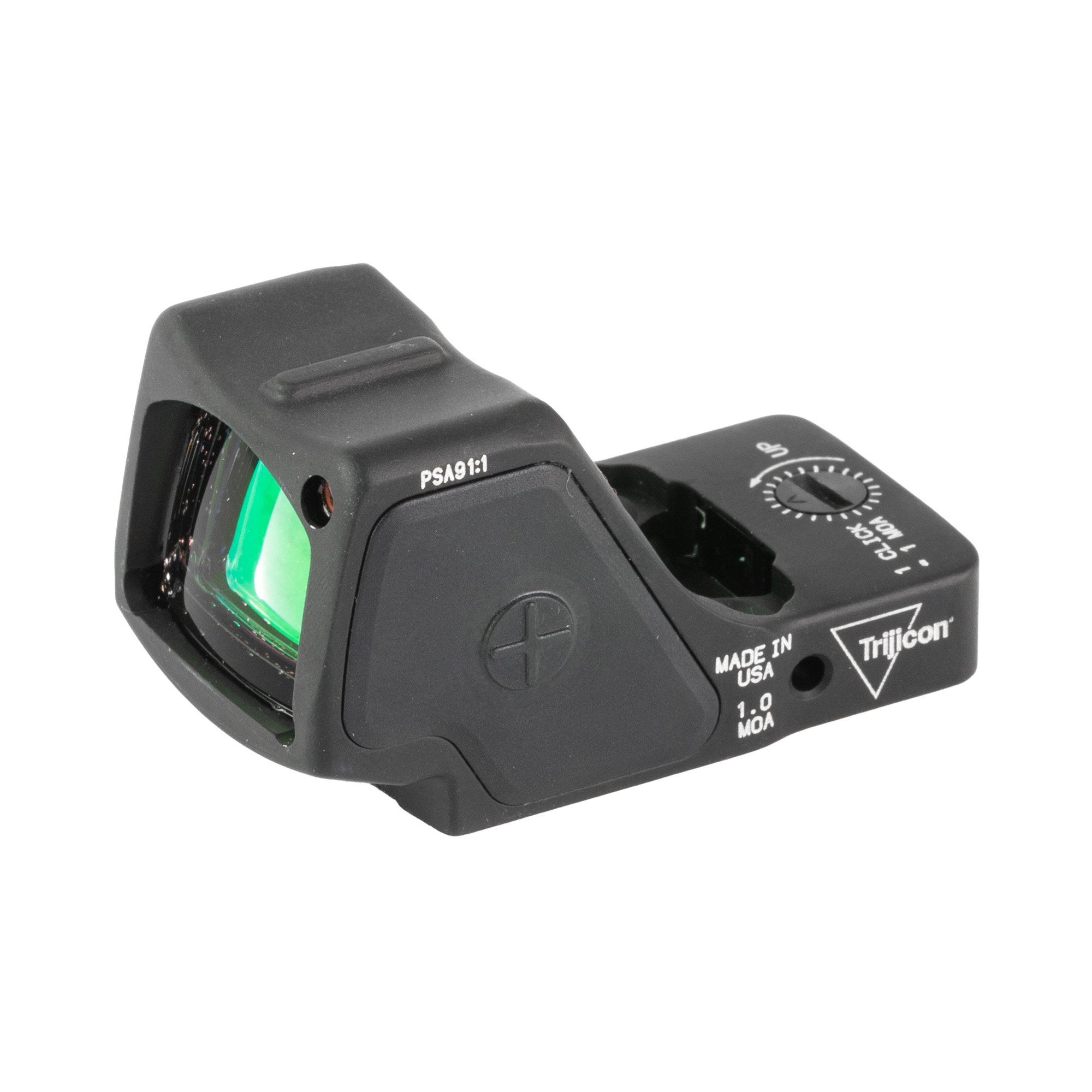
The RMR HD follows a different path. It keeps an open emitter and a shaped protective housing while expanding the window and control features compared with the Type 2. A larger window does not mean the whole optic is enclosed; the emitter path is still exposed behind the lens.
The RMHD2 has a 3.25 MOA center dot, while the RMHD1 has a 1 MOA center dot. Both include a selectable 55 MOA segmented circle. That allows a different reticle presentation without requiring a different family of optic, although you still choose the center-dot size when purchasing the model.
Brightness control is a major reason to consider the HD. It offers manual settings and automatic operation, with a forward-facing light sensor designed to assess lighting in front of the optic. Configurable automatic behavior and dot-to-circle contrast give it more personalization than the RCR’s manually controlled single dot.
Those options are valuable if you want them. If you prefer a fixed dot and a manually selected brightness level, the HD’s extra modes may have little influence on your day-to-day preference. A longer feature list is not necessarily a stronger reason to spend more.
Like the RCR, the HD has a top-loading CR2032 battery. Trijicon’s specification lists more than three years in dot-only mode at setting 5 of 9. The reticle mode is important: adding illuminated elements changes the power demand, so a dot-only runtime should not be presented as a guarantee for every circle/dot configuration.
The RMR HD collection lets you compare the 1 and 3.25 MOA variants without confusing either with a Type 2 or an RCR.
Trijicon RCR vs RMR HD: The Main Differences
| Feature | RCR | RMR HD |
|---|---|---|
| Emitter design | Enclosed | Open |
| Center dot | 3.25 MOA red | 1 or 3.25 MOA red, depending on model |
| Selectable circle | No | 55 MOA segmented circle |
| Brightness control | Manual | Manual and configurable automatic |
| Battery access | Top; CR2032 | Top; CR2032 |
| Published runtime condition | Over 6 years, setting 5 of 10, 70 F | Over 3 years, dot only, setting 5 of 9 |
| Fit consideration | RMR pattern with RCR-specific hardware and plate requirements | RMR pattern with HD body-clearance requirements |
| Advertised item price, September 18, 2026 | $635.72 | $774.00 for the compared 3.25 MOA version |
What an Enclosed Emitter Changes
The RCR’s enclosure is the strongest reason to choose it over the HD. It separates the emitter path from material that could enter an open sight’s rear cavity. For a buyer specifically shopping for an enclosed optic, the RMR HD’s other features do not replace that characteristic.
The HD’s open design should not be described as having no environmental protection. Its electronics and housing have their own specifications. The distinction is narrower and more useful: protected electronics are different from a protected light path. Keeping those two ideas separate avoids overstating either model.
The enclosure also changes the optic’s physical outline and the view through it. Before choosing solely from the words “open” or “enclosed,” consider whether you like the complete housing and window arrangement. Photographs help, but an in-person comparison can reveal preferences that a dimensions table cannot settle.
Controls, Battery Life, and Maintenance
The RCR makes sense for someone who prefers to set brightness manually and leave the reticle as a single dot. The HD is more appealing if automatic response, a circle option, and configurable contrast are reasons you are upgrading. Decide which of those features addresses an actual preference rather than choosing by the number of buttons or modes.
Battery access is effectively a shared advantage over bottom-loading designs. Both accept a CR2032 from above. Published runtime favors the RCR numerically, but the stated brightness scales and reticle conditions differ. Setting 5 on one model is not a standardized brightness measurement equal to setting 5 on the other.
Neither optic’s runtime removes the need to check the battery periodically. The useful distinction is that neither requires removing the optic simply to reach the cell. That convenience remains true even if your own replacement schedule is more conservative than the manufacturer’s maximum-runtime figure.
Price and Fit Before You Decide
On September 18, 2026, our public advertised prices were $635.72 for the RCR and $774.00 for the 3.25 MOA RMR HD, before shipping. The HD was $138.28 more. The linked products show current prices and purchase options.
The premium therefore buys the HD’s particular combination of reticle choice and light-sensing features, not an enclosed emitter. A buyer who values enclosure most may find the less expensive RCR to be the closer match. A buyer who wants the HD’s controls should not assume that choosing the RCR preserves them just because both are newer Trijicon designs.
Include any required compatible plate in the decision. The RCR’s hardware arrangement and the HD’s external dimensions each deserve explicit confirmation. Reusing an accessory is a saving only when the accessory maker supports the exact optic.
Which Trijicon Optic Fits Your Priorities?
Choose the RCR for enclosure and simplicity. Its single dot, manual controls, and top battery access make a coherent package for someone who does not need a circle reticle or automatic brightness.
Choose the RMR HD for configurable viewing and controls. Its circle/dot options and forward-facing light sensor are substantive differences, provided you are comfortable with an open emitter. Compare the RCR, 3.25 MOA RMR HD, and 1 MOA RMR HD according to those priorities, then confirm the complete fit.
Frequently Asked Questions
No. The RMR HD uses an open emitter. The RCR is the enclosed-emitter model in this comparison.
No. The RCR1-C-3300001 has a 3.25 MOA red dot. The RMR HD adds a selectable 55 MOA segmented circle around its center dot.
Yes. Both use a top-access CR2032 compartment, so reaching the battery does not require removing the optic from its mount.
No. The RCR uses manual brightness controls. The RMR HD offers manual and configurable automatic brightness with a forward-facing light sensor.
Do not assume universal compatibility. The RCR has specific hardware and plate requirements, while the RMR HD needs clearance for its body. Confirm the exact optic with the plate manufacturer.
No. Those center-dot sizes belong to separate models. The selectable circle is a feature within each model, not a way to change its fixed center-dot size.
Manufacturer references: Trijicon RCR and RMR HD RMHD2.