
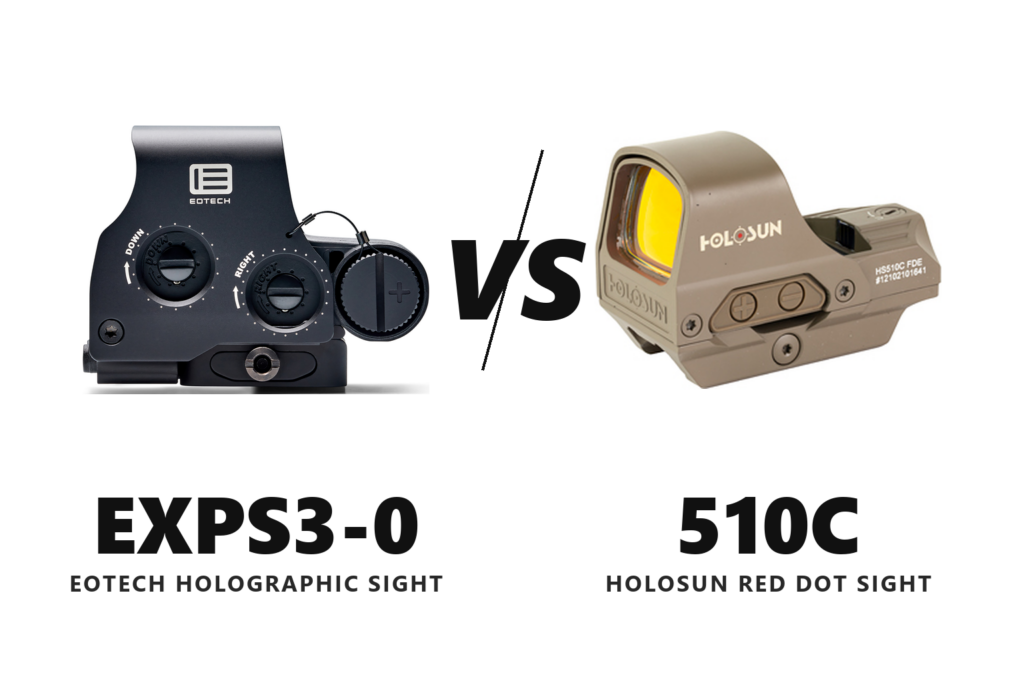
The holographic sight vs red dot choice comes down to how each sight makes its aiming point. An EOTECH Holographic Weapon Sight (HWS) uses a laser diode and holography to create its reticle, while a red dot such as the Holosun 510C, AEMS, or ARO reflects an LED dot off a coated front lens back to your eye.
Choose a holographic sight if you want EOTECH’s 68 MOA ring and 1 MOA dot, plan to add a magnifier, or need 10 night-vision settings, as long as you can live with more frequent battery changes. Choose an LED red dot if lower weight, battery life rated in the tens of thousands of hours, and features such as Shake Awake matter more to you.
| Spec | EOTECH EXPS3-0 | EOTECH XPS2-0 | Holosun 510C |
|---|---|---|---|
| Sight type | Holographic (laser diode) | Holographic (laser diode) | Open reflex (LED) |
| Reticle | 68 MOA ring, 1 MOA dot | 68 MOA ring, 1 MOA dot | 2 MOA dot, 65 MOA circle, or both |
| Battery | One CR123 | One CR123 | CR2032 (side tray) |
| Rated battery life | 1,000 hours (setting 12) | 1,000 hours (setting 12) | Up to 50,000 hours (setting 6) |
| Brightness settings | 20 daylight, 10 night vision | 20 daylight, no night vision | 10 daylight, 2 night vision |
| Listed dimensions | 3.8 x 2.3 x 2.9 in | 3.8 x 2.1 x 2.5 in | 3.3 x 1.68 x 1.78 in |
| Weight | 11.2 oz | 9.0 oz | 4.94 oz |
Figures come from EOTECH and Holosun specifications. EOTECH rates battery life at nominal setting 12 at room temperature, while Holosun rates the 510C at setting 6, so treat the runtime gap as a rough comparison.
What Is a Holographic Sight and How Does It Work?
A holographic sight is a 1x optic that creates its reticle with holography instead of reflecting an LED dot. EOTECH built its business on the Holographic Weapon Sight, and its own site puts the difference bluntly: “This is not a red dot.” The company says the HWS is powered by a laser diode instead of an LED. Here is what EOTECH says that design does on the rifle:
- Reticle and target share one focus. EOTECH says you perceive the holographic reticle as projected at the target, so you can keep both in focus.
- No forward light. According to EOTECH, the holographic image casts no light onto the target, and only the shooter can see the reticle.
- Works with a damaged window. EOTECH says the HWS keeps functioning even when the window is partially shattered or obscured by snow or mud.
- A small aiming point. EOTECH credits the laser diode for the 1 MOA dot at the center of its standard reticle.
Shoppers often call an EOTECH a “holographic red dot,” but EOTECH treats the HWS as its own category, so an EOTECH vs red dot comparison is really holographic vs LED. The company sells the HWS in three series: EXPS, XPS, and the 5 Series. All of our EOTECH holographic sights use this design, and our guide to EOTECH models explains how the series differ.
How a Red Dot Reflex Sight Works
A red dot, also called a reflex sight, uses an LED and a reflective lens instead of holography. Holosun lists an LED as the light source for its 510C, AEMS, and ARO rifle sights. Its FAQ explains the optics: the front (objective) lens is canted so it can reflect the dot or reticle back to your eye, and that lens carries special reflective coatings. Holosun notes that the coatings can cause some glare at odd angles, which is more apparent in low light and indoors with overhead lighting or backlighting.
In everyday use, “red dot” and “reflex sight” mean the same kind of optic. Holosun calls the 510C an open reflex sight and lists the AEMS and ARO as enclosed rifle sights, so the holographic vs reflex sight question is the same one this guide answers. Our Holosun 510C vs AEMS vs ARO comparison covers open versus enclosed designs in more depth.
Holographic Sight vs Red Dot: Reticle and Parallax
Reticle and Sight Picture
The reticle is the first difference you notice. The EXPS3-0 and XPS2-0 use EOTECH’s classic 68 MOA ring with a 1 MOA center dot. EOTECH says the big ring is quick to see and center, and its four hash marks guide your eye to the dot. Other EOTECH patterns, such as a dot-only reticle and ballistic reticles, are separate models, so you choose the reticle when you buy the sight.
Holosun’s Multi-Reticle System (MRS) lets you switch reticles on the optic itself. The 510C and the Holosun AEMS EVO offer a 2 MOA dot, a 65 MOA circle, or both together. The ARO Core comes in 2 MOA dot or MRS versions, and the ARO EVO’s SPR reticle combines a 1.5 MOA center dot, 1 MOA holdovers, a 65 MOA circle, and ranging marks.
The center dot is the clearest spec difference: 1 MOA on the EOTECH versus 2 MOA on most of these Holosun dots. EOTECH defines 1 MOA as about 1 inch at 100 yards, so its dot covers about 1 inch of a target at that distance, half the width of a 2 MOA dot. Both makers offer a ring or circle around the dot for fast pickup at close range, both list unlimited eye relief, and EOTECH says its large rectangular window encourages shooting with both eyes open.
Parallax
Parallax is an apparent change in point of aim when your eye position changes. EOTECH says every optic has some, and it calls the idea of parallax-free red dots and holographic sights a common misconception. It says the HWS minimizes parallax by projecting its reticle at 200 meters, with little parallax when the reticle sits in the center of the window. At the outer edge of the window, EOTECH says the error might reach 4±3 MOA at 71°F for a properly zeroed sight, and it can increase as the temperature changes.
Holosun’s spec tables list parallax as “No” for the 510C, AEMS EVO, ARO Core, and ARO EVO, and its AEMS Core X2 page says an updated optical system reduces parallax. Whichever you buy, zero and shoot through the center of the window, which EOTECH calls the optimum sighting position. EOTECH adds that parallax is typically more pronounced at close range.
Adding a Magnifier to a Holographic Sight or Red Dot
Both technologies work behind a 3x magnifier, and both makers sell matched sets. EOTECH’s HHS VIII pairs an EXPS3-0 with a G33 magnifier, while Holosun offers the ARO Core with its HM3X and similar 510C and ARO EVO combos.
This is where EOTECH makes its strongest case. It says the 1 MOA dot stays 1 MOA regardless of magnification because of how a holographic sight generates its reticle, so you see more of the target without the dot covering more of it. EOTECH goes further and says its aiming dot “does not magnify in size like it does on LED-driven red dots.” That is the maker’s claim, not our test, so compare both through a magnifier if you can.
Controls matter once a magnifier sits behind the sight. The EXPS3-0 has side buttons, which EOTECH calls ideal for adjustments with one of its magnifiers. The XPS2-0 and 512 use rear buttons, which EOTECH says allow quick adjustments without taking your eyes off the target.
Battery Life, Size, and Weight
Runtime is the red dot’s clearest win. Beyond the figures in the table, EOTECH rates the green-reticle XPS2-0 at 600 hours, while Holosun rates the ARO Core and AEMS Core X2 at up to 50,000 hours and the AEMS EVO at up to 100,000 hours.
EOTECH also offers AA power: the company says AA batteries increase battery life and are easier to find, while a CR123 is more compact and takes up less rail space. You can see that trade-off in the AA-powered EOTECH 512, which is 5.6 inches long and weighs 11.5 oz.
Holosun adds power-saving features to its dots. Shake Awake powers the sight on when it senses motion and off when it sits idle. The 510C, AEMS EVO, and ARO EVO also have Solar Failsafe, a solar panel that supplements the battery. Every Holosun dot here loads its CR2032 from a side tray, so you can change it without removing the optic.
On size and weight, the table tells the story: the 510C weighs less than half as much as the EXPS3-0. That difference adds up on a rifle you carry all day.
Night-Vision Compatibility
Night-vision use depends on the model, not the technology. The EXPS3-0, one of EOTECH’s night-vision models, adds 10 settings for Gen I through III+ night-vision devices to its 20 daylight settings. The XPS2-0 and 512 have no night-vision settings, so skip them if you run night vision.
The Holosun rifle dots in this guide all include night-vision settings: two on the 510C, ARO Core, and AEMS Core X2; four on the AEMS EVO and ARO EVO. Holosun notes one quirk on its solar models: in Auto Mode, the reticle dims in darkness to a night-vision setting you can’t see without a night-vision device, and covering the solar cell does the same. If night vision is a priority, the EXPS3-0 gives you the most night-vision settings of any sight here.
Astigmatism: Holographic Sight or Red Dot?
Shooters with astigmatism often ask whether an EOTECH will look sharper than a red dot. Holosun addresses the issue in its FAQ, saying a starburst effect or misshapen dot can be caused by astigmatism. It suggests three things to try:
- Focus on the target, not the dot.
- Wear your prescribed corrective lenses, if you have them.
- Turn the brightness down one or two steps.
Holosun also gives a quick check: rotate the uninstalled optic while you look at the dot. If the odd shape turns with the optic, there may be an electronic or mechanical issue. If it doesn’t, that is how your eye perceives the reflected dot.
We can’t promise that either technology will look better to your eyes. You may see the EOTECH ring and dot differently from an LED dot, so look through both at the brightness you would actually use before you buy.
Which Should You Buy?
Most red dot vs holographic sight decisions come down to magnifiers, night vision, and how often you want to change batteries. Pick a holographic sight if:
- you want EOTECH’s ring-and-dot reticle, especially behind a magnifier;
- you run night vision and want the EXPS3-0’s dedicated night-vision settings;
- you don’t mind keeping spare CR123 or AA batteries on hand.
Pick an LED red dot if:
- you want a lighter optic and a battery you rarely have to think about;
- you like Shake Awake, Solar Failsafe, or switching between a dot and a circle;
- you prefer an enclosed emitter, like the AEMS or ARO.
For a general-purpose AR, our holographic pick is the XPS2-0, which is lighter and more compact than the EXPS3-0. Choose the EXPS3-0 instead for night vision or for side controls behind a magnifier. On the LED side, the 510C is the straightforward choice, with its integrated quick-detach mount and Solar Failsafe. Comparing brands rather than technologies? Read EOTECH vs Holosun and EOTECH vs Aimpoint.
Shop Holographic Sights and Red Dots
We carry both technologies, so you can shop them side by side. Start with the collections below or go straight to the models this guide covers. Every product page lists the model’s full specifications.
- EOTECH holographic sights: every HWS we carry, including the XPS2, EXPS3, and 5 Series.
- EOTECH EXPS3-0, Black: night-vision settings and side buttons.
- Holosun rifle and AR red dots: the 510C, AEMS, ARO, and other rifle dots.
- Holosun ARO EVO: an enclosed sight with a 26mm window and Solar Failsafe.
Related Comparisons
FAQ
Neither is better for everyone. A holographic sight such as the EOTECH EXPS3-0 pairs a 68 MOA ring with a 1 MOA dot that EOTECH says stays 1 MOA under magnification. An LED red dot such as the Holosun 510C is lighter and rated for far longer battery life.
It is a 1x sight that creates its reticle with holography instead of reflecting an LED dot. EOTECH, which makes the Holographic Weapon Sight (HWS), says the HWS is powered by a laser diode and that its reticle appears projected at the target.
A red dot, or reflex sight, uses an LED and a canted, coated front lens that reflects the dot back to your eye, as Holosun explains. A holographic sight such as an EOTECH HWS uses a laser diode and holography to create its reticle instead.
There is no single answer. Holosun’s FAQ says astigmatism can cause a starburst effect or a misshapen dot. You may see an EOTECH reticle differently from an LED dot, so try both before you buy.
An LED red dot, by a wide margin. EOTECH rates the EXPS3-0 at 1,000 continuous hours at nominal setting 12, while Holosun rates the 510C at up to 50,000 hours at setting 6 and the AEMS EVO at up to 100,000 hours.
Night-vision models do. The EXPS3-0 adds 10 night-vision settings for Gen I through III+ devices, while the XPS2-0 and 512 have none.
Yes. EOTECH sells the EXPS3-0 with a G33 3x magnifier as the HHS VIII, and Holosun pairs the ARO Core with its HM3X 3x magnifier. EOTECH says its 1 MOA dot stays 1 MOA under magnification.
Leave a Reply